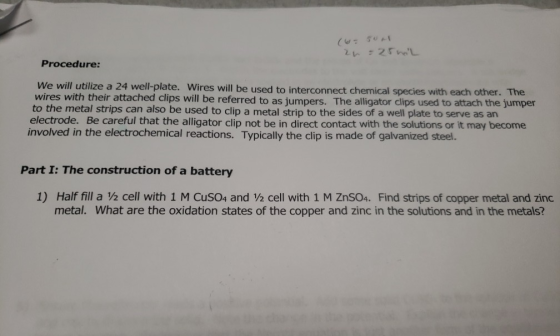
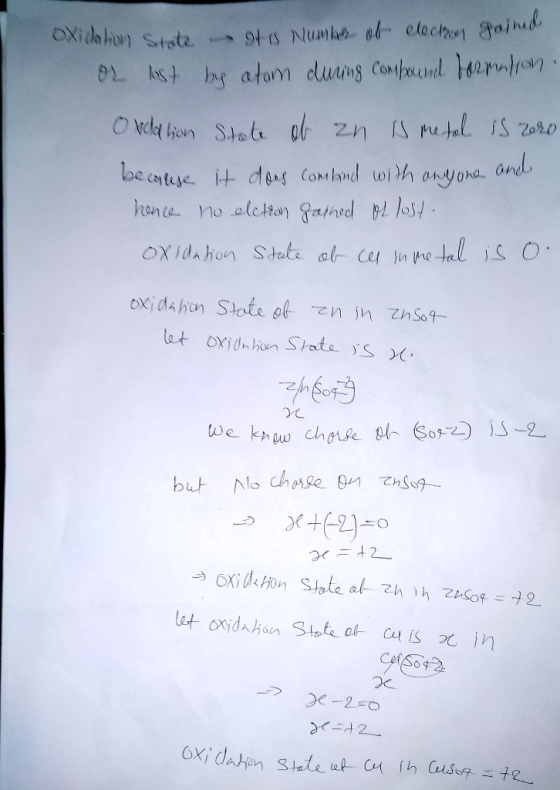
I'm not sure how to find the oxidation states.
Homework Answers
Add Answer to:
I'm not sure how to find the oxidation states.
2n =25nL Procedure: We will utilize a...
Page 1 and 2 are instructions. Please help me solve K for page 3 and page...
 Page 1 and 2 are instructions. Please help me solve K for page 3
and page 4 and please check the other work on Page 3.
Thanyou very much. Will Rate!
CHM 112 Electrochemical Cells and Thermodynamics Section A. Constructing a Small-Scale Electrochemical Cell Woodbridge Campus Objective To construct a small-scale electrochemical cell using a redox system, to measure the cell potential and derive thermodynamic quantities. Procedures 1. Connect the red and black alligator clips to the multimeter to read...
Page 1 and 2 are instructions. Please help me solve K for page 3
and page 4 and please check the other work on Page 3.
Thanyou very much. Will Rate!
CHM 112 Electrochemical Cells and Thermodynamics Section A. Constructing a Small-Scale Electrochemical Cell Woodbridge Campus Objective To construct a small-scale electrochemical cell using a redox system, to measure the cell potential and derive thermodynamic quantities. Procedures 1. Connect the red and black alligator clips to the multimeter to read...
Is #3 correct? "Sn(s)/Sn+2(aq) // Cu+2(aq)/Cu(s)" Also, I need help with #4 and #5. Thanks! (will...
 Is #3 correct? "Sn(s)/Sn+2(aq) // Cu+2(aq)/Cu(s)"
Also, I need help with #4 and #5.
Thanks! (will rate!)
Section A. Constructing a Small-Scale Electrochemical Cell Objective To construct a small-scale electrochemical cell using a redox system, to measure the cell potential and derive thermodynamic quantities. Procedures 1. Connect the red and black alligator clips to the multimeter to read voltage. Set up the multimeter to read DC (direct current) voltage using the tab at the top. 2. Cut the filter paper...
Is #3 correct? "Sn(s)/Sn+2(aq) // Cu+2(aq)/Cu(s)"
Also, I need help with #4 and #5.
Thanks! (will rate!)
Section A. Constructing a Small-Scale Electrochemical Cell Objective To construct a small-scale electrochemical cell using a redox system, to measure the cell potential and derive thermodynamic quantities. Procedures 1. Connect the red and black alligator clips to the multimeter to read voltage. Set up the multimeter to read DC (direct current) voltage using the tab at the top. 2. Cut the filter paper...
how would you go about solving this problem via using equations just looking for the equation order i should go about solving this problem In this experiment you will be using the two half rea...
 how
would you go about solving this problem via using equations
just looking for the equation order i should go about solving this
problem
In this experiment you will be using the two half reactions Cu?"/Cu and Zn2 /Zn. The standard electrode potential, E°, for these half reactions is +0.34V and-0.76V respectively, so the Nernst Equation for these half reactions is the following Cu ea)+2e - Cus) E - 0.34V 0.0592V Cu2+] 0.0592V Zn 2 Note that solids by definition...
how
would you go about solving this problem via using equations
just looking for the equation order i should go about solving this
problem
In this experiment you will be using the two half reactions Cu?"/Cu and Zn2 /Zn. The standard electrode potential, E°, for these half reactions is +0.34V and-0.76V respectively, so the Nernst Equation for these half reactions is the following Cu ea)+2e - Cus) E - 0.34V 0.0592V Cu2+] 0.0592V Zn 2 Note that solids by definition...
need help with the rest of the table EXPERIMENT 10 DETERMINATION OF THE ELECTROCHEMICAL SERIES PURPOSE...
 need help with the rest of the table
EXPERIMENT 10 DETERMINATION OF THE ELECTROCHEMICAL SERIES PURPOSE To determine the standard cell potential values of several electrochemical coll INTRODUCTION The basis for an electrochemical cell is an oxidation reduction Corredor be divided into two half reactions reaction. This reaction can Oxidation half reaction Gloss of electrons) takes place at the anode, which is the positive electrode that the anions migrate to Chence the name anode) Reduction half reaction (gain of electrons)...
need help with the rest of the table
EXPERIMENT 10 DETERMINATION OF THE ELECTROCHEMICAL SERIES PURPOSE To determine the standard cell potential values of several electrochemical coll INTRODUCTION The basis for an electrochemical cell is an oxidation reduction Corredor be divided into two half reactions reaction. This reaction can Oxidation half reaction Gloss of electrons) takes place at the anode, which is the positive electrode that the anions migrate to Chence the name anode) Reduction half reaction (gain of electrons)...
5. What was the purpose of the NaNO3 solution in this experiment? 6. Could a solution...
 5. What was the purpose of the NaNO3 solution in this experiment? 6. Could a solution of NaCl be used instead of NaNO3? 7. What was the purpose of FeSO4 solution in this experiment? 8. Could a solution of FeCl, be used instead of FeSO4? 9. Could a solution of NaSO4 be used instead of FeSO4? 10. Calculate the standard cell potential for the spontaneous redox reaction between a Pb(s)/Pb(NO3)2(aq) half-cell and a Ag(s)/AgNO3(aq) half-cell. Which metal would be oxidized?...
EXPERIMENT: 26 ELECTROCHEMISTRY: GALVANIC AND ELECTROLYTIC CELLS Materials Required : 50 mL beake...
 Help please
EXPERIMENT: 26 ELECTROCHEMISTRY: GALVANIC AND ELECTROLYTIC CELLS Materials Required : 50 mL beakers (2) test tubes sandpaper glass U-tube cotton voltmeter 9.0 V battery connecting wires with alligator clips (2) thermometer iron nail paper clips (2) copper wire magnesium ribbon magnesium sulfate (MgSO) copper sulfate pentahydrate (CuSO, 5H,O) sodium chloride (NaCI) saturated sodium chloride (NaCI)solution phenolphthalein indicator SAFETY PRECAUTIONS: EYE PROTECTION MUST BE WORN AT ALL TIMES IN LABORATORY. Purpose of Experiment: Oxidation-reduction reactions will be performed and...
Help please
EXPERIMENT: 26 ELECTROCHEMISTRY: GALVANIC AND ELECTROLYTIC CELLS Materials Required : 50 mL beakers (2) test tubes sandpaper glass U-tube cotton voltmeter 9.0 V battery connecting wires with alligator clips (2) thermometer iron nail paper clips (2) copper wire magnesium ribbon magnesium sulfate (MgSO) copper sulfate pentahydrate (CuSO, 5H,O) sodium chloride (NaCI) saturated sodium chloride (NaCI)solution phenolphthalein indicator SAFETY PRECAUTIONS: EYE PROTECTION MUST BE WORN AT ALL TIMES IN LABORATORY. Purpose of Experiment: Oxidation-reduction reactions will be performed and...
please help answer question 4, a-f please using the data below from chart 1 objectives from...
 please help answer question 4, a-f please
using the data below from chart 1
objectives from lab, thank you
DATA:CA y 3 Ay No3 Part I: Cell Potential of voltaic cells under standard conditions: cell CU CND2 #27 14.0m Give the half Half cell reaction at Combinations Oxidation Reduction E the anode and with [ion] takes place Theoretical takes place cathode. Write in M here here (V) above the arrow E c (V) if it is oxidation or reduction. |-0.340...
please help answer question 4, a-f please
using the data below from chart 1
objectives from lab, thank you
DATA:CA y 3 Ay No3 Part I: Cell Potential of voltaic cells under standard conditions: cell CU CND2 #27 14.0m Give the half Half cell reaction at Combinations Oxidation Reduction E the anode and with [ion] takes place Theoretical takes place cathode. Write in M here here (V) above the arrow E c (V) if it is oxidation or reduction. |-0.340...
 Page 1 and 2 are instructions. Please help me solve K for page 3
and page 4 and please check the other work on Page 3.
Thanyou very much. Will Rate!
CHM 112 Electrochemical Cells and Thermodynamics Section A. Constructing a Small-Scale Electrochemical Cell Woodbridge Campus Objective To construct a small-scale electrochemical cell using a redox system, to measure the cell potential and derive thermodynamic quantities. Procedures 1. Connect the red and black alligator clips to the multimeter to read...
Page 1 and 2 are instructions. Please help me solve K for page 3
and page 4 and please check the other work on Page 3.
Thanyou very much. Will Rate!
CHM 112 Electrochemical Cells and Thermodynamics Section A. Constructing a Small-Scale Electrochemical Cell Woodbridge Campus Objective To construct a small-scale electrochemical cell using a redox system, to measure the cell potential and derive thermodynamic quantities. Procedures 1. Connect the red and black alligator clips to the multimeter to read...
 Is #3 correct? "Sn(s)/Sn+2(aq) // Cu+2(aq)/Cu(s)"
Also, I need help with #4 and #5.
Thanks! (will rate!)
Section A. Constructing a Small-Scale Electrochemical Cell Objective To construct a small-scale electrochemical cell using a redox system, to measure the cell potential and derive thermodynamic quantities. Procedures 1. Connect the red and black alligator clips to the multimeter to read voltage. Set up the multimeter to read DC (direct current) voltage using the tab at the top. 2. Cut the filter paper...
Is #3 correct? "Sn(s)/Sn+2(aq) // Cu+2(aq)/Cu(s)"
Also, I need help with #4 and #5.
Thanks! (will rate!)
Section A. Constructing a Small-Scale Electrochemical Cell Objective To construct a small-scale electrochemical cell using a redox system, to measure the cell potential and derive thermodynamic quantities. Procedures 1. Connect the red and black alligator clips to the multimeter to read voltage. Set up the multimeter to read DC (direct current) voltage using the tab at the top. 2. Cut the filter paper...
 how
would you go about solving this problem via using equations
just looking for the equation order i should go about solving this
problem
In this experiment you will be using the two half reactions Cu?"/Cu and Zn2 /Zn. The standard electrode potential, E°, for these half reactions is +0.34V and-0.76V respectively, so the Nernst Equation for these half reactions is the following Cu ea)+2e - Cus) E - 0.34V 0.0592V Cu2+] 0.0592V Zn 2 Note that solids by definition...
how
would you go about solving this problem via using equations
just looking for the equation order i should go about solving this
problem
In this experiment you will be using the two half reactions Cu?"/Cu and Zn2 /Zn. The standard electrode potential, E°, for these half reactions is +0.34V and-0.76V respectively, so the Nernst Equation for these half reactions is the following Cu ea)+2e - Cus) E - 0.34V 0.0592V Cu2+] 0.0592V Zn 2 Note that solids by definition...
 need help with the rest of the table
EXPERIMENT 10 DETERMINATION OF THE ELECTROCHEMICAL SERIES PURPOSE To determine the standard cell potential values of several electrochemical coll INTRODUCTION The basis for an electrochemical cell is an oxidation reduction Corredor be divided into two half reactions reaction. This reaction can Oxidation half reaction Gloss of electrons) takes place at the anode, which is the positive electrode that the anions migrate to Chence the name anode) Reduction half reaction (gain of electrons)...
need help with the rest of the table
EXPERIMENT 10 DETERMINATION OF THE ELECTROCHEMICAL SERIES PURPOSE To determine the standard cell potential values of several electrochemical coll INTRODUCTION The basis for an electrochemical cell is an oxidation reduction Corredor be divided into two half reactions reaction. This reaction can Oxidation half reaction Gloss of electrons) takes place at the anode, which is the positive electrode that the anions migrate to Chence the name anode) Reduction half reaction (gain of electrons)...
 5. What was the purpose of the NaNO3 solution in this experiment? 6. Could a solution of NaCl be used instead of NaNO3? 7. What was the purpose of FeSO4 solution in this experiment? 8. Could a solution of FeCl, be used instead of FeSO4? 9. Could a solution of NaSO4 be used instead of FeSO4? 10. Calculate the standard cell potential for the spontaneous redox reaction between a Pb(s)/Pb(NO3)2(aq) half-cell and a Ag(s)/AgNO3(aq) half-cell. Which metal would be oxidized?...
 Help please
EXPERIMENT: 26 ELECTROCHEMISTRY: GALVANIC AND ELECTROLYTIC CELLS Materials Required : 50 mL beakers (2) test tubes sandpaper glass U-tube cotton voltmeter 9.0 V battery connecting wires with alligator clips (2) thermometer iron nail paper clips (2) copper wire magnesium ribbon magnesium sulfate (MgSO) copper sulfate pentahydrate (CuSO, 5H,O) sodium chloride (NaCI) saturated sodium chloride (NaCI)solution phenolphthalein indicator SAFETY PRECAUTIONS: EYE PROTECTION MUST BE WORN AT ALL TIMES IN LABORATORY. Purpose of Experiment: Oxidation-reduction reactions will be performed and...
Help please
EXPERIMENT: 26 ELECTROCHEMISTRY: GALVANIC AND ELECTROLYTIC CELLS Materials Required : 50 mL beakers (2) test tubes sandpaper glass U-tube cotton voltmeter 9.0 V battery connecting wires with alligator clips (2) thermometer iron nail paper clips (2) copper wire magnesium ribbon magnesium sulfate (MgSO) copper sulfate pentahydrate (CuSO, 5H,O) sodium chloride (NaCI) saturated sodium chloride (NaCI)solution phenolphthalein indicator SAFETY PRECAUTIONS: EYE PROTECTION MUST BE WORN AT ALL TIMES IN LABORATORY. Purpose of Experiment: Oxidation-reduction reactions will be performed and...
 please help answer question 4, a-f please
using the data below from chart 1
objectives from lab, thank you
DATA:CA y 3 Ay No3 Part I: Cell Potential of voltaic cells under standard conditions: cell CU CND2 #27 14.0m Give the half Half cell reaction at Combinations Oxidation Reduction E the anode and with [ion] takes place Theoretical takes place cathode. Write in M here here (V) above the arrow E c (V) if it is oxidation or reduction. |-0.340...
please help answer question 4, a-f please
using the data below from chart 1
objectives from lab, thank you
DATA:CA y 3 Ay No3 Part I: Cell Potential of voltaic cells under standard conditions: cell CU CND2 #27 14.0m Give the half Half cell reaction at Combinations Oxidation Reduction E the anode and with [ion] takes place Theoretical takes place cathode. Write in M here here (V) above the arrow E c (V) if it is oxidation or reduction. |-0.340...
Most questions answered within 3 hours.
-
Where is the error in this code sequence?
String s1 = "Hello";
String s2 = "ello";...
asked 11 months ago -
Financial data for Joel de Paris, Inc., for last year
follow:
Joel de Paris, Inc.
Balance...
asked 11 months ago -
Consider this reaction:
Al2(SO4)3 (aq)+ BaCl3
(aq) Al2Cl6 (aq)- +
3BaSO4(s) . What is the...
asked 11 months ago -
Suppose that Savneet is considering increasing her
recent random sample from 20 car rentals to 40...
asked 11 months ago -
Trucks arrive at an unloading terminal at an average rate of 120
per hour.
Trucks arrive...
asked 11 months ago -
Why are methanol and ethanol completely soluble in water while
octanol is not very little soluble....
asked 11 months ago -
A facilities manager at a university reads in a research report
that the mean amount of...
asked 11 months ago -
When the CuSO4 is rehydrated by adding water to the anhydrous
compound, is this an endothermic...
asked 11 months ago -
A ray of sunlight is passing from diamond into crown glass; the
angle of incidence is...
asked 11 months ago -
A block of mass 0.249 kg is placed on top of a light, vertical
spring of...
asked 11 months ago -
how do the kidneys compensate in the presences of acidosis
a) trigger hyperventilate
b) reserve acid...
asked 11 months ago -
Question 501 pts
The rental rate of capital to the firm increases. Which of the
following...
asked 11 months ago