
Homework Answers
For a signal to be even it must satisfies the property of symmetry that is x(t) = x(-t)
For a signal to be odd it must satisfies the property that is x(t) = -x(-t)
For the signal x(t), we can see that it satisfies x(t) = x(-t)
as it is symmetrical with respect to y-axis. So it is even signal.
For the signal y(t), we can see that it does not satisfies any of the two property so it can't be odd or even.
For the signal z(t), we can see that it satisfies z(t) = -z(t)
so it is odd signal.
Add Answer to:
Question #2: Consider the following 3 respective signals, x(t),y(t), z(t) (all labeled x(t), but consider them...
Question #2: Consider the following 3 respective signals, x(t),y(t), z(t) (all labeled x(t), but consider them...
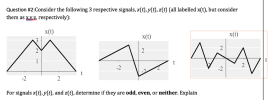 Question #2: Consider the following 3 respective signals, x(t),y(t), z(t) (all labeled x(t), but consider them as respectively): x(t) x(t) x(t) -2 For signals x(t),y(t), and z(t), determine if they are odd, even, or neither. Explain
Consider the following CT periodic signals x(t), y(t) and z(t) a(t) 5 -4 y(t) 5/-4 z(t)...
 Consider the following CT periodic signals x(t), y(t) and z(t) a(t) 5 -4 y(t) 5/-4 z(t) 5 4 (a) [2 marks] Find the Fourier series coefficients, ak, for the CT signal r(t), which is a periodic rectangular wave. You must use the fundamental frequency of r(t) in constructing the Fourier series representation (b) [2 marks] Find the Fourier series coefficients, bk, for the CT signal y(t) cos(t) You must use the fundamental frequency of y(t) in constructing the Fourier series...
Please use matlab and attach the figures of the solution 7. Consider the following CT signals,...
 Please use matlab and attach the figures of the solution
7. Consider the following CT signals, all of them defined for -31 (o)-cos()-sin(4x) ,0)-1.5e 5,0)-)50- For each of these signals indicate whether it is even, odd, or neither, real or complex, periodic or non periodic, type I, type II, or neither. Plot each signal using MATLAB. If a signal is complex, plot magnitude and phase separately. Select a plotting interval and a sampling interval appropriate for the signal in question....
Please use matlab and attach the figures of the solution
7. Consider the following CT signals, all of them defined for -31 (o)-cos()-sin(4x) ,0)-1.5e 5,0)-)50- For each of these signals indicate whether it is even, odd, or neither, real or complex, periodic or non periodic, type I, type II, or neither. Plot each signal using MATLAB. If a signal is complex, plot magnitude and phase separately. Select a plotting interval and a sampling interval appropriate for the signal in question....
Determine whether the following signals are power to energy signals or neither. a.) y(t) = r(t)...
Determine whether the following signals are power to energy signals or neither. a.) y(t) = r(t) = tu(t) (ramp) b.) z(t) = delta(t) (triangular pulse)
JU Q1. Sketch the following SIGNALS and determine for each whether it is: Periodic or aperiodic....
 JU Q1. Sketch the following SIGNALS and determine for each whether it is: Periodic or aperiodic. If periodic, • Even, odd, or neither. If it is neither, specify To. decompose it into even part Ev{x} Energy signal, power signal, or and odd part Od{x} and sketch them. neither. Find the total energy E. and average power PC- 12 -1<n<1 (a) xa n] = lo otherwise (b) xo(t) = xy(t) + x2(t), where x,(t) and x2(t) are the signals shown below:...
1.On the graph below, make a neat and labeled sketch of the signal s(t) = 2...
1.On the graph below, make a neat and labeled sketch of the signal s(t) = 2 + cos( t/4 + 1 ),Describe s(t) as odd, even, or neither. What is the energy in s(t)? What is the power in s(t)? 2.On the graph below, make a neat and labeled sketch of the signal s(t) = 3 rect( t - 2 ) cos( π t ),Describe s(t) as odd, even, or neither. What is the energy in s(t)? What is the...
Problem 2 In each step to follow the signals h(t) r (t) and y(t) denote respectively the impulse ...
 Problem 2 In each step to follow the signals h(t) r (t) and y(t) denote respectively the impulse response. input, and output of a continuous-time LTI system. Accordingly, H(), X (w) and Y (w) denote their Fourier transforms. Hint. Carefully consider for each step whether to work in the time-domain or frequency domain c) Provide a clearly labeled sketch of y(t) for a given x(t)-: cos(mt) δ(t-n) and H(w)-sine(w/2)e-jw Answer: y(t) Σ (-1)"rect(t-1-n)
Problem 2 In each step to follow...
Problem 2 In each step to follow the signals h(t) r (t) and y(t) denote respectively the impulse response. input, and output of a continuous-time LTI system. Accordingly, H(), X (w) and Y (w) denote their Fourier transforms. Hint. Carefully consider for each step whether to work in the time-domain or frequency domain c) Provide a clearly labeled sketch of y(t) for a given x(t)-: cos(mt) δ(t-n) and H(w)-sine(w/2)e-jw Answer: y(t) Σ (-1)"rect(t-1-n)
Problem 2 In each step to follow...
Question #4: Consider the signal x(t) cos(2π (a) Sketch the signal. Please make sure to label...
 Question #4: Consider the signal x(t) cos(2π (a) Sketch the signal. Please make sure to label all relevant features. (b) Is the signal continuous or discrete? Explain. (c) Is the signal even, odd, or neither? Demonstrate
Question 3 (30 points) Consider the signals defined below: *:(t) = cos(2) xz(t) = cos(4+) a)...
 Question 3 (30 points) Consider the signals defined below: *:(t) = cos(2) xz(t) = cos(4+) a) Determine the fundamental period for each signal. b) Determine the fundamental period and fundamental frequency of the signal: y(t) = x;(C)x(0) (t) and x2(c) when the fundamental frequency is c) Determine the Fourier Series coefficients of defined as determined in part (b). d) Using Parseval's relation, determine the power of xy(t) and xy(t) e) Determine and plot the Fourier Series Coefficients of y(t). Show...
 Question #2: Consider the following 3 respective signals, x(t),y(t), z(t) (all labeled x(t), but consider them as respectively): x(t) x(t) x(t) -2 For signals x(t),y(t), and z(t), determine if they are odd, even, or neither. Explain
 Consider the following CT periodic signals x(t), y(t) and z(t) a(t) 5 -4 y(t) 5/-4 z(t) 5 4 (a) [2 marks] Find the Fourier series coefficients, ak, for the CT signal r(t), which is a periodic rectangular wave. You must use the fundamental frequency of r(t) in constructing the Fourier series representation (b) [2 marks] Find the Fourier series coefficients, bk, for the CT signal y(t) cos(t) You must use the fundamental frequency of y(t) in constructing the Fourier series...
 Please use matlab and attach the figures of the solution
7. Consider the following CT signals, all of them defined for -31 (o)-cos()-sin(4x) ,0)-1.5e 5,0)-)50- For each of these signals indicate whether it is even, odd, or neither, real or complex, periodic or non periodic, type I, type II, or neither. Plot each signal using MATLAB. If a signal is complex, plot magnitude and phase separately. Select a plotting interval and a sampling interval appropriate for the signal in question....
Please use matlab and attach the figures of the solution
7. Consider the following CT signals, all of them defined for -31 (o)-cos()-sin(4x) ,0)-1.5e 5,0)-)50- For each of these signals indicate whether it is even, odd, or neither, real or complex, periodic or non periodic, type I, type II, or neither. Plot each signal using MATLAB. If a signal is complex, plot magnitude and phase separately. Select a plotting interval and a sampling interval appropriate for the signal in question....
 JU Q1. Sketch the following SIGNALS and determine for each whether it is: Periodic or aperiodic. If periodic, • Even, odd, or neither. If it is neither, specify To. decompose it into even part Ev{x} Energy signal, power signal, or and odd part Od{x} and sketch them. neither. Find the total energy E. and average power PC- 12 -1<n<1 (a) xa n] = lo otherwise (b) xo(t) = xy(t) + x2(t), where x,(t) and x2(t) are the signals shown below:...
 Problem 2 In each step to follow the signals h(t) r (t) and y(t) denote respectively the impulse response. input, and output of a continuous-time LTI system. Accordingly, H(), X (w) and Y (w) denote their Fourier transforms. Hint. Carefully consider for each step whether to work in the time-domain or frequency domain c) Provide a clearly labeled sketch of y(t) for a given x(t)-: cos(mt) δ(t-n) and H(w)-sine(w/2)e-jw Answer: y(t) Σ (-1)"rect(t-1-n)
Problem 2 In each step to follow...
Problem 2 In each step to follow the signals h(t) r (t) and y(t) denote respectively the impulse response. input, and output of a continuous-time LTI system. Accordingly, H(), X (w) and Y (w) denote their Fourier transforms. Hint. Carefully consider for each step whether to work in the time-domain or frequency domain c) Provide a clearly labeled sketch of y(t) for a given x(t)-: cos(mt) δ(t-n) and H(w)-sine(w/2)e-jw Answer: y(t) Σ (-1)"rect(t-1-n)
Problem 2 In each step to follow...
 Question #4: Consider the signal x(t) cos(2π (a) Sketch the signal. Please make sure to label all relevant features. (b) Is the signal continuous or discrete? Explain. (c) Is the signal even, odd, or neither? Demonstrate
 Question 3 (30 points) Consider the signals defined below: *:(t) = cos(2) xz(t) = cos(4+) a) Determine the fundamental period for each signal. b) Determine the fundamental period and fundamental frequency of the signal: y(t) = x;(C)x(0) (t) and x2(c) when the fundamental frequency is c) Determine the Fourier Series coefficients of defined as determined in part (b). d) Using Parseval's relation, determine the power of xy(t) and xy(t) e) Determine and plot the Fourier Series Coefficients of y(t). Show...
Most questions answered within 3 hours.
-
Where is the error in this code sequence?
String s1 = "Hello";
String s2 = "ello";...
asked 10 months ago -
Financial data for Joel de Paris, Inc., for last year
follow:
Joel de Paris, Inc.
Balance...
asked 10 months ago -
Consider this reaction:
Al2(SO4)3 (aq)+ BaCl3
(aq) Al2Cl6 (aq)- +
3BaSO4(s) . What is the...
asked 10 months ago -
Suppose that Savneet is considering increasing her
recent random sample from 20 car rentals to 40...
asked 10 months ago -
Trucks arrive at an unloading terminal at an average rate of 120
per hour.
Trucks arrive...
asked 10 months ago -
Why are methanol and ethanol completely soluble in water while
octanol is not very little soluble....
asked 10 months ago -
A facilities manager at a university reads in a research report
that the mean amount of...
asked 10 months ago -
When the CuSO4 is rehydrated by adding water to the anhydrous
compound, is this an endothermic...
asked 10 months ago -
A ray of sunlight is passing from diamond into crown glass; the
angle of incidence is...
asked 10 months ago -
A block of mass 0.249 kg is placed on top of a light, vertical
spring of...
asked 10 months ago -
how do the kidneys compensate in the presences of acidosis
a) trigger hyperventilate
b) reserve acid...
asked 10 months ago -
Question 501 pts
The rental rate of capital to the firm increases. Which of the
following...
asked 10 months ago