
Homework Answers

Add Answer to:
02: Consider a line axis where there are blocks at positionx - 3 and x--3 and...
Q2: Consider a line axis where there are blocks at position x 3 and x 3...
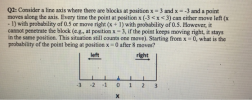 Q2: Consider a line axis where there are blocks at position x 3 and x 3 and a point moves along the axis. Every time the point at position x (-3 <x <3) can either move left (x - 1) with probability of 0.5 or move right (x +1) with probability of 0.5. However, it cannot penetrate the block (e.g., at position x 3, if the point keeps moving right, it stays in the same position. This situation still counts...
Q2: Consider a line axis where there are blocks at position x 3 and x 3...
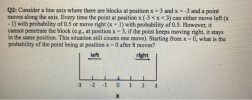 Q2: Consider a line axis where there are blocks at position x 3 and x 3 and a point moves along the axis. Every time the point at position x (-3 <x <3) can either move left (x - 1) with probability of 0.5 or move right (x +1) with probability of 0.5. However, it cannot penetrate the block (e.g., at position x 3, if the point keeps moving right, it stays in the same position. This situation still counts...
Consider a line axis where there are blocks at position x = 3 and x =...
Consider a line axis where there are blocks at position x = 3 and x = -3 and a point moves along the axis. Every time the point at position x (-3 < x < 3) can either move left (x - 1) with probability of 0.5 or move right (x + 1) with probability of 0.5. However, it cannot penetrate the block (e.g., at position x = 3, if the point keeps moving right, it stays in the same...
2. Two blocks of unknown mass my and m2 are made of the same material. The...
 2. Two blocks of unknown mass my and m2 are made of the same material. The blocks are attached by a massless spring and sit on a frictionless surface. The spring is released, and each block moves away from the other and slides up a ramp. Block mis observed to slide up the left ramp and reach a height of hy. Block ma is observed to slide up the right ramp, which is not identical to the left ramp and...
6. Consider a line charge with uniform charge density λ lying on the x-axis from x...
 6. Consider a line charge with uniform charge density λ lying on the x-axis from x =-L to x = 0. a) Determine the electric field a distance y above the right end of the line charge (point P in the figure) and a distance r to the right of the line charge (point P2 in the figure). Pi C-I b) In lecture you saw the electric field of an infinite line charge. Now we wil consider a "semi-infinite" line...
A conservative force F(x) acts on a 1.7 kg particle that moves along an x axis....
 A conservative force F(x) acts on a 1.7 kg particle that moves along an x axis. The potential energy U(x) associated with F(x) is graphed in the figure. When the particle is atx-2.0 m, its velocity is -1.7 m/s. (a) What is F(x) at this position, including sign? Between what positions on the (b) left and (c) right does the particle move? (d) what is its particle's speed at x = 7.0 m? x (m) 0 10 15 0 -5...
6. Consider a line charge with uniform charge density λ lying on the x-axis from z...
 6. Consider a line charge with uniform charge density λ lying on the x-axis from z =-L to 0. a) Determine the electric field a distance y above the right end of the line charge (point P in the figure) and a distance r to the right of the line charge (point P2 in the figure). P2 b) In lecture you saw the electric field of an infinite line charge. Now we will consider a "semi-infinite" line charge; that is,...
3.) Given: The link shown is guided by two blocks at A and B, which move...
 3.) Given: The link shown is guided by two blocks at A and B, which move in the fixed slots. If the velocity of block A is 2 m/s downward, determine the velocity of block B at the instant 0 = 450 Note: The Velocity-Difference Equation is as follows: Yg - VA + VBIA - VA+WAB ®RBIA In addition, the following value for angular velocity is given: Ô = 7rad/s (fixed frame link 1) Find: (a) State the velocity of...
A conservative force F(x) acts on a 2.0 kg particle that moves along an x axis....
 A conservative force F(x) acts on a 2.0 kg particle that moves along an x axis. The potential energy U(x) associated with F(x) is graphed in the figure. When the particle is at x-2.0 m, its velocity is -1.4 m/s. (a) What is F(x) at this position, including sign? Between what positions on the (b) left and (c) right does the particle move? (d) what is its particle's speed at x = 7.0 m? x (m) 10 15 (a) Number...
The figure shows a two-ended “rocket” that is initially stationary on a frictionless floor, with its...
 The figure shows a two-ended “rocket” that is initially
stationary on a frictionless floor, with its center at the origin
of an x axis. The rocket consists of a central block C (of mass M = 6.70 kg) and blocks L and R (each of mass m = 1.50 kg) on the left and
right sides. Small explosions can shoot either of the side blocks
away from block C and along the x axis. Here is
the sequence: (1) At time t =...
The figure shows a two-ended “rocket” that is initially
stationary on a frictionless floor, with its center at the origin
of an x axis. The rocket consists of a central block C (of mass M = 6.70 kg) and blocks L and R (each of mass m = 1.50 kg) on the left and
right sides. Small explosions can shoot either of the side blocks
away from block C and along the x axis. Here is
the sequence: (1) At time t =...
 Q2: Consider a line axis where there are blocks at position x 3 and x 3 and a point moves along the axis. Every time the point at position x (-3 <x <3) can either move left (x - 1) with probability of 0.5 or move right (x +1) with probability of 0.5. However, it cannot penetrate the block (e.g., at position x 3, if the point keeps moving right, it stays in the same position. This situation still counts...
 Q2: Consider a line axis where there are blocks at position x 3 and x 3 and a point moves along the axis. Every time the point at position x (-3 <x <3) can either move left (x - 1) with probability of 0.5 or move right (x +1) with probability of 0.5. However, it cannot penetrate the block (e.g., at position x 3, if the point keeps moving right, it stays in the same position. This situation still counts...
 2. Two blocks of unknown mass my and m2 are made of the same material. The blocks are attached by a massless spring and sit on a frictionless surface. The spring is released, and each block moves away from the other and slides up a ramp. Block mis observed to slide up the left ramp and reach a height of hy. Block ma is observed to slide up the right ramp, which is not identical to the left ramp and...
 6. Consider a line charge with uniform charge density λ lying on the x-axis from x =-L to x = 0. a) Determine the electric field a distance y above the right end of the line charge (point P in the figure) and a distance r to the right of the line charge (point P2 in the figure). Pi C-I b) In lecture you saw the electric field of an infinite line charge. Now we wil consider a "semi-infinite" line...
 A conservative force F(x) acts on a 1.7 kg particle that moves along an x axis. The potential energy U(x) associated with F(x) is graphed in the figure. When the particle is atx-2.0 m, its velocity is -1.7 m/s. (a) What is F(x) at this position, including sign? Between what positions on the (b) left and (c) right does the particle move? (d) what is its particle's speed at x = 7.0 m? x (m) 0 10 15 0 -5...
 6. Consider a line charge with uniform charge density λ lying on the x-axis from z =-L to 0. a) Determine the electric field a distance y above the right end of the line charge (point P in the figure) and a distance r to the right of the line charge (point P2 in the figure). P2 b) In lecture you saw the electric field of an infinite line charge. Now we will consider a "semi-infinite" line charge; that is,...
 3.) Given: The link shown is guided by two blocks at A and B, which move in the fixed slots. If the velocity of block A is 2 m/s downward, determine the velocity of block B at the instant 0 = 450 Note: The Velocity-Difference Equation is as follows: Yg - VA + VBIA - VA+WAB ®RBIA In addition, the following value for angular velocity is given: Ô = 7rad/s (fixed frame link 1) Find: (a) State the velocity of...
 A conservative force F(x) acts on a 2.0 kg particle that moves along an x axis. The potential energy U(x) associated with F(x) is graphed in the figure. When the particle is at x-2.0 m, its velocity is -1.4 m/s. (a) What is F(x) at this position, including sign? Between what positions on the (b) left and (c) right does the particle move? (d) what is its particle's speed at x = 7.0 m? x (m) 10 15 (a) Number...
 The figure shows a two-ended “rocket” that is initially
stationary on a frictionless floor, with its center at the origin
of an x axis. The rocket consists of a central block C (of mass M = 6.70 kg) and blocks L and R (each of mass m = 1.50 kg) on the left and
right sides. Small explosions can shoot either of the side blocks
away from block C and along the x axis. Here is
the sequence: (1) At time t =...
The figure shows a two-ended “rocket” that is initially
stationary on a frictionless floor, with its center at the origin
of an x axis. The rocket consists of a central block C (of mass M = 6.70 kg) and blocks L and R (each of mass m = 1.50 kg) on the left and
right sides. Small explosions can shoot either of the side blocks
away from block C and along the x axis. Here is
the sequence: (1) At time t =...
Most questions answered within 3 hours.
-
Where is the error in this code sequence?
String s1 = "Hello";
String s2 = "ello";...
asked 10 months ago -
Financial data for Joel de Paris, Inc., for last year
follow:
Joel de Paris, Inc.
Balance...
asked 10 months ago -
Consider this reaction:
Al2(SO4)3 (aq)+ BaCl3
(aq) Al2Cl6 (aq)- +
3BaSO4(s) . What is the...
asked 10 months ago -
Suppose that Savneet is considering increasing her
recent random sample from 20 car rentals to 40...
asked 10 months ago -
Trucks arrive at an unloading terminal at an average rate of 120
per hour.
Trucks arrive...
asked 10 months ago -
Why are methanol and ethanol completely soluble in water while
octanol is not very little soluble....
asked 10 months ago -
A facilities manager at a university reads in a research report
that the mean amount of...
asked 10 months ago -
When the CuSO4 is rehydrated by adding water to the anhydrous
compound, is this an endothermic...
asked 10 months ago -
A ray of sunlight is passing from diamond into crown glass; the
angle of incidence is...
asked 10 months ago -
A block of mass 0.249 kg is placed on top of a light, vertical
spring of...
asked 10 months ago -
how do the kidneys compensate in the presences of acidosis
a) trigger hyperventilate
b) reserve acid...
asked 10 months ago -
Question 501 pts
The rental rate of capital to the firm increases. Which of the
following...
asked 10 months ago