

Homework Answers

Add Answer to:
3. For the reaction, P,(s, red) + 10 CL(g) a) AH°(in the units of kcal, kJ,...
25. If 5,000. J of work were required to compress 54.0 L of a gas contained...
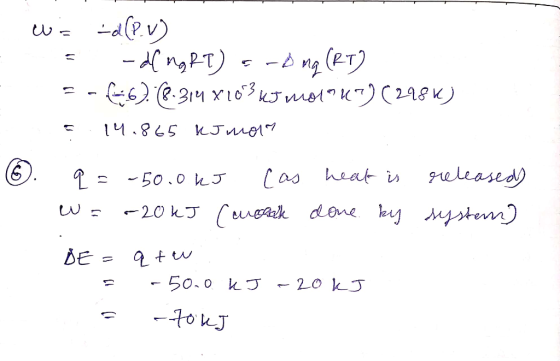
 25. If 5,000. J of work were required to compress 54.0 L of a gas contained in a cylinder fitted with a weightless movable piston under an external pressure of 745 torr, then what is its final volume? 3. For the reaction, P (s, red) + 10 Cl(g) a) AH°(in the units of kcal, k.J, and liter-atm) b) AE® (in the units of kJ) c) work (w) (in the units of kJ) 4 PCl(g), calculate: Ан, Р, =-73.6 kJ mol...
10. Given the following thermochemical data: 2 P(s) + 3 Cl, (g) → 2 PCI, (1)...
 10. Given the following thermochemical data: 2 P(s) + 3 Cl, (g) → 2 PCI, (1) AH = -636 kJ/mol PCI, (1) PCI, (s) + C12 (8) AH = 138 kJ/mol compute the enthalpy of formation of PCI, (s), that is the enthalpy change for the reaction P(8) + 5/2 CI, (g) - PCI, (5) AH-? kJ/mol
Given the heats of the following reactions: AH° kJ 1. P.(s) + 6C,(g) -->4PCI (g) -1225.6...
 Given the heats of the following reactions: AH° kJ 1. P.(s) + 6C,(g) -->4PCI (g) -1225.6 II. P (s) + 50, (g) ---->P,(s) -2967.3 III. PCI, (g) + Cl, (g) ---> PCI (g) -84.2 IV. PCI,(g) + x0,(g)--->CI PO(g) -285.7 Calculate the value of AH® for the reaction below: P.O.(s) + 6PCI_(8) ---> 10C1, PO(g) -110.5 kJ -610.1 kJ -2682.2 kJ (D) -7555.0 kJ (A) (B)
12. (5 pt) Consider the reaction: PCI PCL + Cl AH = -15.0 kJ and the...
 12. (5 pt) Consider the reaction: PCI PCL + Cl AH = -15.0 kJ and the energy of activation of the reaction is 25.0 kJ. Determine the frequency factor for the reaction PCI + Cl2 ---- PCls, with a rate constant of 1.080 L.mol's at 27 °C. 13. (5 pts) Consider the reaction in equilibrium: 3 A (g) + 3 B () --- 6 C(s) + 3 D (8) K = 2.40 at 27 °C. Determine K for the equilibrium...
CH4(8)+ 202(g) CO2(g) + 2H2O(g) AH -890.3 kJ 3. Given: PSs(s) + 802(g) PAO10(s)+3SO2(g) AH -3676...
 CH4(8)+ 202(g) CO2(g) + 2H2O(g) AH -890.3 kJ 3. Given: PSs(s) + 802(g) PAO10(s)+3SO2(g) AH -3676 k How much heat is produced from the burning of 7.00 g of PSs 4. Calculate the mass of P4O10 produced along 15000. calories of heat. 5. A system absorbs 105 kJ of heat from its surroundings and does 96.0 J of work. Calculate AE. 159
2) From the following data in the Born-Haber cycle, Na(s) → Na(g) 4C12(g) → Cl(g) AH:-108...
 2) From the following data in the Born-Haber cycle, Na(s) → Na(g) 4C12(g) → Cl(g) AH:-108 kJ/mol AHj - 495.9 kJ/mol ara =-349 kJ/mol Na(g) → Na+(g) + e- Cl(g) + e-→ Cl-(g) Na(s) +4C12(g) → NaCl(s) AHoverall =-411 kJ/mol calculate the lattice energy of NaCI.
QUESTION 19 3 points S In the reaction Mg0(s) → Mg(s) + + 0.502(g) the enthalpy change AH*) is +6...
 QUESTION 19 3 points S In the reaction Mg0(s) → Mg(s) + + 0.502(g) the enthalpy change AH*) is +602(AHP) kj mol. 1 and the entropy change (A5) is +109J k-1 mor1. Explain if the reaction is feasible at 1000K or 6000K? Berenrenh Arial
QUESTION 19 3 points S In the reaction Mg0(s) → Mg(s) + + 0.502(g) the enthalpy change AH*) is +602(AHP) kj mol. 1 and the entropy change (A5) is +109J k-1 mor1. Explain if the reaction...
QUESTION 19 3 points S In the reaction Mg0(s) → Mg(s) + + 0.502(g) the enthalpy change AH*) is +602(AHP) kj mol. 1 and the entropy change (A5) is +109J k-1 mor1. Explain if the reaction is feasible at 1000K or 6000K? Berenrenh Arial
QUESTION 19 3 points S In the reaction Mg0(s) → Mg(s) + + 0.502(g) the enthalpy change AH*) is +602(AHP) kj mol. 1 and the entropy change (A5) is +109J k-1 mor1. Explain if the reaction...
DH=DUIDIN 1. In following reaction H2(g) + Cl2(g) + 2HCl(g) AH=- 184.6 kJ/mol If 4 moles...
 DH=DUIDIN 1. In following reaction H2(g) + Cl2(g) + 2HCl(g) AH=- 184.6 kJ/mol If 4 moles of H2 react with 4 moles of Cl, to form HCI. Calculate AU for this reaction, assumimg the reaction goes to completion against a pressure of 138.0 atm at constant volume. (IL atm = 101.3 J) pranai DU=q tw A) -738.4 kJ B) -369.2 kJ C) 138.0 kJ D) 184.6 kJ E) 244.5 kJ 4H =-92.3 ou-bH
1. A degreasing agent, tetrachloroethylene, is produced in the reaction CH4(g) +4 HCl(g) +2 02(g) →...
 1. A degreasing agent, tetrachloroethylene, is produced in the reaction CH4(g) +4 HCl(g) +2 02(g) → C2C14(1) + 4H2O(1) AH° (kJ/mol): 52.26 -92.31 - 285.8 a) determine AH°for CCl4(1) AH' - 878.5 kJ a) AH° for C,CL(1) = b) How much heat (kJ) would be evolved when 7.5 kg of CH4(g) reacts completely (with stoichiometric amounts of HCl and O2)? b) heat, do = c) Using the equation for work done by/on the system; w=-P AV, calculate the amount of...
The standard enthalpy change for the following reaction is -415 kJ at 298 K. Zn(s) + Ch(g) → ZnCl2() AH° = -415 k...
 The standard enthalpy change for the following reaction is -415 kJ at 298 K. Zn(s) + Ch(g) → ZnCl2() AH° = -415 kJ What is the standard enthalpy change for the reaction at 298 K? ZnCl(s) — Zn(s) + Cl2(g) The standard enthalpy change for the following reaction is -50.6 kJ at 298 K. N2H40 - N2(g) + 2 H2(g) AH° = -50.6 kJ What is the standard enthalpy change for this reaction at 298 K? N2(g) + 2 H2(g)...
 25. If 5,000. J of work were required to compress 54.0 L of a gas contained in a cylinder fitted with a weightless movable piston under an external pressure of 745 torr, then what is its final volume? 3. For the reaction, P (s, red) + 10 Cl(g) a) AH°(in the units of kcal, k.J, and liter-atm) b) AE® (in the units of kJ) c) work (w) (in the units of kJ) 4 PCl(g), calculate: Ан, Р, =-73.6 kJ mol...
 10. Given the following thermochemical data: 2 P(s) + 3 Cl, (g) → 2 PCI, (1) AH = -636 kJ/mol PCI, (1) PCI, (s) + C12 (8) AH = 138 kJ/mol compute the enthalpy of formation of PCI, (s), that is the enthalpy change for the reaction P(8) + 5/2 CI, (g) - PCI, (5) AH-? kJ/mol
 Given the heats of the following reactions: AH° kJ 1. P.(s) + 6C,(g) -->4PCI (g) -1225.6 II. P (s) + 50, (g) ---->P,(s) -2967.3 III. PCI, (g) + Cl, (g) ---> PCI (g) -84.2 IV. PCI,(g) + x0,(g)--->CI PO(g) -285.7 Calculate the value of AH® for the reaction below: P.O.(s) + 6PCI_(8) ---> 10C1, PO(g) -110.5 kJ -610.1 kJ -2682.2 kJ (D) -7555.0 kJ (A) (B)
 12. (5 pt) Consider the reaction: PCI PCL + Cl AH = -15.0 kJ and the energy of activation of the reaction is 25.0 kJ. Determine the frequency factor for the reaction PCI + Cl2 ---- PCls, with a rate constant of 1.080 L.mol's at 27 °C. 13. (5 pts) Consider the reaction in equilibrium: 3 A (g) + 3 B () --- 6 C(s) + 3 D (8) K = 2.40 at 27 °C. Determine K for the equilibrium...
 CH4(8)+ 202(g) CO2(g) + 2H2O(g) AH -890.3 kJ 3. Given: PSs(s) + 802(g) PAO10(s)+3SO2(g) AH -3676 k How much heat is produced from the burning of 7.00 g of PSs 4. Calculate the mass of P4O10 produced along 15000. calories of heat. 5. A system absorbs 105 kJ of heat from its surroundings and does 96.0 J of work. Calculate AE. 159
 2) From the following data in the Born-Haber cycle, Na(s) → Na(g) 4C12(g) → Cl(g) AH:-108 kJ/mol AHj - 495.9 kJ/mol ara =-349 kJ/mol Na(g) → Na+(g) + e- Cl(g) + e-→ Cl-(g) Na(s) +4C12(g) → NaCl(s) AHoverall =-411 kJ/mol calculate the lattice energy of NaCI.
 QUESTION 19 3 points S In the reaction Mg0(s) → Mg(s) + + 0.502(g) the enthalpy change AH*) is +602(AHP) kj mol. 1 and the entropy change (A5) is +109J k-1 mor1. Explain if the reaction is feasible at 1000K or 6000K? Berenrenh Arial
QUESTION 19 3 points S In the reaction Mg0(s) → Mg(s) + + 0.502(g) the enthalpy change AH*) is +602(AHP) kj mol. 1 and the entropy change (A5) is +109J k-1 mor1. Explain if the reaction...
QUESTION 19 3 points S In the reaction Mg0(s) → Mg(s) + + 0.502(g) the enthalpy change AH*) is +602(AHP) kj mol. 1 and the entropy change (A5) is +109J k-1 mor1. Explain if the reaction is feasible at 1000K or 6000K? Berenrenh Arial
QUESTION 19 3 points S In the reaction Mg0(s) → Mg(s) + + 0.502(g) the enthalpy change AH*) is +602(AHP) kj mol. 1 and the entropy change (A5) is +109J k-1 mor1. Explain if the reaction...
 DH=DUIDIN 1. In following reaction H2(g) + Cl2(g) + 2HCl(g) AH=- 184.6 kJ/mol If 4 moles of H2 react with 4 moles of Cl, to form HCI. Calculate AU for this reaction, assumimg the reaction goes to completion against a pressure of 138.0 atm at constant volume. (IL atm = 101.3 J) pranai DU=q tw A) -738.4 kJ B) -369.2 kJ C) 138.0 kJ D) 184.6 kJ E) 244.5 kJ 4H =-92.3 ou-bH
 1. A degreasing agent, tetrachloroethylene, is produced in the reaction CH4(g) +4 HCl(g) +2 02(g) → C2C14(1) + 4H2O(1) AH° (kJ/mol): 52.26 -92.31 - 285.8 a) determine AH°for CCl4(1) AH' - 878.5 kJ a) AH° for C,CL(1) = b) How much heat (kJ) would be evolved when 7.5 kg of CH4(g) reacts completely (with stoichiometric amounts of HCl and O2)? b) heat, do = c) Using the equation for work done by/on the system; w=-P AV, calculate the amount of...
 The standard enthalpy change for the following reaction is -415 kJ at 298 K. Zn(s) + Ch(g) → ZnCl2() AH° = -415 kJ What is the standard enthalpy change for the reaction at 298 K? ZnCl(s) — Zn(s) + Cl2(g) The standard enthalpy change for the following reaction is -50.6 kJ at 298 K. N2H40 - N2(g) + 2 H2(g) AH° = -50.6 kJ What is the standard enthalpy change for this reaction at 298 K? N2(g) + 2 H2(g)...
Most questions answered within 3 hours.
-
Where is the error in this code sequence?
String s1 = "Hello";
String s2 = "ello";...
asked 11 months ago -
Financial data for Joel de Paris, Inc., for last year
follow:
Joel de Paris, Inc.
Balance...
asked 11 months ago -
Consider this reaction:
Al2(SO4)3 (aq)+ BaCl3
(aq) Al2Cl6 (aq)- +
3BaSO4(s) . What is the...
asked 11 months ago -
Suppose that Savneet is considering increasing her
recent random sample from 20 car rentals to 40...
asked 11 months ago -
Trucks arrive at an unloading terminal at an average rate of 120
per hour.
Trucks arrive...
asked 11 months ago -
Why are methanol and ethanol completely soluble in water while
octanol is not very little soluble....
asked 11 months ago -
A facilities manager at a university reads in a research report
that the mean amount of...
asked 11 months ago -
When the CuSO4 is rehydrated by adding water to the anhydrous
compound, is this an endothermic...
asked 11 months ago -
A ray of sunlight is passing from diamond into crown glass; the
angle of incidence is...
asked 11 months ago -
A block of mass 0.249 kg is placed on top of a light, vertical
spring of...
asked 11 months ago -
how do the kidneys compensate in the presences of acidosis
a) trigger hyperventilate
b) reserve acid...
asked 11 months ago -
Question 501 pts
The rental rate of capital to the firm increases. Which of the
following...
asked 11 months ago