
Homework Answers
Add Answer to:
Given the heats of the following reactions: AH° kJ 1. P.(s) + 6C,(g) -->4PCI (g) -1225.6...
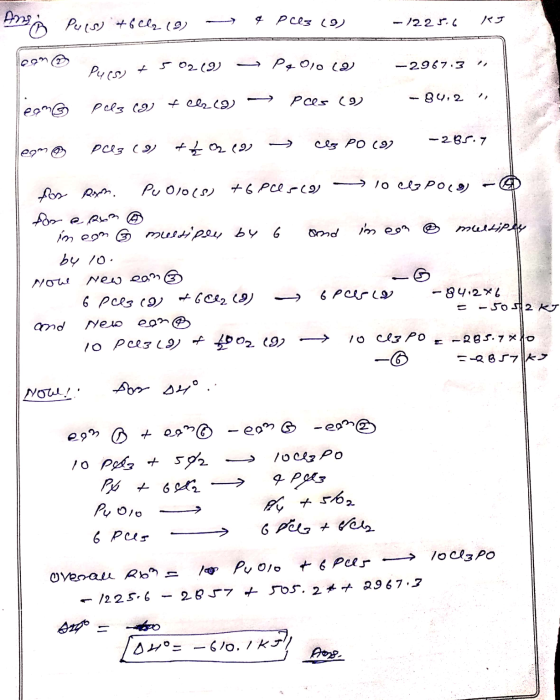
32. Given the following data: A. P4(s)+ 6 Cl2(g)4 PCls(g) B. P4(s)+ 5 02(g) P4O10(s)AH=- 2967.3...
 32. Given the following data: A. P4(s)+ 6 Cl2(g)4 PCls(g) B. P4(s)+ 5 02(g) P4O10(s)AH=- 2967.3 C. PCls(g)+Cl2(g) PCIS(g) D. PCI3(g)+O2(g) ClaPO(g) AH-285.7 AH 1225.6 kJ AH=-84.2 Calculate AH for the reaction: P4O10(s)+6 PCI5(g) 10 CI3PO(g). Note when I solved this problem, I used 3 of the 4 data reactions, added them together, then used the fourth data reaction to get to the desired reaction. -B-6C+10D+A
P,010(s) + 6PC13(g) → 10POCI;(8) 1. The synthesis of phosphoryl chloride (POCI,) is represented in the...
 P,010(s) + 6PC13(g) → 10POCI;(8) 1. The synthesis of phosphoryl chloride (POCI,) is represented in the reaction above. a. Determine the value of the standard enthalpy change AHⓇxn for the synthesis of POCI(g) at 298K using the following information. (5 points) i. P,(s) +6C12(g) → 4PC12(g) AH° = -1225.6 kJ ii. P.(s) + 502(g) →P,0,.() AH = -2967.3 kJ iii. PCI,(g) + Cl, (g) → PC1,(g) AH = -84.2 kJ iv. PCI,(g) + 1/2 0,(g) → POCI,(g) AH° = -285.7...
Assume all reactants and products are gases unless noted otherwise. Given the following data; P4(s) +...
Assume all reactants and products are gases unless noted otherwise. Given the following data; P4(s) + 6Cl2 → 4PCl3 ∆H = -1225.6 kJ P4(s) + 5O2 → P4O10(s) ∆H = -2967.3 kJ PCl3 + Cl2 → PCl5 ∆H = -84.2 kJ PCl3 + 1/2O2 → Cl3PO ∆H = -285.7 kJ Calculate ∆Hrxn for the following reaction. P4O10 + 6PCl5 → 10Cl3 PO
Calculate the value of ΔH° for the following reaction: P4O10(s) + 6PCl5(g) ---> 10Cl3PO(g) P4(s) +...
Calculate the value of ΔH° for the following reaction: P4O10(s) + 6PCl5(g) ---> 10Cl3PO(g) P4(s) + 6Cl2(g) ---> 4PCl3(g) ΔH° = -1225.6 kJ P4(s) + 5O2(g) ---> P4O10(s) ΔH° = -2967.3 kJ PCl3(g) + Cl2(g) ---> PCl5(g) ΔH° = -84.2 kJ PCl3(g) + (1/2)O2(g) ---> Cl3PO(g) ΔH° = -285.7 k please explain well i do not understand these kind of problems
answers ncider 31. The work function for lithium is 279.7 KJ/mol. a. What is the maximum...
 answers
ncider 31. The work function for lithium is 279.7 KJ/mol. a. What is the maximum wavelength of light that can remove an electron from an atom on the surface of lithium metal? 5/3 ly 32. Given the following data: A. Pa(s) + 6 Cl:(g)4 PCl(g) B. Pa(s)+ 5 0:(g) P4Oo(s)AH-2967.3 C. PCl(g) + Cl:(g) PCls(g) D. PCIb(g)+%O:(g) ClaPO(g) AH-1225.6 kJ 3ot AH-84.2 AH-285.7 Calculate AH for the reaction: P4O10(s)+6 PCIs(g) 10 ClhPO(g). Note when I solved this problem, I...
answers
ncider 31. The work function for lithium is 279.7 KJ/mol. a. What is the maximum wavelength of light that can remove an electron from an atom on the surface of lithium metal? 5/3 ly 32. Given the following data: A. Pa(s) + 6 Cl:(g)4 PCl(g) B. Pa(s)+ 5 0:(g) P4Oo(s)AH-2967.3 C. PCl(g) + Cl:(g) PCls(g) D. PCIb(g)+%O:(g) ClaPO(g) AH-1225.6 kJ 3ot AH-84.2 AH-285.7 Calculate AH for the reaction: P4O10(s)+6 PCIs(g) 10 ClhPO(g). Note when I solved this problem, I...
- PCI) D ) 10. In cop 0.10-MN 4PCI() AH -1280k 4.ใณใน Assum - 4PCI(s) AH...
 - PCI) D ) 10. In cop 0.10-MN 4PCI() AH -1280k 4.ใณใน Assum - 4PCI(s) AH = -1774 kJ calculate 4.184 / & Cakeware for PCHD + C G : PC) - P 10C) *** of water when its The specific heat of 2. Calculate the heat absorbed by 155g of water temperature rises from 18.0°C to 47.5°C. The water is 4.184/8 C Mer is alture rises from sorbed by za & Calculate 4H® for the following reaction: SIO (s)...
3(20 pts) Consider the data: P4(s) + 6 Cl2(g) ----> 4 PC13(g) P4(s) + 5 O2(g)...
 3(20 pts) Consider the data: P4(s) + 6 Cl2(g) ----> 4 PC13(g) P4(s) + 5 O2(g) -----> P4010(s) PC13(g) + Cl2(g) ---> PCls(g) PC13(g) + 1/2O2(g) ----> C13PO(g) AH° (kJ/mol) -1226.6 -2967.3 -84.2 -285.7 Using only the above reaction data, compute the AHX of P4010(s) + 6 PCls(8) ----> 10 C13PO (g)
2. Given the following heats of formation, calculate AH for the reaction 2 CO(g) + 5...
 2. Given the following heats of formation, calculate AH for the reaction 2 CO(g) + 5 H2(g) → C2H6 (g) + 2 H2O(g) Compound AH°F (kJ/mol) Compound AH°F (kJ/mol) 52.28 C₂H6 (8) -84.68 C2H4 (8) -393.5 CO2(g) -241.8 H2O(g) -285.9 CO(g) -110.5 H2O(1)
3. For the reaction, P,(s, red) + 10 CL(g) a) AH°(in the units of kcal, kJ,...
 3. For the reaction, P,(s, red) + 10 CL(g) a) AH°(in the units of kcal, kJ, and liter-atm) b) AE (in the units of kJ) c) work (w) (in the units of kJ) 4 PCl,(g), calculate: АН, Р =-73.6 kJ mol 4(s,red) AHP PCI,(g) = -398.9 kJ mol 6. For a chemical process 50. kJ of heat energy were released and 20. kJ of work were done by the system. Calculate AE for this process.
Need Help 2. Given: Pa(s) + 3 O2(g) → P.O(s) AH = -1640.1 kJ Pa(s) +...
 Need Help
2. Given: Pa(s) + 3 O2(g) → P.O(s) AH = -1640.1 kJ Pa(s) + 5 O2(g) → P4010(s) AH = -2940.1 kJ Use Hess Law to calculate the AH for P.O(s) + 2O2(g)→ P4010(s)
Need Help
2. Given: Pa(s) + 3 O2(g) → P.O(s) AH = -1640.1 kJ Pa(s) + 5 O2(g) → P4010(s) AH = -2940.1 kJ Use Hess Law to calculate the AH for P.O(s) + 2O2(g)→ P4010(s)
 32. Given the following data: A. P4(s)+ 6 Cl2(g)4 PCls(g) B. P4(s)+ 5 02(g) P4O10(s)AH=- 2967.3 C. PCls(g)+Cl2(g) PCIS(g) D. PCI3(g)+O2(g) ClaPO(g) AH-285.7 AH 1225.6 kJ AH=-84.2 Calculate AH for the reaction: P4O10(s)+6 PCI5(g) 10 CI3PO(g). Note when I solved this problem, I used 3 of the 4 data reactions, added them together, then used the fourth data reaction to get to the desired reaction. -B-6C+10D+A
 P,010(s) + 6PC13(g) → 10POCI;(8) 1. The synthesis of phosphoryl chloride (POCI,) is represented in the reaction above. a. Determine the value of the standard enthalpy change AHⓇxn for the synthesis of POCI(g) at 298K using the following information. (5 points) i. P,(s) +6C12(g) → 4PC12(g) AH° = -1225.6 kJ ii. P.(s) + 502(g) →P,0,.() AH = -2967.3 kJ iii. PCI,(g) + Cl, (g) → PC1,(g) AH = -84.2 kJ iv. PCI,(g) + 1/2 0,(g) → POCI,(g) AH° = -285.7...
 answers
ncider 31. The work function for lithium is 279.7 KJ/mol. a. What is the maximum wavelength of light that can remove an electron from an atom on the surface of lithium metal? 5/3 ly 32. Given the following data: A. Pa(s) + 6 Cl:(g)4 PCl(g) B. Pa(s)+ 5 0:(g) P4Oo(s)AH-2967.3 C. PCl(g) + Cl:(g) PCls(g) D. PCIb(g)+%O:(g) ClaPO(g) AH-1225.6 kJ 3ot AH-84.2 AH-285.7 Calculate AH for the reaction: P4O10(s)+6 PCIs(g) 10 ClhPO(g). Note when I solved this problem, I...
answers
ncider 31. The work function for lithium is 279.7 KJ/mol. a. What is the maximum wavelength of light that can remove an electron from an atom on the surface of lithium metal? 5/3 ly 32. Given the following data: A. Pa(s) + 6 Cl:(g)4 PCl(g) B. Pa(s)+ 5 0:(g) P4Oo(s)AH-2967.3 C. PCl(g) + Cl:(g) PCls(g) D. PCIb(g)+%O:(g) ClaPO(g) AH-1225.6 kJ 3ot AH-84.2 AH-285.7 Calculate AH for the reaction: P4O10(s)+6 PCIs(g) 10 ClhPO(g). Note when I solved this problem, I...
 - PCI) D ) 10. In cop 0.10-MN 4PCI() AH -1280k 4.ใณใน Assum - 4PCI(s) AH = -1774 kJ calculate 4.184 / & Cakeware for PCHD + C G : PC) - P 10C) *** of water when its The specific heat of 2. Calculate the heat absorbed by 155g of water temperature rises from 18.0°C to 47.5°C. The water is 4.184/8 C Mer is alture rises from sorbed by za & Calculate 4H® for the following reaction: SIO (s)...
 3(20 pts) Consider the data: P4(s) + 6 Cl2(g) ----> 4 PC13(g) P4(s) + 5 O2(g) -----> P4010(s) PC13(g) + Cl2(g) ---> PCls(g) PC13(g) + 1/2O2(g) ----> C13PO(g) AH° (kJ/mol) -1226.6 -2967.3 -84.2 -285.7 Using only the above reaction data, compute the AHX of P4010(s) + 6 PCls(8) ----> 10 C13PO (g)
 2. Given the following heats of formation, calculate AH for the reaction 2 CO(g) + 5 H2(g) → C2H6 (g) + 2 H2O(g) Compound AH°F (kJ/mol) Compound AH°F (kJ/mol) 52.28 C₂H6 (8) -84.68 C2H4 (8) -393.5 CO2(g) -241.8 H2O(g) -285.9 CO(g) -110.5 H2O(1)
 3. For the reaction, P,(s, red) + 10 CL(g) a) AH°(in the units of kcal, kJ, and liter-atm) b) AE (in the units of kJ) c) work (w) (in the units of kJ) 4 PCl,(g), calculate: АН, Р =-73.6 kJ mol 4(s,red) AHP PCI,(g) = -398.9 kJ mol 6. For a chemical process 50. kJ of heat energy were released and 20. kJ of work were done by the system. Calculate AE for this process.
 Need Help
2. Given: Pa(s) + 3 O2(g) → P.O(s) AH = -1640.1 kJ Pa(s) + 5 O2(g) → P4010(s) AH = -2940.1 kJ Use Hess Law to calculate the AH for P.O(s) + 2O2(g)→ P4010(s)
Need Help
2. Given: Pa(s) + 3 O2(g) → P.O(s) AH = -1640.1 kJ Pa(s) + 5 O2(g) → P4010(s) AH = -2940.1 kJ Use Hess Law to calculate the AH for P.O(s) + 2O2(g)→ P4010(s)
Most questions answered within 3 hours.
-
Where is the error in this code sequence?
String s1 = "Hello";
String s2 = "ello";...
asked 11 months ago -
Financial data for Joel de Paris, Inc., for last year
follow:
Joel de Paris, Inc.
Balance...
asked 11 months ago -
Consider this reaction:
Al2(SO4)3 (aq)+ BaCl3
(aq) Al2Cl6 (aq)- +
3BaSO4(s) . What is the...
asked 11 months ago -
Suppose that Savneet is considering increasing her
recent random sample from 20 car rentals to 40...
asked 11 months ago -
Trucks arrive at an unloading terminal at an average rate of 120
per hour.
Trucks arrive...
asked 11 months ago -
Why are methanol and ethanol completely soluble in water while
octanol is not very little soluble....
asked 11 months ago -
A facilities manager at a university reads in a research report
that the mean amount of...
asked 11 months ago -
When the CuSO4 is rehydrated by adding water to the anhydrous
compound, is this an endothermic...
asked 11 months ago -
A ray of sunlight is passing from diamond into crown glass; the
angle of incidence is...
asked 11 months ago -
A block of mass 0.249 kg is placed on top of a light, vertical
spring of...
asked 11 months ago -
how do the kidneys compensate in the presences of acidosis
a) trigger hyperventilate
b) reserve acid...
asked 11 months ago -
Question 501 pts
The rental rate of capital to the firm increases. Which of the
following...
asked 11 months ago