
Homework Answers
Add Answer to:
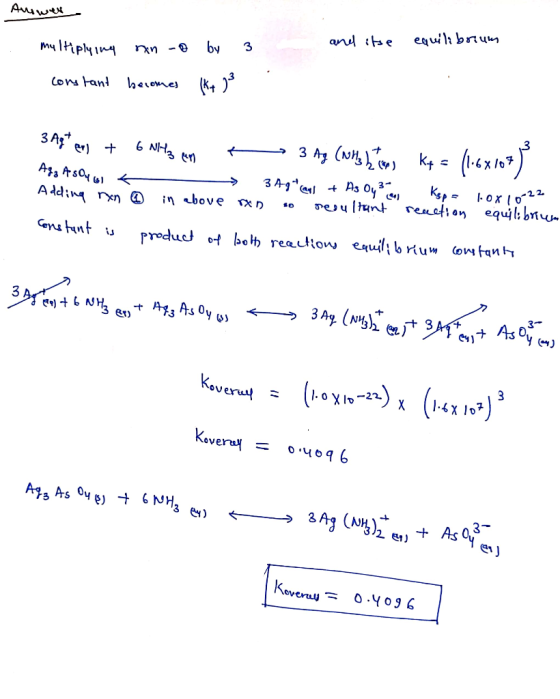
F1. What is the Koverall given the information below: Ag3AsO4 (s) < > 3 Ag+ (aq)...
1. Given the two equilibria below, Ag(NH3)2(aq) = Agt(aq) + 2NH3(aq); Kd = 5.9 x 10⁻⁸...
 1. Given the two equilibria below, Ag(NH3)2(aq) = Agt(aq) + 2NH3(aq); Kd = 5.9 x 10⁻⁸ AgBr(s) Ag+(aq) + Br" (aq); Ksp = 5 x 10-13 what is K, for the following equilibrium? AgBr(s) + 2NH3(aq) = Ag(NH3)2(aq) + Br" (aq) a. 3 x 10-20 b.2.7 x 100 c. 7.2 x 10⁻¹¹ d. 8.5 x 10⁻⁶ e. 1.2 x 10⁵
please answer both questions QUESTION 26 Given the two equilibria below, Ag(NH3)2 (aq) = Ag (aq)...
 please answer both questions
QUESTION 26 Given the two equilibria below, Ag(NH3)2 (aq) = Ag (aq) + 2 NH3(aq) Kd-5.9x 10⁻⁸ Agl(s) Ag (aq)+I (aq) what is Ke for the following equilibrium? 10-17 Agl(s)+2NH3(aq) Ag(NH3)2"(aq)+ I (aq) а. 7.1 x 10⁸ b. 1.4x 10⁻⁹ 2.0 x 10⁻¹⁸ d. 4.9x 10⁻²⁴ 2.7 x 100 QUESTION 27 One liter of saturated zinc hydroxide solution contains 0.000222 g of dissolved Zn(OH)2. Use this information to estimate the Ksp for Zn(OH)2 1 pol a...
please answer both questions
QUESTION 26 Given the two equilibria below, Ag(NH3)2 (aq) = Ag (aq) + 2 NH3(aq) Kd-5.9x 10⁻⁸ Agl(s) Ag (aq)+I (aq) what is Ke for the following equilibrium? 10-17 Agl(s)+2NH3(aq) Ag(NH3)2"(aq)+ I (aq) а. 7.1 x 10⁸ b. 1.4x 10⁻⁹ 2.0 x 10⁻¹⁸ d. 4.9x 10⁻²⁴ 2.7 x 100 QUESTION 27 One liter of saturated zinc hydroxide solution contains 0.000222 g of dissolved Zn(OH)2. Use this information to estimate the Ksp for Zn(OH)2 1 pol a...
Given the electrochemical cell below, answer the following questions. S<H2(g) 00 Ag Agt H+ If the...
 Given the electrochemical cell below, answer the following questions. S<H2(g) 00 Ag Agt H+ If the concentration of Agt is 0.0115 M, the concentration of H+ is 0.355 M, and the pressure of Hy is 1.00 atm, calculate the cell potential at 25.0°C.
Given the following reactions, AgBr(s) = Ag+ (aq) + Br(aq) Ksp = 5.8 x 10⁻¹³ Ag+...
 Given the following reactions, AgBr(s) = Ag+ (aq) + Br(aq) Ksp = 5.8 x 10⁻¹³ Ag+ (aq) + 2 CN"(aq) = Ag(CN)2(aq) Kf = 9.5 x 10²¹ determine the equilibrium constant for the reaction below. AgBr(s) + 2 CN"(aq) =Ag(CN)2(aq) + Br(aq) Answer: 1.2E21 Check
Given the following reactions, AgBr(s) Ag (aq) + Br(aq) Ag*(aq)2 CN (aq)=Ag(CN)2(aq) K 1.2E+21 determine the...
 Given the following reactions, AgBr(s) Ag (aq) + Br(aq) Ag*(aq)2 CN (aq)=Ag(CN)2(aq) K 1.2E+21 determine the equilibrium constant for the reaction below AgBr(s)2 CN-(aq)= Ag(CN)2 (aq) Brr(aq) Ksp 5.4E-13
Predict Precipitation Question Consider the following equilibrium: Ag, PO, (s) 3 Ag (aq) + PO(aq) If the concentrat...
 Predict Precipitation Question Consider the following equilibrium: Ag, PO, (s) 3 Ag (aq) + PO(aq) If the concentration of the Ag ion at a certain point is 6.3 x 10 M, and Ksp=9.1 x 10⁴, will a precipitate form? - Select the correct answer below: Oyes, because Q> K yes, because Q < K no, because o> K no, because < K
Predict Precipitation Question Consider the following equilibrium: Ag, PO, (s) 3 Ag (aq) + PO(aq) If the concentration...
Predict Precipitation Question Consider the following equilibrium: Ag, PO, (s) 3 Ag (aq) + PO(aq) If the concentration of the Ag ion at a certain point is 6.3 x 10 M, and Ksp=9.1 x 10⁴, will a precipitate form? - Select the correct answer below: Oyes, because Q> K yes, because Q < K no, because o> K no, because < K
Predict Precipitation Question Consider the following equilibrium: Ag, PO, (s) 3 Ag (aq) + PO(aq) If the concentration...
Consider the following equilibrium: Ag (aq) 2 NH3(aq) Ag(NH)21'(aq) AH15 k How does each of the...
 Consider the following equilibrium: Ag (aq) 2 NH3(aq) Ag(NH)21'(aq) AH15 k How does each of the following situations affect the position of the equilibrium? 1. Dissolving AgNO in the solution. (Remember that metal nitrates are fully soluble in water 2. 3. 4. and will dissociate upon dissolving: MfNOJy(s)->xMn"(aq) + yNO3-(aq).) Bubbling NH, (g) into the solution. (Remember that NIH, gas is soluble in water) Heating the solution. Dissolving NaCl in the solution, given the following information AgClo Ag(a) Cl(aq) K-1.8x...
Given the Ksp = 1.2 x 10⁻¹² for Ag2 CrO4 and K+ = 1.7 x 10⁷...
 Given the Ksp = 1.2 x 10⁻¹² for Ag2 CrO4 and K+ = 1.7 x 10⁷ for (Ag(NH3)21, calculate the equilibrium constant for Ag2CrO4(s) + 4 NH3(aq) + 2 Ag(NH3)21+ (aq) + Cr042-aq) and explain whether the reaction favors reactants or products at equilibrium? Show work. TTT Arial 3 (12pt) • T. E. 3. 's Path:p Words:0
For the reaction ATP(aq) + H200) <-> ADP(aq) + phosphate (aq), AG° = -30.5 kJ/mol. What...
 For the reaction ATP(aq) + H200) <-> ADP(aq) + phosphate (aq), AG° = -30.5 kJ/mol. What is the value of AG in at 310K assuming (ATP] = 0.25M and [ADP] = [phosphate] = 0.030M? -45.0 kJ -1.45 x 10⁴ kJ +16.0 kJ insufficient information or none of these
is in equilibrium with Ag,SO3 (s) and 4.30 x 10⁻³ M Agt? What concentration of SO...
 is in equilibrium with Ag,SO3 (s) and 4.30 x 10⁻³ M Agt? What concentration of SO The Ksp of Ag,SO2 can be found in this table M
 1. Given the two equilibria below, Ag(NH3)2(aq) = Agt(aq) + 2NH3(aq); Kd = 5.9 x 10⁻⁸ AgBr(s) Ag+(aq) + Br" (aq); Ksp = 5 x 10-13 what is K, for the following equilibrium? AgBr(s) + 2NH3(aq) = Ag(NH3)2(aq) + Br" (aq) a. 3 x 10-20 b.2.7 x 100 c. 7.2 x 10⁻¹¹ d. 8.5 x 10⁻⁶ e. 1.2 x 10⁵
 please answer both questions
QUESTION 26 Given the two equilibria below, Ag(NH3)2 (aq) = Ag (aq) + 2 NH3(aq) Kd-5.9x 10⁻⁸ Agl(s) Ag (aq)+I (aq) what is Ke for the following equilibrium? 10-17 Agl(s)+2NH3(aq) Ag(NH3)2"(aq)+ I (aq) а. 7.1 x 10⁸ b. 1.4x 10⁻⁹ 2.0 x 10⁻¹⁸ d. 4.9x 10⁻²⁴ 2.7 x 100 QUESTION 27 One liter of saturated zinc hydroxide solution contains 0.000222 g of dissolved Zn(OH)2. Use this information to estimate the Ksp for Zn(OH)2 1 pol a...
please answer both questions
QUESTION 26 Given the two equilibria below, Ag(NH3)2 (aq) = Ag (aq) + 2 NH3(aq) Kd-5.9x 10⁻⁸ Agl(s) Ag (aq)+I (aq) what is Ke for the following equilibrium? 10-17 Agl(s)+2NH3(aq) Ag(NH3)2"(aq)+ I (aq) а. 7.1 x 10⁸ b. 1.4x 10⁻⁹ 2.0 x 10⁻¹⁸ d. 4.9x 10⁻²⁴ 2.7 x 100 QUESTION 27 One liter of saturated zinc hydroxide solution contains 0.000222 g of dissolved Zn(OH)2. Use this information to estimate the Ksp for Zn(OH)2 1 pol a...
 Given the electrochemical cell below, answer the following questions. S<H2(g) 00 Ag Agt H+ If the concentration of Agt is 0.0115 M, the concentration of H+ is 0.355 M, and the pressure of Hy is 1.00 atm, calculate the cell potential at 25.0°C.
 Given the following reactions, AgBr(s) = Ag+ (aq) + Br(aq) Ksp = 5.8 x 10⁻¹³ Ag+ (aq) + 2 CN"(aq) = Ag(CN)2(aq) Kf = 9.5 x 10²¹ determine the equilibrium constant for the reaction below. AgBr(s) + 2 CN"(aq) =Ag(CN)2(aq) + Br(aq) Answer: 1.2E21 Check
 Given the following reactions, AgBr(s) Ag (aq) + Br(aq) Ag*(aq)2 CN (aq)=Ag(CN)2(aq) K 1.2E+21 determine the equilibrium constant for the reaction below AgBr(s)2 CN-(aq)= Ag(CN)2 (aq) Brr(aq) Ksp 5.4E-13
 Predict Precipitation Question Consider the following equilibrium: Ag, PO, (s) 3 Ag (aq) + PO(aq) If the concentration of the Ag ion at a certain point is 6.3 x 10 M, and Ksp=9.1 x 10⁴, will a precipitate form? - Select the correct answer below: Oyes, because Q> K yes, because Q < K no, because o> K no, because < K
Predict Precipitation Question Consider the following equilibrium: Ag, PO, (s) 3 Ag (aq) + PO(aq) If the concentration...
Predict Precipitation Question Consider the following equilibrium: Ag, PO, (s) 3 Ag (aq) + PO(aq) If the concentration of the Ag ion at a certain point is 6.3 x 10 M, and Ksp=9.1 x 10⁴, will a precipitate form? - Select the correct answer below: Oyes, because Q> K yes, because Q < K no, because o> K no, because < K
Predict Precipitation Question Consider the following equilibrium: Ag, PO, (s) 3 Ag (aq) + PO(aq) If the concentration...
 Consider the following equilibrium: Ag (aq) 2 NH3(aq) Ag(NH)21'(aq) AH15 k How does each of the following situations affect the position of the equilibrium? 1. Dissolving AgNO in the solution. (Remember that metal nitrates are fully soluble in water 2. 3. 4. and will dissociate upon dissolving: MfNOJy(s)->xMn"(aq) + yNO3-(aq).) Bubbling NH, (g) into the solution. (Remember that NIH, gas is soluble in water) Heating the solution. Dissolving NaCl in the solution, given the following information AgClo Ag(a) Cl(aq) K-1.8x...
 Given the Ksp = 1.2 x 10⁻¹² for Ag2 CrO4 and K+ = 1.7 x 10⁷ for (Ag(NH3)21, calculate the equilibrium constant for Ag2CrO4(s) + 4 NH3(aq) + 2 Ag(NH3)21+ (aq) + Cr042-aq) and explain whether the reaction favors reactants or products at equilibrium? Show work. TTT Arial 3 (12pt) • T. E. 3. 's Path:p Words:0
 For the reaction ATP(aq) + H200) <-> ADP(aq) + phosphate (aq), AG° = -30.5 kJ/mol. What is the value of AG in at 310K assuming (ATP] = 0.25M and [ADP] = [phosphate] = 0.030M? -45.0 kJ -1.45 x 10⁴ kJ +16.0 kJ insufficient information or none of these
 is in equilibrium with Ag,SO3 (s) and 4.30 x 10⁻³ M Agt? What concentration of SO The Ksp of Ag,SO2 can be found in this table M
Most questions answered within 3 hours.
-
Where is the error in this code sequence?
String s1 = "Hello";
String s2 = "ello";...
asked 10 months ago -
Financial data for Joel de Paris, Inc., for last year
follow:
Joel de Paris, Inc.
Balance...
asked 10 months ago -
Consider this reaction:
Al2(SO4)3 (aq)+ BaCl3
(aq) Al2Cl6 (aq)- +
3BaSO4(s) . What is the...
asked 10 months ago -
Suppose that Savneet is considering increasing her
recent random sample from 20 car rentals to 40...
asked 10 months ago -
Trucks arrive at an unloading terminal at an average rate of 120
per hour.
Trucks arrive...
asked 10 months ago -
Why are methanol and ethanol completely soluble in water while
octanol is not very little soluble....
asked 10 months ago -
A facilities manager at a university reads in a research report
that the mean amount of...
asked 10 months ago -
When the CuSO4 is rehydrated by adding water to the anhydrous
compound, is this an endothermic...
asked 10 months ago -
A ray of sunlight is passing from diamond into crown glass; the
angle of incidence is...
asked 10 months ago -
A block of mass 0.249 kg is placed on top of a light, vertical
spring of...
asked 10 months ago -
how do the kidneys compensate in the presences of acidosis
a) trigger hyperventilate
b) reserve acid...
asked 10 months ago -
Question 501 pts
The rental rate of capital to the firm increases. Which of the
following...
asked 10 months ago