
Homework Answers
Request Answer!
We need at least 10 more requests to produce the answer.
0 / 10 have requested this problem solution
The more requests, the faster the answer.
Add Answer to:
For the reaction ATP(aq) + H200) <-> ADP(aq) + phosphate (aq), AG° = -30.5 kJ/mol. What...
For the reaction ATP + H2O ⇔ ADP + phosphate, ΔG° = -30.5 kJ/mol. Very high...
For the reaction ATP + H2O ⇔ ADP + phosphate, ΔG° = -30.5 kJ/mol. Very high concentrations of ADP and phosphate (such that Q>>K) would likely have which of the following effects (explain your thinking): a. ΔG would be less negative than ΔG°, because conditions would disfavor the formation of more ADP b. ΔG would be more negative than ΔG°, because conditions would favor the formation of more ADP c. ΔG° and ΔG are unrelated in this case, because conditions...
2. For the following reaction: ATP+ creatine + H2O creatine phosphate + ADP + P, The...
 2. For the following reaction: ATP+ creatine + H2O creatine phosphate + ADP + P, The relevant half reactions are: ATP → ADP + Pi Creatine phosphate + H2O-> creatine AG-30.5 kJ/mol ΔG°,--43.1 kJ/mol a. (2 pts.) Calculate the ΔG°, for the overall reaction. b. (2 pts.) Is the reaction spontaneous or non-spontaneous? Endergonic or exergonic?
er at initial change (AG The standard free energy change (AG) for ATP hydrolysis is -30.5 kJ/ mol ATP, ADP, and I a...
 er at initial change (AG The standard free energy change (AG) for ATP hydrolysis is -30.5 kJ/ mol ATP, ADP, and I are mixed together at initial concentrations of 1 M each then left alone until the reaction below has come to equilibrium. For each species (ie. ATP. ADP and P.) indicate whether the concentration will be equal to 1 M, less than 1 M, or greater than 1 M after the reaction had reached equilibrium. Explain why. ATP +...
ATP(aq) +H20(l) >>>ADP(aq) + HPO4^2- for which ΔG°rxn = –30.5 kJ/mol at 37.0 °C and pH...
ATP(aq) +H20(l) >>>ADP(aq) + HPO4^2- for which ΔG°rxn = –30.5 kJ/mol at 37.0 °C and pH 7.0. Calculate the value of ΔGrxn in a biological cell in which [ATP] = 5.0 mM, [ADP] = 0.60 mM, and [HPO42–] = 5.0 mM.
10) The AG for the hydrolysis of creatine phosphate is -43.1 k/mol, whereas the AG for...
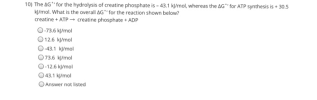 10) The AG for the hydrolysis of creatine phosphate is -43.1 k/mol, whereas the AG for ATP synthesis is+30.5 kj/mol, what is the overall ΔG., for the reaction shown below? creatine + ATP creatine phosphate+ADP O-73.6 kj/mol O12.6 k/mol -43.1 k/mol O73.6 k/mol -12.6 kj/mol 043.1 Wmol Answer not listed
Shown is acetyl phosphate. Say a new enzyme uses acetyl phosphate to phosphorylate ADP to make ATP (acetyl phosphate + ADP —> acetate + ATP). What is the standard free energy change of this reacti...
 Shown is acetyl phosphate. Say a new enzyme uses acetyl
phosphate to phosphorylate ADP to make ATP (acetyl phosphate + ADP
—> acetate + ATP). What is the standard free energy change of
this reaction?
CH3 Table 13-2 Standard Free Energies of Phosphate Hydrolysis of Some Compounds of Biological Interest AGo (kJ mol 1) 61.9 -49.4 45.6 43.1 -43.1 30.5 -20.9 19.2 13.8 13.8 -9.2 Compound Phosphoenolpyruvate 1,3-Bisphosphoglycerate ATP AMP + PP,) Acetyl phosphate Phosphocreatine ATP ㈠ ADP + Pi)...
Shown is acetyl phosphate. Say a new enzyme uses acetyl
phosphate to phosphorylate ADP to make ATP (acetyl phosphate + ADP
—> acetate + ATP). What is the standard free energy change of
this reaction?
CH3 Table 13-2 Standard Free Energies of Phosphate Hydrolysis of Some Compounds of Biological Interest AGo (kJ mol 1) 61.9 -49.4 45.6 43.1 -43.1 30.5 -20.9 19.2 13.8 13.8 -9.2 Compound Phosphoenolpyruvate 1,3-Bisphosphoglycerate ATP AMP + PP,) Acetyl phosphate Phosphocreatine ATP ㈠ ADP + Pi)...
Consider the following reaction: Glucose + ATP ↔Glucose -6-phosphate + ADP Using the information in the...
 Consider the following reaction:
Glucose + ATP ↔Glucose -6-phosphate + ADP
Using the information in the below determine Go for
this reaction and comment on the spontaneity of this reaction.
What the information does the Go parameters in the
table below provides about the rate of the ATP hydrolysis.
Below is the structure of glucose-6-phosphate. Identify which
anomer does it represent?
Standard free energies of hydrolysis of some
phosphorylated compounds
compound
Go (kJ mol-1)
ATP (to ADP)
-30.5
pyrophosphate
-19.3...
Consider the following reaction:
Glucose + ATP ↔Glucose -6-phosphate + ADP
Using the information in the below determine Go for
this reaction and comment on the spontaneity of this reaction.
What the information does the Go parameters in the
table below provides about the rate of the ATP hydrolysis.
Below is the structure of glucose-6-phosphate. Identify which
anomer does it represent?
Standard free energies of hydrolysis of some
phosphorylated compounds
compound
Go (kJ mol-1)
ATP (to ADP)
-30.5
pyrophosphate
-19.3...
7.5 Hexokinase catalyzes the reaction: ATP + Glucose A glucose-6-phosphate + ADP AG - -4 562...
7.5 Hexokinase catalyzes the reaction: ATP + Glucose A glucose-6-phosphate + ADP AG - -4 562 cal / mol Keg = 2.21 x 10³ Calculate the concentration of glucose-6-phosphate necessary to force the hexokinase reaction to go in the opposite direction (towards the synthesis of glucose and ATP) in the presence of 10-5 M glucose, 10-3 M ATP and 10-4 M ADP.
Given the following: phosphocreatine → creatine + Pi ΔG = −43.0 kJ/mol ATP → ADP + Pi...
Given the following: phosphocreatine → creatine + Pi ΔG = −43.0 kJ/mol ATP → ADP + Pi ΔG = −30.5 kJ/mol What is the overall ΔG for the following Reaction? phosphocreatine + ADP → creatine + ATP A) -12.5 kJ/mol B) + 73.5 kJ/mol C) -73.5 kJ/mol D) + 12.5 kJ/mol
Consider the hydrolysis of ATP: ATP(aq) + H2O(l) → ADP(aq) + Pi(aq). This reaction has ΔH°=...
Consider the hydrolysis of ATP: ATP(aq) + H2O(l) → ADP(aq) + Pi(aq). This reaction has ΔH°= −24.3 kJ/mol and ΔS°= +21.6 J/mol-K. The actual concentrations of ATP, ADP, and Pi are not 1 M in a biological cell. How much energy can the conversion of ATP to ADP supply when it occurs at physiological conditions in E. coli where the temperature is 37°C and the approximate concentrations are ATP = 11.2 mM, ADP = 1.52 mM, Pi = 20.0 mM?...
 2. For the following reaction: ATP+ creatine + H2O creatine phosphate + ADP + P, The relevant half reactions are: ATP → ADP + Pi Creatine phosphate + H2O-> creatine AG-30.5 kJ/mol ΔG°,--43.1 kJ/mol a. (2 pts.) Calculate the ΔG°, for the overall reaction. b. (2 pts.) Is the reaction spontaneous or non-spontaneous? Endergonic or exergonic?
 er at initial change (AG The standard free energy change (AG) for ATP hydrolysis is -30.5 kJ/ mol ATP, ADP, and I are mixed together at initial concentrations of 1 M each then left alone until the reaction below has come to equilibrium. For each species (ie. ATP. ADP and P.) indicate whether the concentration will be equal to 1 M, less than 1 M, or greater than 1 M after the reaction had reached equilibrium. Explain why. ATP +...
 10) The AG for the hydrolysis of creatine phosphate is -43.1 k/mol, whereas the AG for ATP synthesis is+30.5 kj/mol, what is the overall ΔG., for the reaction shown below? creatine + ATP creatine phosphate+ADP O-73.6 kj/mol O12.6 k/mol -43.1 k/mol O73.6 k/mol -12.6 kj/mol 043.1 Wmol Answer not listed
 Shown is acetyl phosphate. Say a new enzyme uses acetyl
phosphate to phosphorylate ADP to make ATP (acetyl phosphate + ADP
—> acetate + ATP). What is the standard free energy change of
this reaction?
CH3 Table 13-2 Standard Free Energies of Phosphate Hydrolysis of Some Compounds of Biological Interest AGo (kJ mol 1) 61.9 -49.4 45.6 43.1 -43.1 30.5 -20.9 19.2 13.8 13.8 -9.2 Compound Phosphoenolpyruvate 1,3-Bisphosphoglycerate ATP AMP + PP,) Acetyl phosphate Phosphocreatine ATP ㈠ ADP + Pi)...
Shown is acetyl phosphate. Say a new enzyme uses acetyl
phosphate to phosphorylate ADP to make ATP (acetyl phosphate + ADP
—> acetate + ATP). What is the standard free energy change of
this reaction?
CH3 Table 13-2 Standard Free Energies of Phosphate Hydrolysis of Some Compounds of Biological Interest AGo (kJ mol 1) 61.9 -49.4 45.6 43.1 -43.1 30.5 -20.9 19.2 13.8 13.8 -9.2 Compound Phosphoenolpyruvate 1,3-Bisphosphoglycerate ATP AMP + PP,) Acetyl phosphate Phosphocreatine ATP ㈠ ADP + Pi)...
 Consider the following reaction:
Glucose + ATP ↔Glucose -6-phosphate + ADP
Using the information in the below determine Go for
this reaction and comment on the spontaneity of this reaction.
What the information does the Go parameters in the
table below provides about the rate of the ATP hydrolysis.
Below is the structure of glucose-6-phosphate. Identify which
anomer does it represent?
Standard free energies of hydrolysis of some
phosphorylated compounds
compound
Go (kJ mol-1)
ATP (to ADP)
-30.5
pyrophosphate
-19.3...
Consider the following reaction:
Glucose + ATP ↔Glucose -6-phosphate + ADP
Using the information in the below determine Go for
this reaction and comment on the spontaneity of this reaction.
What the information does the Go parameters in the
table below provides about the rate of the ATP hydrolysis.
Below is the structure of glucose-6-phosphate. Identify which
anomer does it represent?
Standard free energies of hydrolysis of some
phosphorylated compounds
compound
Go (kJ mol-1)
ATP (to ADP)
-30.5
pyrophosphate
-19.3...
Most questions answered within 3 hours.
-
Where is the error in this code sequence?
String s1 = "Hello";
String s2 = "ello";...
asked 11 months ago -
Financial data for Joel de Paris, Inc., for last year
follow:
Joel de Paris, Inc.
Balance...
asked 11 months ago -
Consider this reaction:
Al2(SO4)3 (aq)+ BaCl3
(aq) Al2Cl6 (aq)- +
3BaSO4(s) . What is the...
asked 11 months ago -
Suppose that Savneet is considering increasing her
recent random sample from 20 car rentals to 40...
asked 11 months ago -
Trucks arrive at an unloading terminal at an average rate of 120
per hour.
Trucks arrive...
asked 11 months ago -
Why are methanol and ethanol completely soluble in water while
octanol is not very little soluble....
asked 11 months ago -
A facilities manager at a university reads in a research report
that the mean amount of...
asked 11 months ago -
When the CuSO4 is rehydrated by adding water to the anhydrous
compound, is this an endothermic...
asked 11 months ago -
A ray of sunlight is passing from diamond into crown glass; the
angle of incidence is...
asked 11 months ago -
A block of mass 0.249 kg is placed on top of a light, vertical
spring of...
asked 11 months ago -
how do the kidneys compensate in the presences of acidosis
a) trigger hyperventilate
b) reserve acid...
asked 11 months ago -
Question 501 pts
The rental rate of capital to the firm increases. Which of the
following...
asked 11 months ago