

Homework Answers
Add Answer to:
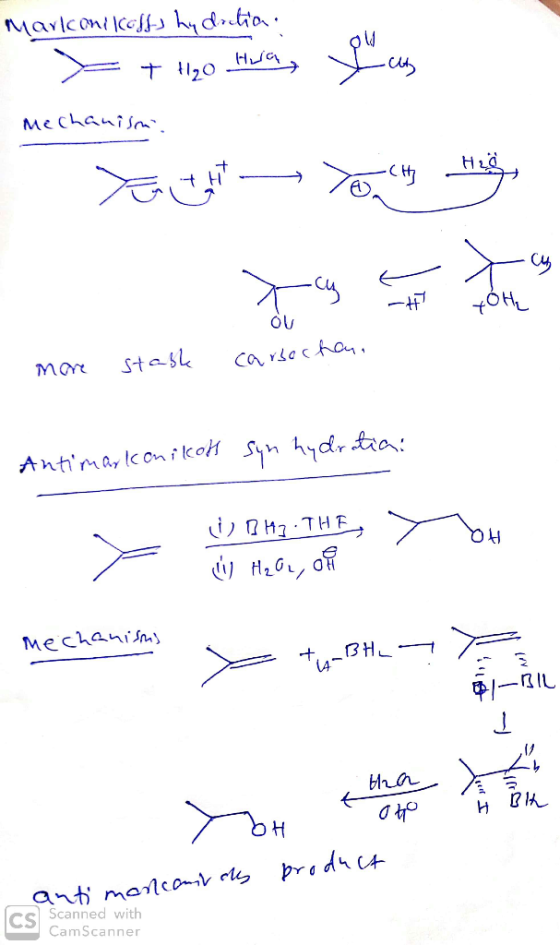
Give an example reaction for Markovnikov hydration without the possibility of rearrangement. Give an example reaction...
Should a halogenation reaction be overall first or second order kinetics? Also, Explain why it gives...
 Should a halogenation reaction be overall first or second order kinetics? Also, Explain why it gives anti addition rather than syn.
can you explain both numbers 4 and 5 and give reasons as to why/how the answer was achieved 4. For each reaction, ma...
 can you explain both numbers 4 and 5 and give reasons as to
why/how the answer was achieved
4. For each reaction, mark all of the statements below that correctly describe the reaction X1,80 X 14, THX MGOMO H,0 2) H,O, NOH H, Markovnikov addition Anti-Markovnikov addition Syn addition Anti addition Syn and Anti addition Rearrangement acou Rearrangement does not coeur 5. Insert the necessary reagents and product to complete this synthetic pathway. HO Br H2SO, (conc.) H2, Pt heat
can you explain both numbers 4 and 5 and give reasons as to
why/how the answer was achieved
4. For each reaction, mark all of the statements below that correctly describe the reaction X1,80 X 14, THX MGOMO H,0 2) H,O, NOH H, Markovnikov addition Anti-Markovnikov addition Syn addition Anti addition Syn and Anti addition Rearrangement acou Rearrangement does not coeur 5. Insert the necessary reagents and product to complete this synthetic pathway. HO Br H2SO, (conc.) H2, Pt heat
1) Please explain what it means for a reaction to create a Markovnikov product. Why does...
 1) Please explain what it means for a reaction to create a Markovnikov product. Why does the reagent favor being added in this order and not Anti-Markovnikov See the reaction below. 2) Why do molecules perform carbocation rearrangements? How will you determine when to perform a carbocation rearrangement? see reaction below. The X-
Acid Catalyzed Hydration-treatment of alkenes with water in the presence of acid catalyst leads to the...
 Acid Catalyzed Hydration-treatment of alkenes with water in the presence of acid catalyst leads to the formation of alcohols. H2SO4/H2O > 150°C Mechanism Major Product Acid catalyzed dehydration goes through a carbocation intermediate. This means that the Markovnikov product is obtained when carbocation rearrangements do not occur. The need for excessively high temperatures makes this reaction of limited use in laboratory synthesis. Oxymercuration - Oxymercuration involves the addition of Hg to the alkene using mercury (II) acetate Hg(OAc) followed by...
need help on questions 3 and 4 please Expt 6.2B, Hydration of Alkenes Fall Semester Name:...
 need help on questions 3 and 4 please
Expt 6.2B, Hydration of Alkenes Fall Semester Name: 1. Draw your reaction (ChemSketch or ChemDraw). It should fit on one line and look good. Show all products actually formed + H₂O H₂SO4 norbornene exo- norborneol 2. What was the stereochemistry (endo or exo) of your reaction? How do you know? exo 3. The carbocation in our particular reaction was secondary. Was a rearrangement possible? If so, why didn't it occur? 4. Oxymercuration-demercuration...
need help on questions 3 and 4 please
Expt 6.2B, Hydration of Alkenes Fall Semester Name: 1. Draw your reaction (ChemSketch or ChemDraw). It should fit on one line and look good. Show all products actually formed + H₂O H₂SO4 norbornene exo- norborneol 2. What was the stereochemistry (endo or exo) of your reaction? How do you know? exo 3. The carbocation in our particular reaction was secondary. Was a rearrangement possible? If so, why didn't it occur? 4. Oxymercuration-demercuration...
4.(18 points) Using the arrow, provide the detailed reaction conditions necessary to give the following. You...
 4.(18 points) Using the arrow, provide the detailed reaction conditions necessary to give the following. You do not need to provide any starting material or product, just the reaction conditions (see example below) 1.B Example: Show reagent 'B' followed by aqueous acid: 2. H30 a. Markovnikov addition of H2O to a double bond: b. Anti-Markovnikov addition of H2O to a double bond: c. Markovnikov addition to form an alkyl bromide from an alkene: d. Reaction conditions to change 1,2-dimethylcyclohexene into...
Experiment 8 - Addition to Alkenes What is Markovnikov's Rule? Chem 2321 In this experiment you...
 Experiment 8 - Addition to Alkenes What is Markovnikov's Rule? Chem 2321 In this experiment you will synthesize a brom ohydrin according to the reaction shown below. Using infrared (IR) spectroscopy and a simple chemical test, you will determine which product (Markovnikov or anti-Markovnikov) is formed. N-bromosuccinimide Br (NBS) но or н.о, THF ""сн, он "Br CH3 CH3 1-methylcyclohexene Markovnikov product anti-Markovnikov product Halogenation of alkenes is an important reaction in organic chemistry. When carried out in an aqueous solution,...
1. Give the structure of the product(s) for the following addition reactions. Show appropriate stereochemistry if...
 1. Give the structure of the product(s) for the following addition reactions. Show appropriate stereochemistry if necessary to get the full credits. (5 points) 50% H2SO4 50% H20 1. BH3, THF 2. H2O2/KOH CH3COOH ry condon YY PEO 1. 03 2. Zn/H2O 2. Give the syn or anti addition products for the following addition reactions. Show appropriate stereochemistry if necessary to get the full credits. (5 points total) Hz/Pt 1 point 1 point Hypt DBk Det ook o BryH2O 1....
An irreversible reaction A + B products is studied under conditions where the initial concentrations...
An irreversible reaction A + B products is studied under conditions where the initial concentrations of A and B are equal. Under these circumstances, a graph of ln([A]) as a function of time is linear. What is the order in A? (A) Zeroth order B) First order (C) Second order (D) The order in A cannot be determined based on the information given. Doesn't the first order reaction kinetics say that the graph of ln[A] vs t gives a...
What is the complete mechanism necessary to find the product of example D. Organic Chemistry: Integrat......
 What is the complete mechanism necessary to find the product of
example D.
Organic Chemistry: Integrat... Shop Now < 8 Addition Reactions of... Go to 8 Addition Reactions of Alkenes STEP 1 Redraw the C=C bonds longer than normal. 344 8.1 Introduction to Addition Reactions COD ji o STEP 2 Erase the center of each C=C bond and place two oxygen atoms in the space. 8.2 Alkenes in Nature and in Industry 345 8.3 Addition vs. Elimination: A Thermodynamic Perspective...
What is the complete mechanism necessary to find the product of
example D.
Organic Chemistry: Integrat... Shop Now < 8 Addition Reactions of... Go to 8 Addition Reactions of Alkenes STEP 1 Redraw the C=C bonds longer than normal. 344 8.1 Introduction to Addition Reactions COD ji o STEP 2 Erase the center of each C=C bond and place two oxygen atoms in the space. 8.2 Alkenes in Nature and in Industry 345 8.3 Addition vs. Elimination: A Thermodynamic Perspective...
 Should a halogenation reaction be overall first or second order kinetics? Also, Explain why it gives anti addition rather than syn.
 can you explain both numbers 4 and 5 and give reasons as to
why/how the answer was achieved
4. For each reaction, mark all of the statements below that correctly describe the reaction X1,80 X 14, THX MGOMO H,0 2) H,O, NOH H, Markovnikov addition Anti-Markovnikov addition Syn addition Anti addition Syn and Anti addition Rearrangement acou Rearrangement does not coeur 5. Insert the necessary reagents and product to complete this synthetic pathway. HO Br H2SO, (conc.) H2, Pt heat
can you explain both numbers 4 and 5 and give reasons as to
why/how the answer was achieved
4. For each reaction, mark all of the statements below that correctly describe the reaction X1,80 X 14, THX MGOMO H,0 2) H,O, NOH H, Markovnikov addition Anti-Markovnikov addition Syn addition Anti addition Syn and Anti addition Rearrangement acou Rearrangement does not coeur 5. Insert the necessary reagents and product to complete this synthetic pathway. HO Br H2SO, (conc.) H2, Pt heat
 1) Please explain what it means for a reaction to create a Markovnikov product. Why does the reagent favor being added in this order and not Anti-Markovnikov See the reaction below. 2) Why do molecules perform carbocation rearrangements? How will you determine when to perform a carbocation rearrangement? see reaction below. The X-
 Acid Catalyzed Hydration-treatment of alkenes with water in the presence of acid catalyst leads to the formation of alcohols. H2SO4/H2O > 150°C Mechanism Major Product Acid catalyzed dehydration goes through a carbocation intermediate. This means that the Markovnikov product is obtained when carbocation rearrangements do not occur. The need for excessively high temperatures makes this reaction of limited use in laboratory synthesis. Oxymercuration - Oxymercuration involves the addition of Hg to the alkene using mercury (II) acetate Hg(OAc) followed by...
 need help on questions 3 and 4 please
Expt 6.2B, Hydration of Alkenes Fall Semester Name: 1. Draw your reaction (ChemSketch or ChemDraw). It should fit on one line and look good. Show all products actually formed + H₂O H₂SO4 norbornene exo- norborneol 2. What was the stereochemistry (endo or exo) of your reaction? How do you know? exo 3. The carbocation in our particular reaction was secondary. Was a rearrangement possible? If so, why didn't it occur? 4. Oxymercuration-demercuration...
need help on questions 3 and 4 please
Expt 6.2B, Hydration of Alkenes Fall Semester Name: 1. Draw your reaction (ChemSketch or ChemDraw). It should fit on one line and look good. Show all products actually formed + H₂O H₂SO4 norbornene exo- norborneol 2. What was the stereochemistry (endo or exo) of your reaction? How do you know? exo 3. The carbocation in our particular reaction was secondary. Was a rearrangement possible? If so, why didn't it occur? 4. Oxymercuration-demercuration...
 4.(18 points) Using the arrow, provide the detailed reaction conditions necessary to give the following. You do not need to provide any starting material or product, just the reaction conditions (see example below) 1.B Example: Show reagent 'B' followed by aqueous acid: 2. H30 a. Markovnikov addition of H2O to a double bond: b. Anti-Markovnikov addition of H2O to a double bond: c. Markovnikov addition to form an alkyl bromide from an alkene: d. Reaction conditions to change 1,2-dimethylcyclohexene into...
 Experiment 8 - Addition to Alkenes What is Markovnikov's Rule? Chem 2321 In this experiment you will synthesize a brom ohydrin according to the reaction shown below. Using infrared (IR) spectroscopy and a simple chemical test, you will determine which product (Markovnikov or anti-Markovnikov) is formed. N-bromosuccinimide Br (NBS) но or н.о, THF ""сн, он "Br CH3 CH3 1-methylcyclohexene Markovnikov product anti-Markovnikov product Halogenation of alkenes is an important reaction in organic chemistry. When carried out in an aqueous solution,...
 1. Give the structure of the product(s) for the following addition reactions. Show appropriate stereochemistry if necessary to get the full credits. (5 points) 50% H2SO4 50% H20 1. BH3, THF 2. H2O2/KOH CH3COOH ry condon YY PEO 1. 03 2. Zn/H2O 2. Give the syn or anti addition products for the following addition reactions. Show appropriate stereochemistry if necessary to get the full credits. (5 points total) Hz/Pt 1 point 1 point Hypt DBk Det ook o BryH2O 1....
 What is the complete mechanism necessary to find the product of
example D.
Organic Chemistry: Integrat... Shop Now < 8 Addition Reactions of... Go to 8 Addition Reactions of Alkenes STEP 1 Redraw the C=C bonds longer than normal. 344 8.1 Introduction to Addition Reactions COD ji o STEP 2 Erase the center of each C=C bond and place two oxygen atoms in the space. 8.2 Alkenes in Nature and in Industry 345 8.3 Addition vs. Elimination: A Thermodynamic Perspective...
What is the complete mechanism necessary to find the product of
example D.
Organic Chemistry: Integrat... Shop Now < 8 Addition Reactions of... Go to 8 Addition Reactions of Alkenes STEP 1 Redraw the C=C bonds longer than normal. 344 8.1 Introduction to Addition Reactions COD ji o STEP 2 Erase the center of each C=C bond and place two oxygen atoms in the space. 8.2 Alkenes in Nature and in Industry 345 8.3 Addition vs. Elimination: A Thermodynamic Perspective...
Most questions answered within 3 hours.
-
Where is the error in this code sequence?
String s1 = "Hello";
String s2 = "ello";...
asked 10 months ago -
Financial data for Joel de Paris, Inc., for last year
follow:
Joel de Paris, Inc.
Balance...
asked 10 months ago -
Consider this reaction:
Al2(SO4)3 (aq)+ BaCl3
(aq) Al2Cl6 (aq)- +
3BaSO4(s) . What is the...
asked 10 months ago -
Suppose that Savneet is considering increasing her
recent random sample from 20 car rentals to 40...
asked 10 months ago -
Trucks arrive at an unloading terminal at an average rate of 120
per hour.
Trucks arrive...
asked 10 months ago -
Why are methanol and ethanol completely soluble in water while
octanol is not very little soluble....
asked 10 months ago -
A facilities manager at a university reads in a research report
that the mean amount of...
asked 10 months ago -
When the CuSO4 is rehydrated by adding water to the anhydrous
compound, is this an endothermic...
asked 10 months ago -
A ray of sunlight is passing from diamond into crown glass; the
angle of incidence is...
asked 10 months ago -
A block of mass 0.249 kg is placed on top of a light, vertical
spring of...
asked 10 months ago -
how do the kidneys compensate in the presences of acidosis
a) trigger hyperventilate
b) reserve acid...
asked 10 months ago -
Question 501 pts
The rental rate of capital to the firm increases. Which of the
following...
asked 10 months ago