
Homework Answers
Add Answer to:
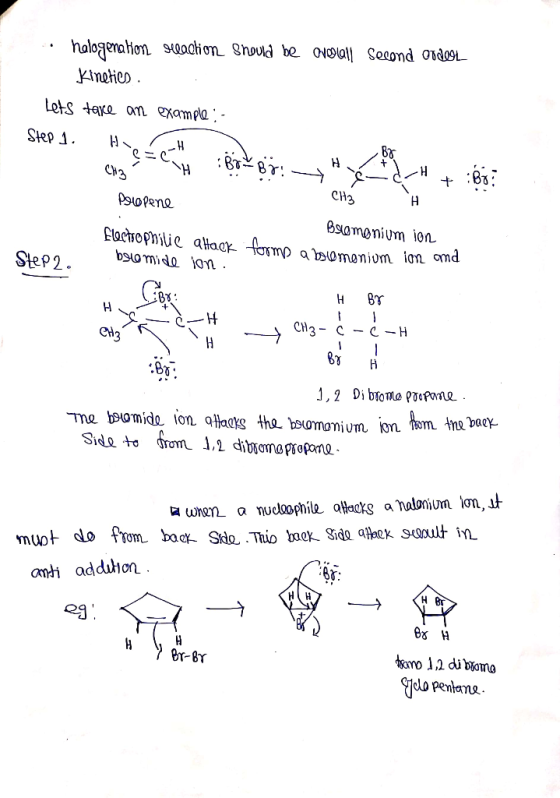
Should a halogenation reaction be overall first or second order kinetics? Also, Explain why it gives...
Give an example reaction for Markovnikov hydration without the possibility of rearrangement. Give an example reaction...
 Give an example reaction for Markovnikov hydration without the possibility of rearrangement. Give an example reaction for syn antiMarkovnikov hydration. Should a halogenation reaction be overall first or second order kinetics? Also, Explain why it gives anti addition rather than syn.
Why does a drug that follows zero order kinetics, behave as a first order reaction at...
Why does a drug that follows zero order kinetics, behave as a first order reaction at low concentrations of the drug?
Explain why, in the base-catalyzed halogenation of acetone, the second and third halogenations occur on the...
Explain why, in the base-catalyzed halogenation of acetone, the second and third halogenations occur on the same carbon as the first, and not on the carbon of the other methyl group.Please explain briefly.
Compare and contrast how first-order reaction kinetics and zero-order reaction kinetics differ in terms of the...
Compare and contrast how first-order reaction kinetics and zero-order reaction kinetics differ in terms of the depletion of a reactant A in a chemical reaction. Assume an initial concentration of 420 mg of A. Assume a half-life of 30 minutes if first-order kinetics are obeyed, and a depletion rate of 60 mg/hour if zero-order kinetics are obeyed. Use a clearly drawn graph(s) to determine which rate will result in complete depletion of A over the shortest time. Assume 99% to...
The reaction below is first order in H2, second order in NO and the overall rate...
 The reaction below is first order in H2, second order in NO and the overall rate of the reaction is 0.0028 M/s. What is the rate when [Hz] is doubled and [NO] is tripled? 2 H2(g) + 2NO(g) N2(g) + 2 H2O(g) 0.0029 M/S 0.0073 M/S 0.13 M/S 0.050 M/S
Kinetics Question: a) Explain why the rate of reaction must be defined in a manner that...
Kinetics Question: a) Explain why the rate of reaction must be defined in a manner that is not dependent on which reactant or product is used to measure it. b) Explain why rate laws must be determined experimentally. c) Explain how the rate limiting step in a mechanism determines the overall reaction rate.
What is the difference between a first order and a second order reaction? a. For a...
What is the difference between a first order and a second order reaction? a. For a first order reaction, plotting the natural logarithm of A versus time always gives a straight line with a slope equal to -k For a second order reaction a plot of 1 / A versus time, will produce a straight line with a slope equal to k b. For a first order reaction, plotting the natural logarithm of A versus time always gives a straight...
can you explain both numbers 4 and 5 and give reasons as to why/how the answer was achieved 4. For each reaction, ma...
 can you explain both numbers 4 and 5 and give reasons as to
why/how the answer was achieved
4. For each reaction, mark all of the statements below that correctly describe the reaction X1,80 X 14, THX MGOMO H,0 2) H,O, NOH H, Markovnikov addition Anti-Markovnikov addition Syn addition Anti addition Syn and Anti addition Rearrangement acou Rearrangement does not coeur 5. Insert the necessary reagents and product to complete this synthetic pathway. HO Br H2SO, (conc.) H2, Pt heat
can you explain both numbers 4 and 5 and give reasons as to
why/how the answer was achieved
4. For each reaction, mark all of the statements below that correctly describe the reaction X1,80 X 14, THX MGOMO H,0 2) H,O, NOH H, Markovnikov addition Anti-Markovnikov addition Syn addition Anti addition Syn and Anti addition Rearrangement acou Rearrangement does not coeur 5. Insert the necessary reagents and product to complete this synthetic pathway. HO Br H2SO, (conc.) H2, Pt heat
write a general reaction mechanism that displays second-order rate kinetics. Please describe how the concentration of...
write a general reaction mechanism that displays second-order rate kinetics. Please describe how the concentration of reactants might lead to the observation of second-order versus first-order kinetic data? That is to say, what ratios of reactants in a bimolecular reaction would lead to the observation of second-order versus first-order kinetic data? For such conditions that yield first-order kinetic data, please describe how such reactions, though technically bimolecular, can be treated mathematically as first-order data.
The homogeneous gas reaction 2A ---> 3R follows second-order kinetics. For a feed rate of 4m3/...
The homogeneous gas reaction 2A ---> 3R follows second-order kinetics. For a feed rate of 4m3/hr of pure A at 5 atm and 350oC, an experimental reactor consisting of a 2.5 cm ID pipe 2 m long gives 65% conversion of feed. A commercial plant is to treat 310 m3/hr of feed consisting of 50% A, 50% inerts at 25 atm and 350 degrees C to obtain 80% conversion. Assume plug flow in the pipe, negligible pressure drop, and ideal...
 Give an example reaction for Markovnikov hydration without the possibility of rearrangement. Give an example reaction for syn antiMarkovnikov hydration. Should a halogenation reaction be overall first or second order kinetics? Also, Explain why it gives anti addition rather than syn.
 The reaction below is first order in H2, second order in NO and the overall rate of the reaction is 0.0028 M/s. What is the rate when [Hz] is doubled and [NO] is tripled? 2 H2(g) + 2NO(g) N2(g) + 2 H2O(g) 0.0029 M/S 0.0073 M/S 0.13 M/S 0.050 M/S
 can you explain both numbers 4 and 5 and give reasons as to
why/how the answer was achieved
4. For each reaction, mark all of the statements below that correctly describe the reaction X1,80 X 14, THX MGOMO H,0 2) H,O, NOH H, Markovnikov addition Anti-Markovnikov addition Syn addition Anti addition Syn and Anti addition Rearrangement acou Rearrangement does not coeur 5. Insert the necessary reagents and product to complete this synthetic pathway. HO Br H2SO, (conc.) H2, Pt heat
can you explain both numbers 4 and 5 and give reasons as to
why/how the answer was achieved
4. For each reaction, mark all of the statements below that correctly describe the reaction X1,80 X 14, THX MGOMO H,0 2) H,O, NOH H, Markovnikov addition Anti-Markovnikov addition Syn addition Anti addition Syn and Anti addition Rearrangement acou Rearrangement does not coeur 5. Insert the necessary reagents and product to complete this synthetic pathway. HO Br H2SO, (conc.) H2, Pt heat
Most questions answered within 3 hours.
-
Where is the error in this code sequence?
String s1 = "Hello";
String s2 = "ello";...
asked 10 months ago -
Financial data for Joel de Paris, Inc., for last year
follow:
Joel de Paris, Inc.
Balance...
asked 10 months ago -
Consider this reaction:
Al2(SO4)3 (aq)+ BaCl3
(aq) Al2Cl6 (aq)- +
3BaSO4(s) . What is the...
asked 10 months ago -
Suppose that Savneet is considering increasing her
recent random sample from 20 car rentals to 40...
asked 10 months ago -
Trucks arrive at an unloading terminal at an average rate of 120
per hour.
Trucks arrive...
asked 10 months ago -
Why are methanol and ethanol completely soluble in water while
octanol is not very little soluble....
asked 10 months ago -
A facilities manager at a university reads in a research report
that the mean amount of...
asked 10 months ago -
When the CuSO4 is rehydrated by adding water to the anhydrous
compound, is this an endothermic...
asked 10 months ago -
A ray of sunlight is passing from diamond into crown glass; the
angle of incidence is...
asked 10 months ago -
A block of mass 0.249 kg is placed on top of a light, vertical
spring of...
asked 10 months ago -
how do the kidneys compensate in the presences of acidosis
a) trigger hyperventilate
b) reserve acid...
asked 10 months ago -
Question 501 pts
The rental rate of capital to the firm increases. Which of the
following...
asked 10 months ago