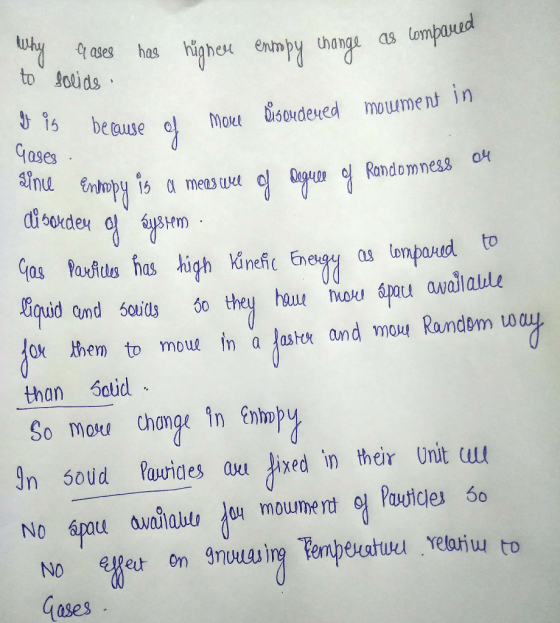
1. Consider the temperature dependence of entropy, it has a ln functional form. But it increases...
1. Consider the temperature dependence of entropy, it has a ln functional form. But it increases faster for a gas than for a liquid or solid, explain why.
Homework Answers
Add Answer to:
1. Consider the temperature dependence of entropy, it has a ln
functional form. But it increases...
Entropy of naphthalene: Consider naphthalene C10H8 at atmospheric pressure. It is a solid with a melting...
Entropy of naphthalene: Consider naphthalene C10H8 at atmospheric pressure. It is a solid with a melting point at 80.1 degrees Celsius and a boiling point at 218 degrees Celsius. The latent heat of fusion is 19,123 kJ / mol. The molar heat at constant pressure of solid naphthalene has a functional temperature dependence (in K) which is linear. Its value is 0 at T = 0 K and 188.41 J / mol-K at T = 317.15 K. The molar heat...
How does the entropy of the system change when: a.) the temperature of the system increases b.) the volume of a gas...
How does the entropy of the system change when: a.) the temperature of the system increases b.) the volume of a gas increases c.) equal volumes of ethanol and water are mixed to form a solution Please provide why it increases or decreases.
20. Which of the following statements is FALSE? A. The entropy of the universe increases during...
 20. Which of the following statements is FALSE? A. The entropy of the universe increases during spontaneous processes. B. During chemical and physical changes, energy is conserved. C. The entropy of H2O liquid is greater than the entropy of H2O solid at 0°C. D. The entropy of O2(g) should be greater than the entropy of CO2(g) when at the same temperature, E. The absolute entropy of a substance generally decreases when temperature decreases.
9) An increase in the temperature of a solution usually A) increases the boiling point. B)...
 9) An increase in the temperature of a solution usually A) increases the boiling point. B) increases the solubility of a gas in the solution. C) increases the solubility of a solid solute in the solution. D) decreases the solubility of a solid solute in the solution. E) decreases the solubility of a liquid solute in the solution. 10) The solubility of Kl is 50 g in 100 g of H20 at 20°C. If 110 grams of Kl are added...
explain on a molecular level why liquid co2 has lower entropy than gas co2
explain on a molecular level why liquid co2 has lower entropy than gas co2
The entropy of a substance increases as we change it from solid to liquid to gas, as we increase the motion and configurations possible (and go from a highly ordered structure to one lacking any struc...
The entropy of a substance increases as we change it from solid to liquid to gas, as we increase the motion and configurations possible (and go from a highly ordered structure to one lacking any structure). With this comes the expectation that dissolving a solid (changing state from solid to aqueous) will increase the entropy of the system. Using Appendix II from your textbook, calculate the entropy for the dissolution of MgCl2, make sure to include the chemical equation you...
Entropy (S) The second factor involved in determining whether or not a process is spontaneous is...
 Entropy (S) The second factor involved in determining whether or not a process is spontaneous is the change in randomness or entropy (AS). Entropy is represented by the symbol S. Again, experience can help us understand the relationship between entropy and spontaneous processes. If we look at the two drawings below, we can predict which picture represents the stack of marbles "before" and after they are bumped. We expect the stack of marbles (less random, lower entropy) to be the...
un plase uansion from a liquid to a gas • an increase in the number of...
 un plase uansion from a liquid to a gas • an increase in the number of moles of a gas during a chemical reaction EXAMPLE 17.1 Predicting the Sign of Entropy Change Predict the sign of AS for each process: (a) H2O(g) → H2O(1) (b) Solid carbon dioxide sublimes. (c) 2 N2O(g) —> 2 N2(8) + O2(g) SOLUTION (a) Since a gas has a greater entropy than a liquid, the entropy decreases and AS is negative. (b) Since a solid...
The temperature of hte triple point: 195.41 K Consider the phase diagram of NH3. Triple...
The temperature of hte triple point: 195.41 K Consider the phase diagram of NH3. Triple point: 195.410 K and 0.06921 atm Normal boiling point: -33.342 oC Normal freezing point: -77.728 oC Density of liquid: 0.618g/mL Density of solid: 0.817 g/mL (a) Determine the heat of fusion, the heat of vaporization the heat of sublimation at near the triple point. (b) Determine the entropy change of fusion, vaporization and sublimation at near the triple point. (c) Plot the phase diagram...
*Explanations should be brief. Draw a box around each final answer, if applicable.* 1. Consider intermolecular...
 *Explanations should be brief. Draw a box around each final answer, if applicable.* 1. Consider intermolecular forces and kinetic energies with respect to a solid and a liquid. Explain why molecules in a liquid are free to move past each other, while molecules in a solid are held in fixed positions. 2. Use your knowledge of intermolecular forces to provide an explanation for why the boiling point of 2-hexanol is higher than the boiling point of 2,3-dimethyl-2-butanol. Be sure to...
 20. Which of the following statements is FALSE? A. The entropy of the universe increases during spontaneous processes. B. During chemical and physical changes, energy is conserved. C. The entropy of H2O liquid is greater than the entropy of H2O solid at 0°C. D. The entropy of O2(g) should be greater than the entropy of CO2(g) when at the same temperature, E. The absolute entropy of a substance generally decreases when temperature decreases.
 9) An increase in the temperature of a solution usually A) increases the boiling point. B) increases the solubility of a gas in the solution. C) increases the solubility of a solid solute in the solution. D) decreases the solubility of a solid solute in the solution. E) decreases the solubility of a liquid solute in the solution. 10) The solubility of Kl is 50 g in 100 g of H20 at 20°C. If 110 grams of Kl are added...
 Entropy (S) The second factor involved in determining whether or not a process is spontaneous is the change in randomness or entropy (AS). Entropy is represented by the symbol S. Again, experience can help us understand the relationship between entropy and spontaneous processes. If we look at the two drawings below, we can predict which picture represents the stack of marbles "before" and after they are bumped. We expect the stack of marbles (less random, lower entropy) to be the...
 un plase uansion from a liquid to a gas • an increase in the number of moles of a gas during a chemical reaction EXAMPLE 17.1 Predicting the Sign of Entropy Change Predict the sign of AS for each process: (a) H2O(g) → H2O(1) (b) Solid carbon dioxide sublimes. (c) 2 N2O(g) —> 2 N2(8) + O2(g) SOLUTION (a) Since a gas has a greater entropy than a liquid, the entropy decreases and AS is negative. (b) Since a solid...
 *Explanations should be brief. Draw a box around each final answer, if applicable.* 1. Consider intermolecular forces and kinetic energies with respect to a solid and a liquid. Explain why molecules in a liquid are free to move past each other, while molecules in a solid are held in fixed positions. 2. Use your knowledge of intermolecular forces to provide an explanation for why the boiling point of 2-hexanol is higher than the boiling point of 2,3-dimethyl-2-butanol. Be sure to...
Most questions answered within 3 hours.
-
Where is the error in this code sequence?
String s1 = "Hello";
String s2 = "ello";...
asked 10 months ago -
Financial data for Joel de Paris, Inc., for last year
follow:
Joel de Paris, Inc.
Balance...
asked 10 months ago -
Consider this reaction:
Al2(SO4)3 (aq)+ BaCl3
(aq) Al2Cl6 (aq)- +
3BaSO4(s) . What is the...
asked 10 months ago -
Suppose that Savneet is considering increasing her
recent random sample from 20 car rentals to 40...
asked 10 months ago -
Trucks arrive at an unloading terminal at an average rate of 120
per hour.
Trucks arrive...
asked 10 months ago -
Why are methanol and ethanol completely soluble in water while
octanol is not very little soluble....
asked 10 months ago -
A facilities manager at a university reads in a research report
that the mean amount of...
asked 10 months ago -
When the CuSO4 is rehydrated by adding water to the anhydrous
compound, is this an endothermic...
asked 10 months ago -
A ray of sunlight is passing from diamond into crown glass; the
angle of incidence is...
asked 10 months ago -
A block of mass 0.249 kg is placed on top of a light, vertical
spring of...
asked 10 months ago -
how do the kidneys compensate in the presences of acidosis
a) trigger hyperventilate
b) reserve acid...
asked 10 months ago -
Question 501 pts
The rental rate of capital to the firm increases. Which of the
following...
asked 10 months ago