( ??/?? ) ? = ? − ? ( ??/?? )p Using the expression derived above,...
( ??/?? ) ? = ? − ? ( ??/?? )p
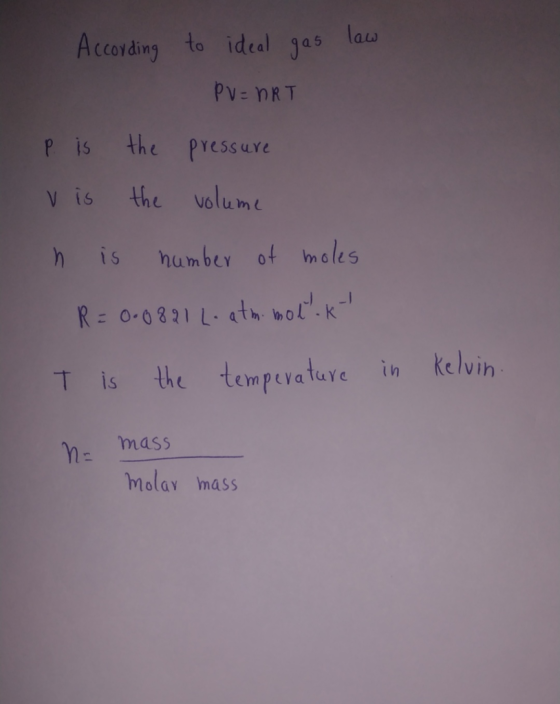
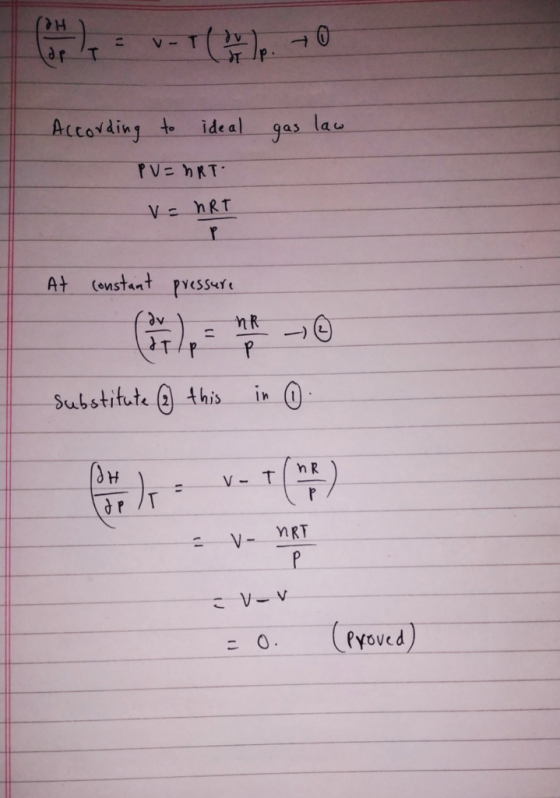
Using the expression derived above, prove that for an ideal gas, ( ??/?? ) ? = 0
Homework Answers
Add Answer to:
( ??/?? ) ? = ? − ? ( ??/?? )p
Using the expression derived above,...
1 N 3 V c. When we derived the expression fact that they interact with each...
 1 N 3 V c. When we derived the expression fact that they interact with each other. Discuss whether the pressure of a real gas for which these assumptions are not true should be larger or smaller than the pressure of the ideal gas calculated according to the derived expression. Compare an ideal gas and a real gas assuming the gases are in containers of the same volume and have the same number of particles with the same average of...
c. Derive the following expression Using the expression in part c, derive an expression for terms...
 c. Derive the following expression Using the expression in part c, derive an expression for terms of only Rand P. d. ASof an ideal gas in How does the molar entropy change with increasing pressure for an ideal gas? Justify you answer using the result in part d e.
The internal energy of an ideal gas can be derived using statistical mechanics as U=U(S,V)=αNkB(N/V)2/3 e2S/3NkB...
The internal energy of an ideal gas can be derived using statistical mechanics as U=U(S,V)=αNkB(N/V)2/3 e2S/3NkB where α is a constant. Show that this expression leads to the equation of state for an ideal gas pV = NkBT. (What is dU?)
Using the expression we derived above, work out the minimum speed at which you can travel...
Using the expression we derived above, work out the minimum speed at which you can travel around the banked curve, using these values: g = 10 m/s2; r = 160 m; tangent of the angle = 1/4 (this corresponds to an angle of 14 degrees); coefficient of static friction = 0.20. Hint: if the tangent of the angle is 1/4, then the sine of the angle divided by the cosine of the angle is 1/4, which means that the cosine...
(b) (i) Starting with the definition of enthalpy, H = U + pl, and using a...
 (b) (i) Starting with the definition of enthalpy, H = U + pl, and using a Maxwell relation, derive the following general equation of state. Write your derivation clearly and logically, showing all steps. You may use the following fundamental equation for change in internal energy without further proof: dU = Tds -pdv. TUDENT NAME NSHE # or My Nevadał: ii) Using the expression derived in (i) above, prove that for an ideal gas,
Derive above expression for chem potential of an ideal gas Chem Potential for ideal gas
 Derive above expression for chem potential of an ideal gas
Chem Potential for ideal gas
Derive above expression for chem potential of an ideal gas
Chem Potential for ideal gas
For the ideal gas equation PV = RT, find an expression for (partial differential P/partial differential...
 For the ideal gas equation PV = RT, find an expression for (partial differential P/partial differential V)_T by using the method of implicit differentiation (make sure you show all your work). Compare your answer to the result you get by first solving for P in the ideal gas equation and then taking the derivative. b) Repeat part (a) for the van der Waals equation of state.
What is the expression for pressure as a function of density P(density) of an isothermal atmosphere...
What is the expression for pressure as a function of density P(density) of an isothermal atmosphere (ideal gas at temperature T=T0)
(1) Prove that if R is a PID and P is a prime ideal, then R/P is another PID Show that if I is an...
 (1) Prove that if R is a PID and P is a prime ideal, then R/P is another PID Show that if I is an arbitrary ideal, then R/I might not be a PID (2) Find an expression for the ged and lem of a pair of nonzero elements a, b in a UFD, and prove that it is correct.
(1) Prove that if R is a PID and P is a prime ideal, then R/P is another PID Show...
(1) Prove that if R is a PID and P is a prime ideal, then R/P is another PID Show that if I is an arbitrary ideal, then R/I might not be a PID (2) Find an expression for the ged and lem of a pair of nonzero elements a, b in a UFD, and prove that it is correct.
(1) Prove that if R is a PID and P is a prime ideal, then R/P is another PID Show...
Using a quasi-static P-V diagram, show how you would calculate the work done by/on an ideal...
Using a quasi-static P-V diagram, show how you would calculate the work done by/on an ideal gas. Prove your answer mathematically.
 1 N 3 V c. When we derived the expression fact that they interact with each other. Discuss whether the pressure of a real gas for which these assumptions are not true should be larger or smaller than the pressure of the ideal gas calculated according to the derived expression. Compare an ideal gas and a real gas assuming the gases are in containers of the same volume and have the same number of particles with the same average of...
 c. Derive the following expression Using the expression in part c, derive an expression for terms of only Rand P. d. ASof an ideal gas in How does the molar entropy change with increasing pressure for an ideal gas? Justify you answer using the result in part d e.
 (b) (i) Starting with the definition of enthalpy, H = U + pl, and using a Maxwell relation, derive the following general equation of state. Write your derivation clearly and logically, showing all steps. You may use the following fundamental equation for change in internal energy without further proof: dU = Tds -pdv. TUDENT NAME NSHE # or My Nevadał: ii) Using the expression derived in (i) above, prove that for an ideal gas,
 Derive above expression for chem potential of an ideal gas
Chem Potential for ideal gas
Derive above expression for chem potential of an ideal gas
Chem Potential for ideal gas
 For the ideal gas equation PV = RT, find an expression for (partial differential P/partial differential V)_T by using the method of implicit differentiation (make sure you show all your work). Compare your answer to the result you get by first solving for P in the ideal gas equation and then taking the derivative. b) Repeat part (a) for the van der Waals equation of state.
 (1) Prove that if R is a PID and P is a prime ideal, then R/P is another PID Show that if I is an arbitrary ideal, then R/I might not be a PID (2) Find an expression for the ged and lem of a pair of nonzero elements a, b in a UFD, and prove that it is correct.
(1) Prove that if R is a PID and P is a prime ideal, then R/P is another PID Show...
(1) Prove that if R is a PID and P is a prime ideal, then R/P is another PID Show that if I is an arbitrary ideal, then R/I might not be a PID (2) Find an expression for the ged and lem of a pair of nonzero elements a, b in a UFD, and prove that it is correct.
(1) Prove that if R is a PID and P is a prime ideal, then R/P is another PID Show...
Most questions answered within 3 hours.
-
Where is the error in this code sequence?
String s1 = "Hello";
String s2 = "ello";...
asked 11 months ago -
Financial data for Joel de Paris, Inc., for last year
follow:
Joel de Paris, Inc.
Balance...
asked 11 months ago -
Consider this reaction:
Al2(SO4)3 (aq)+ BaCl3
(aq) Al2Cl6 (aq)- +
3BaSO4(s) . What is the...
asked 11 months ago -
Suppose that Savneet is considering increasing her
recent random sample from 20 car rentals to 40...
asked 11 months ago -
Trucks arrive at an unloading terminal at an average rate of 120
per hour.
Trucks arrive...
asked 11 months ago -
Why are methanol and ethanol completely soluble in water while
octanol is not very little soluble....
asked 11 months ago -
A facilities manager at a university reads in a research report
that the mean amount of...
asked 11 months ago -
When the CuSO4 is rehydrated by adding water to the anhydrous
compound, is this an endothermic...
asked 11 months ago -
A ray of sunlight is passing from diamond into crown glass; the
angle of incidence is...
asked 11 months ago -
A block of mass 0.249 kg is placed on top of a light, vertical
spring of...
asked 11 months ago -
how do the kidneys compensate in the presences of acidosis
a) trigger hyperventilate
b) reserve acid...
asked 11 months ago -
Question 501 pts
The rental rate of capital to the firm increases. Which of the
following...
asked 11 months ago