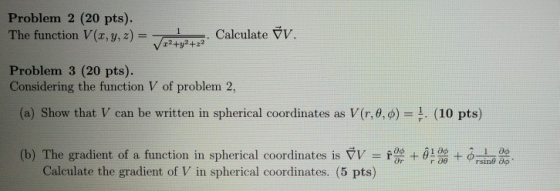
only do problem 3a,b.
show full work
Homework Answers
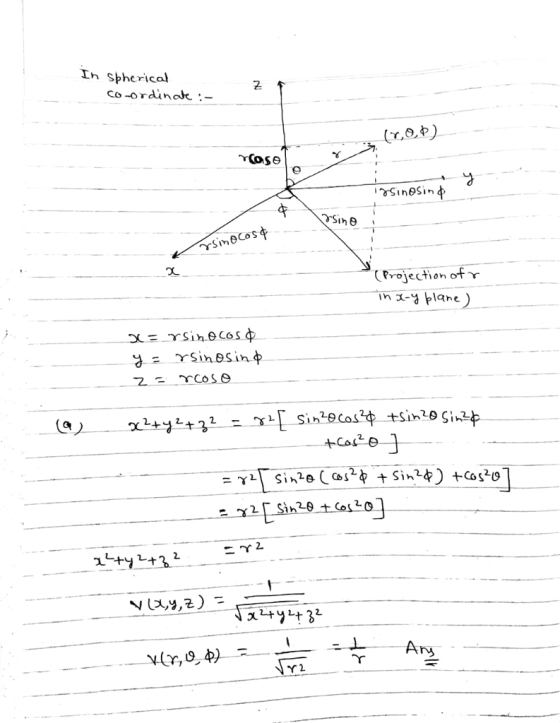
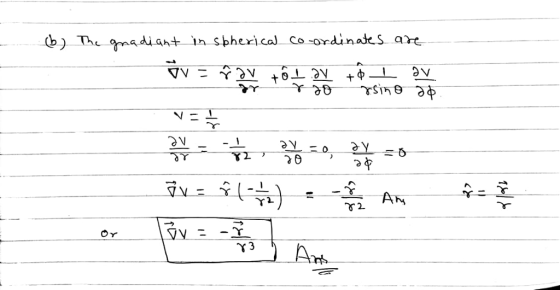
Add Answer to:
only do problem 3a,b.
show full work
Problem 2 (20 pts). The function V (x, y,...
only do problem 3c, the second picture is the answer to problem 2, the answer I...
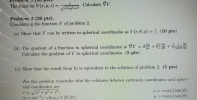 only do problem 3c, the second picture is the answer
to problem 2, the answer I got for 3b is -1/(r^2)
The tinction V(x, y,z) Problem 3 (20 pts). Considering the function V of problem 2, (a) Show that V can be written in spherical coordinates as V(r, θ, φ-1. (10 pts) r + θ + φ (b) The gradient of a function in spherical coordinates is VV Calculate the gradient of V in spherical coordinates. (5 pts) (e) Show...
only do problem 3c, the second picture is the answer
to problem 2, the answer I got for 3b is -1/(r^2)
The tinction V(x, y,z) Problem 3 (20 pts). Considering the function V of problem 2, (a) Show that V can be written in spherical coordinates as V(r, θ, φ-1. (10 pts) r + θ + φ (b) The gradient of a function in spherical coordinates is VV Calculate the gradient of V in spherical coordinates. (5 pts) (e) Show...
Help please. I would really appreciate clear, full explanation of the method used. like and comment are rewarded for good answer. (a) Let v(r) be a scalar function of r, where r V +y? +22 (i) Show...
 Help please. I would really appreciate clear, full
explanation of the method used. like and comment are rewarded for
good answer.
(a) Let v(r) be a scalar function of r, where r V +y? +22 (i) Show that (i) If F Vu) evaluate Jc Fdr where C is straight line going from the point defined by vector r1 to the point defined by r2 (b) Consider a body with a surface defined by 2(x2 + y2) + 4z2 1 (i)...
Help please. I would really appreciate clear, full
explanation of the method used. like and comment are rewarded for
good answer.
(a) Let v(r) be a scalar function of r, where r V +y? +22 (i) Show that (i) If F Vu) evaluate Jc Fdr where C is straight line going from the point defined by vector r1 to the point defined by r2 (b) Consider a body with a surface defined by 2(x2 + y2) + 4z2 1 (i)...
A. Make a sketch of a vector F- (x,y, z), labeling the appropriate spherical coordinates. In addi...
 A. Make a sketch of a vector F- (x,y, z), labeling the appropriate spherical coordinates. In addition, show the unit vectors r, θ, and φ at that point B. Write the vectors ŕ.0, and ф in terms of the unit vectors x, y, and г. Here's the easy way to do this 1. For r, simply use the fact that/r 2. For φ, use the following formula sin θ Explain why the above formula works 3. Compute θ via θ...
Log(2 - 2) (x2 y Question 2. Consider the function f(x, y, (a) What is the maximal domain of f? (...
 log(2 - 2) (x2 y Question 2. Consider the function f(x, y, (a) What is the maximal domain of f? (Write your answer in set notation.) (b) Find ▽f. (c) Find the tangent hyperplnes Te2)(r, y,z) and Tao2-)f(x, y, z). Find the intersection of these two hyperplanes, and very briefly describe the intersection in words (0,1, 1) and set notation. Confirm that the point (2, 2, 1) is on this level surface, and that Vf(2, 2, 1) is (d) On...
Problem 3. (30 pts.) Let f(x) 32-1 (a) Calculate the derivative (the gradient) (r) and the second derivative (the Hessian) "() (4pts) (b) Using ro = 10, iterate the gradient descent method (y...
 Problem 3. (30 pts.) Let f(x) 32-1 (a) Calculate the derivative (the gradient) (r) and the second derivative (the Hessian) "() (4pts) (b) Using ro = 10, iterate the gradient descent method (you choose your ok) until s(k10-6 (11 pts) (c) Using zo = 10, iterate Newton's method (you choose your 0k ) until Irk-rk-1 < 10-6. (15 pts) Problem 4. (30 pts.) Let D ), (1,2), (3,2), (4,3),(4,4)] be a collection of data points. Your task is to find...
Write the vector differential operator "DEL-V in Cartesian coordinates Cylindrical coordinates Spherical coordinates. 2. Show for...
 Write the vector differential operator "DEL-V in Cartesian coordinates Cylindrical coordinates Spherical coordinates. 2. Show for any "nice" scalar function (x,y,z), the Curl of the gradient of (x,y,z) is Zero.. VxVo = 0 Hint: assume the order of differentiation can be switched 3. Find the volume of a sphere of radius R by integrating the infinitesimal volume element of the sphere. 4. Write Maxwell's equations for the case of electro and magneto statics (the fields do not change in time)...
That is a z' (z prime), not z^12. Please answer all parts and show full work,...
 That is a z' (z prime), not z^12. Please answer all parts and
show full work, thank you!
x(m) (25 pts) Problem 3 The Savart Law This problem is similar to that of Problem 1 except here we have an infinite wire with current I(z) at the point (x-2,y 3,-0) using the Bigt -Savart Law. A and we will be finding the magnetic field H due to this current 13) +13 10 (2,3,0 dl r(0,0,z) -5 -10 (a) What is...
That is a z' (z prime), not z^12. Please answer all parts and
show full work, thank you!
x(m) (25 pts) Problem 3 The Savart Law This problem is similar to that of Problem 1 except here we have an infinite wire with current I(z) at the point (x-2,y 3,-0) using the Bigt -Savart Law. A and we will be finding the magnetic field H due to this current 13) +13 10 (2,3,0 dl r(0,0,z) -5 -10 (a) What is...
That is a z' (z prime), not z^12. Please answer all parts and show full work, thank you!
 That is a z' (z prime), not z^12. Please answer all parts and
show full work, thank you!
x(m) (25 pts) Problem 3 The Savart Law This problem is similar to that of Problem 1 except here we have an infinite wire with current I(z) at the point (x-2,y 3,-0) using the Bigt -Savart Law. A and we will be finding the magnetic field H due to this current 13) +13 10 (2,3,0 dl r(0,0,z) -5 -10 (a) What is...
That is a z' (z prime), not z^12. Please answer all parts and
show full work, thank you!
x(m) (25 pts) Problem 3 The Savart Law This problem is similar to that of Problem 1 except here we have an infinite wire with current I(z) at the point (x-2,y 3,-0) using the Bigt -Savart Law. A and we will be finding the magnetic field H due to this current 13) +13 10 (2,3,0 dl r(0,0,z) -5 -10 (a) What is...
1. (20 pts) RVs X and Y have joint density function 22 f(x, y) =(0 if O <z<1 and 0<y<2 īf 0 < x < 1 and 0 < y < 2 otherwise (a) Find E(X), V(X), E(Y), and V(Y). (b) Find t...
 1. (20 pts) RVs X and Y have joint density function 22 f(x, y) =(0 if O <z<1 and 0<y<2 īf 0 < x < 1 and 0 < y < 2 otherwise (a) Find E(X), V(X), E(Y), and V(Y). (b) Find the covariance cov(X,Y) and the associated correlation ρ (c) Find the marginal densities fx and fy. (Be sure to say where they're nonzero.) (d) Find E(X | Y = 1.5). (e) Are X and Y independent? Give two...
2. (5 pts) Assume A E Rm** with m > n has (full) rank n. Show that At = (ATA)TAT, What is the pse...
 2. (5 pts) Assume A E Rm** with m > n has (full) rank n. Show that At = (ATA)TAT, What is the pseudo-inverse of a vector u R" regarded as an m x 1 matrix? 3. (5 pts) Let B AT where A is the matrix in Problem 1. Use Matlab to find the singular value decomposition and the Moore-Penrose pseudo-inverse of B. Then solve minimum-norm least squares problem minl-ll : FE R minimizes IBr-ey where c- [1,2. Compare...
 only do problem 3c, the second picture is the answer
to problem 2, the answer I got for 3b is -1/(r^2)
The tinction V(x, y,z) Problem 3 (20 pts). Considering the function V of problem 2, (a) Show that V can be written in spherical coordinates as V(r, θ, φ-1. (10 pts) r + θ + φ (b) The gradient of a function in spherical coordinates is VV Calculate the gradient of V in spherical coordinates. (5 pts) (e) Show...
only do problem 3c, the second picture is the answer
to problem 2, the answer I got for 3b is -1/(r^2)
The tinction V(x, y,z) Problem 3 (20 pts). Considering the function V of problem 2, (a) Show that V can be written in spherical coordinates as V(r, θ, φ-1. (10 pts) r + θ + φ (b) The gradient of a function in spherical coordinates is VV Calculate the gradient of V in spherical coordinates. (5 pts) (e) Show...
 Help please. I would really appreciate clear, full
explanation of the method used. like and comment are rewarded for
good answer.
(a) Let v(r) be a scalar function of r, where r V +y? +22 (i) Show that (i) If F Vu) evaluate Jc Fdr where C is straight line going from the point defined by vector r1 to the point defined by r2 (b) Consider a body with a surface defined by 2(x2 + y2) + 4z2 1 (i)...
Help please. I would really appreciate clear, full
explanation of the method used. like and comment are rewarded for
good answer.
(a) Let v(r) be a scalar function of r, where r V +y? +22 (i) Show that (i) If F Vu) evaluate Jc Fdr where C is straight line going from the point defined by vector r1 to the point defined by r2 (b) Consider a body with a surface defined by 2(x2 + y2) + 4z2 1 (i)...
 A. Make a sketch of a vector F- (x,y, z), labeling the appropriate spherical coordinates. In addition, show the unit vectors r, θ, and φ at that point B. Write the vectors ŕ.0, and ф in terms of the unit vectors x, y, and г. Here's the easy way to do this 1. For r, simply use the fact that/r 2. For φ, use the following formula sin θ Explain why the above formula works 3. Compute θ via θ...
 log(2 - 2) (x2 y Question 2. Consider the function f(x, y, (a) What is the maximal domain of f? (Write your answer in set notation.) (b) Find ▽f. (c) Find the tangent hyperplnes Te2)(r, y,z) and Tao2-)f(x, y, z). Find the intersection of these two hyperplanes, and very briefly describe the intersection in words (0,1, 1) and set notation. Confirm that the point (2, 2, 1) is on this level surface, and that Vf(2, 2, 1) is (d) On...
 Problem 3. (30 pts.) Let f(x) 32-1 (a) Calculate the derivative (the gradient) (r) and the second derivative (the Hessian) "() (4pts) (b) Using ro = 10, iterate the gradient descent method (you choose your ok) until s(k10-6 (11 pts) (c) Using zo = 10, iterate Newton's method (you choose your 0k ) until Irk-rk-1 < 10-6. (15 pts) Problem 4. (30 pts.) Let D ), (1,2), (3,2), (4,3),(4,4)] be a collection of data points. Your task is to find...
 Write the vector differential operator "DEL-V in Cartesian coordinates Cylindrical coordinates Spherical coordinates. 2. Show for any "nice" scalar function (x,y,z), the Curl of the gradient of (x,y,z) is Zero.. VxVo = 0 Hint: assume the order of differentiation can be switched 3. Find the volume of a sphere of radius R by integrating the infinitesimal volume element of the sphere. 4. Write Maxwell's equations for the case of electro and magneto statics (the fields do not change in time)...
 That is a z' (z prime), not z^12. Please answer all parts and
show full work, thank you!
x(m) (25 pts) Problem 3 The Savart Law This problem is similar to that of Problem 1 except here we have an infinite wire with current I(z) at the point (x-2,y 3,-0) using the Bigt -Savart Law. A and we will be finding the magnetic field H due to this current 13) +13 10 (2,3,0 dl r(0,0,z) -5 -10 (a) What is...
That is a z' (z prime), not z^12. Please answer all parts and
show full work, thank you!
x(m) (25 pts) Problem 3 The Savart Law This problem is similar to that of Problem 1 except here we have an infinite wire with current I(z) at the point (x-2,y 3,-0) using the Bigt -Savart Law. A and we will be finding the magnetic field H due to this current 13) +13 10 (2,3,0 dl r(0,0,z) -5 -10 (a) What is...
 That is a z' (z prime), not z^12. Please answer all parts and
show full work, thank you!
x(m) (25 pts) Problem 3 The Savart Law This problem is similar to that of Problem 1 except here we have an infinite wire with current I(z) at the point (x-2,y 3,-0) using the Bigt -Savart Law. A and we will be finding the magnetic field H due to this current 13) +13 10 (2,3,0 dl r(0,0,z) -5 -10 (a) What is...
That is a z' (z prime), not z^12. Please answer all parts and
show full work, thank you!
x(m) (25 pts) Problem 3 The Savart Law This problem is similar to that of Problem 1 except here we have an infinite wire with current I(z) at the point (x-2,y 3,-0) using the Bigt -Savart Law. A and we will be finding the magnetic field H due to this current 13) +13 10 (2,3,0 dl r(0,0,z) -5 -10 (a) What is...
 1. (20 pts) RVs X and Y have joint density function 22 f(x, y) =(0 if O <z<1 and 0<y<2 īf 0 < x < 1 and 0 < y < 2 otherwise (a) Find E(X), V(X), E(Y), and V(Y). (b) Find the covariance cov(X,Y) and the associated correlation ρ (c) Find the marginal densities fx and fy. (Be sure to say where they're nonzero.) (d) Find E(X | Y = 1.5). (e) Are X and Y independent? Give two...
 2. (5 pts) Assume A E Rm** with m > n has (full) rank n. Show that At = (ATA)TAT, What is the pseudo-inverse of a vector u R" regarded as an m x 1 matrix? 3. (5 pts) Let B AT where A is the matrix in Problem 1. Use Matlab to find the singular value decomposition and the Moore-Penrose pseudo-inverse of B. Then solve minimum-norm least squares problem minl-ll : FE R minimizes IBr-ey where c- [1,2. Compare...
Most questions answered within 3 hours.
-
Where is the error in this code sequence?
String s1 = "Hello";
String s2 = "ello";...
asked 11 months ago -
Financial data for Joel de Paris, Inc., for last year
follow:
Joel de Paris, Inc.
Balance...
asked 11 months ago -
Consider this reaction:
Al2(SO4)3 (aq)+ BaCl3
(aq) Al2Cl6 (aq)- +
3BaSO4(s) . What is the...
asked 11 months ago -
Suppose that Savneet is considering increasing her
recent random sample from 20 car rentals to 40...
asked 11 months ago -
Trucks arrive at an unloading terminal at an average rate of 120
per hour.
Trucks arrive...
asked 11 months ago -
Why are methanol and ethanol completely soluble in water while
octanol is not very little soluble....
asked 11 months ago -
A facilities manager at a university reads in a research report
that the mean amount of...
asked 11 months ago -
When the CuSO4 is rehydrated by adding water to the anhydrous
compound, is this an endothermic...
asked 11 months ago -
A ray of sunlight is passing from diamond into crown glass; the
angle of incidence is...
asked 11 months ago -
A block of mass 0.249 kg is placed on top of a light, vertical
spring of...
asked 11 months ago -
how do the kidneys compensate in the presences of acidosis
a) trigger hyperventilate
b) reserve acid...
asked 11 months ago -
Question 501 pts
The rental rate of capital to the firm increases. Which of the
following...
asked 11 months ago