Describe the chain of infection of malaria to analyze how it is spread. Describe how you...
Describe the chain of infection of malaria to analyze how it is spread. Describe how you can break the chain of malaria as well
Homework Answers
The causative agent of malaria is Plasmodium and it is transmitted by bite of infected female Anopheles mosquito.
Chain of infection
- Infected female anopheles mosquito bites and injects sporozoite into human
- Sporozoite then migrate to liver and initiate exoerythocytic schizogony to form merozoites which then infect RBC and initiate erythrocytic schizogony (which is repeated every 48 - 72 hours, causing fever)
- Some merozoites form male and female gametocyte, which are then ingested by another mosquito during her blood meal (bite).
- Male gametocyte fertilize female gametocyte and this lead to formation of zygote. Zygote further develop into motile ookinete, which penetrate stomach wall of mosquito and develop into sporozoites which then migrate to salivary gland of mosquito. When mosquito bites another human then this cycle is repeated.
To break the chain we have to apply some intervention like
- Eliminating mosquito - this will eliminate the plasmodium and will end chain of transmission. This can be done by use of insecticide, genetic methods, killing larva, eliminating breeding of mosquito
- Elimination of parasite plasmodium
- Use of mosquito nets and repellent (for personal protection) - this will ensure that mosquito doesn't bite and therefore transmission among human will decrease.
Feel free to comment if you have any problem in understanding this answer.
Add Answer to:
Describe the chain of infection of malaria to analyze how it is
spread. Describe how you...
Choose several infectious diseases and analyze how they are spread, using the chain of infection. Examples...
Choose several infectious diseases and analyze how they are spread, using the chain of infection. Examples are AIDS, rabies, cryptosporidiosis, cholera, malaria, smallpox, syphilis. For each disease, how can the chain of infection be interrupted?
Choose several infectious diseases and analyze how they are spread, using the chain of infection. Examples...
Choose several infectious diseases and analyze how they are spread, using the chain of infection. Examples are AIDS, rabies, cryptosporidiosis, cholera, malaria, smallpox, syphilis. For each disease, how can the chain of infection be interrupted? . Note: Please do not copy from internet because plagiarism is strictly prohibited
One only needs to break one link in the chain of infection to prevent the spread...
 One only needs to break one link in the chain of infection to
prevent the spread of disease. Which link do you think would be the
easiest to break to prevent the most recent influenza virus (H1N1)
and why?
CHAIN OF INFECTION Infectious Disease For an infection to develop, Reservoir Susceptible Host each link of the chain must be connected. Breaking any link of the chain Portal of Entry Portal of Exit can stop the transmission of infection! Mode of...
One only needs to break one link in the chain of infection to
prevent the spread of disease. Which link do you think would be the
easiest to break to prevent the most recent influenza virus (H1N1)
and why?
CHAIN OF INFECTION Infectious Disease For an infection to develop, Reservoir Susceptible Host each link of the chain must be connected. Breaking any link of the chain Portal of Entry Portal of Exit can stop the transmission of infection! Mode of...
One only needs to break one link in the chain of infection to prevent the spread...
 One only needs to break one
link in the chain of infection to prevent the spread of disease.
Which link do you think would be the easiest to break to prevent
the most recent influenza virus (H1N1) and why? Your answer must
include the name of a link on the chain and a reasonable
explanation for why that would work. Include how the flu is
transmitted. Be sure to cite and reference your sources. Note: Some
people refer to intestinal...
One only needs to break one
link in the chain of infection to prevent the spread of disease.
Which link do you think would be the easiest to break to prevent
the most recent influenza virus (H1N1) and why? Your answer must
include the name of a link on the chain and a reasonable
explanation for why that would work. Include how the flu is
transmitted. Be sure to cite and reference your sources. Note: Some
people refer to intestinal...
Questions to Ask Yourself 1. How can you control the spread of infection when you provide...
 Questions to Ask Yourself 1. How can you control the spread of infection when you provide care for a person with an open wound? 2. How can you spread infection if you have a cold? C 3. In the past, how have you possibly spread pathogens through direct and indirect contact? Think of three ways. 4. What will you do in the future to avoid spreading pathogens by direct and indirect contact? Think of three ways 5. Airborne precautions are...
1. Study the chain of infection, and in what place(s) do you think it might be...
1. Study the chain of infection, and in what place(s) do you think it might be the easiest to break the chain of infection? Please provide reasons to support your assertions. 2. If you are a patient in the hospital, what makes it more likely that you might contract a disease? 3. What are the responsibilities of the health care providers to prevent you from contracting a disease in the hospital?
Analyze the value chain analysis of your favorite company and describe the strengths and how they...
Analyze the value chain analysis of your favorite company and describe the strengths and how they achieve economies of scale in their industry. Please avoid big names like Amazon, Walmart, Apple, Starbucks, etc., and concentrate more on your favorite shop in your neighborhood, a small business you really like, your family business or your favorite restaurant, etc. Be specific and cite your sources in APA format. Thank you!
Describe what malaria is and where it is prevalent – in what areas of the globe...
Describe what malaria is and where it is prevalent – in what areas of the globe and in what habitats? Describe how an individual’s genotype influences their chance of contracting malaria: Which individual is more likely to get malaria -an individual with two HbA alleles or an individual with one HbA allele and one HbS allele? Why? Describe the effect of malaria on the frequency of the HbS allele in areas where malaria is common: In areas with malaria, which...
KNOWLEDGE DRILL 3-3: BREAKING THE CHAIN OF INFECTION (Box 3-1) List five things a phlebotomist can...
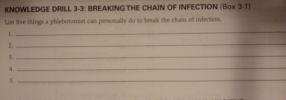 KNOWLEDGE DRILL 3-3: BREAKING THE CHAIN OF INFECTION (Box 3-1) List five things a phlebotomist can personally do to break the chain of infection. 4
Vector Control and Malaria: Explore how effective public health measures, such as bed nets and indoor...
Vector Control and Malaria: Explore how effective public health measures, such as bed nets and indoor spraying, can be controlling the spread of malaria by themselves and in combination with other measures. Include the successes and challenges of this measure in your response.
 One only needs to break one link in the chain of infection to
prevent the spread of disease. Which link do you think would be the
easiest to break to prevent the most recent influenza virus (H1N1)
and why?
CHAIN OF INFECTION Infectious Disease For an infection to develop, Reservoir Susceptible Host each link of the chain must be connected. Breaking any link of the chain Portal of Entry Portal of Exit can stop the transmission of infection! Mode of...
One only needs to break one link in the chain of infection to
prevent the spread of disease. Which link do you think would be the
easiest to break to prevent the most recent influenza virus (H1N1)
and why?
CHAIN OF INFECTION Infectious Disease For an infection to develop, Reservoir Susceptible Host each link of the chain must be connected. Breaking any link of the chain Portal of Entry Portal of Exit can stop the transmission of infection! Mode of...
 One only needs to break one
link in the chain of infection to prevent the spread of disease.
Which link do you think would be the easiest to break to prevent
the most recent influenza virus (H1N1) and why? Your answer must
include the name of a link on the chain and a reasonable
explanation for why that would work. Include how the flu is
transmitted. Be sure to cite and reference your sources. Note: Some
people refer to intestinal...
One only needs to break one
link in the chain of infection to prevent the spread of disease.
Which link do you think would be the easiest to break to prevent
the most recent influenza virus (H1N1) and why? Your answer must
include the name of a link on the chain and a reasonable
explanation for why that would work. Include how the flu is
transmitted. Be sure to cite and reference your sources. Note: Some
people refer to intestinal...
 Questions to Ask Yourself 1. How can you control the spread of infection when you provide care for a person with an open wound? 2. How can you spread infection if you have a cold? C 3. In the past, how have you possibly spread pathogens through direct and indirect contact? Think of three ways. 4. What will you do in the future to avoid spreading pathogens by direct and indirect contact? Think of three ways 5. Airborne precautions are...
 KNOWLEDGE DRILL 3-3: BREAKING THE CHAIN OF INFECTION (Box 3-1) List five things a phlebotomist can personally do to break the chain of infection. 4
Most questions answered within 3 hours.
-
Where is the error in this code sequence?
String s1 = "Hello";
String s2 = "ello";...
asked 11 months ago -
Financial data for Joel de Paris, Inc., for last year
follow:
Joel de Paris, Inc.
Balance...
asked 11 months ago -
Consider this reaction:
Al2(SO4)3 (aq)+ BaCl3
(aq) Al2Cl6 (aq)- +
3BaSO4(s) . What is the...
asked 11 months ago -
Suppose that Savneet is considering increasing her
recent random sample from 20 car rentals to 40...
asked 11 months ago -
Trucks arrive at an unloading terminal at an average rate of 120
per hour.
Trucks arrive...
asked 11 months ago -
Why are methanol and ethanol completely soluble in water while
octanol is not very little soluble....
asked 11 months ago -
A facilities manager at a university reads in a research report
that the mean amount of...
asked 11 months ago -
When the CuSO4 is rehydrated by adding water to the anhydrous
compound, is this an endothermic...
asked 11 months ago -
A ray of sunlight is passing from diamond into crown glass; the
angle of incidence is...
asked 11 months ago -
A block of mass 0.249 kg is placed on top of a light, vertical
spring of...
asked 11 months ago -
how do the kidneys compensate in the presences of acidosis
a) trigger hyperventilate
b) reserve acid...
asked 11 months ago -
Question 501 pts
The rental rate of capital to the firm increases. Which of the
following...
asked 11 months ago