
Homework Answers
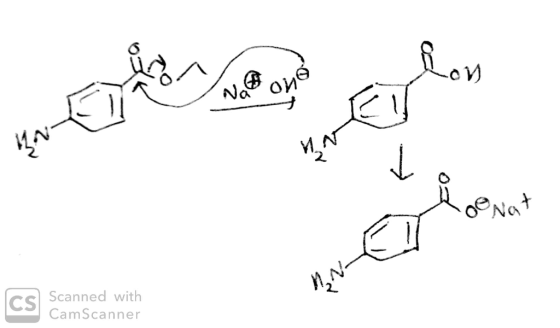
In presence of 5% NaOH, benzocaine undergo Hydrolysis to give p-aminobenzoic acid which become soluble in water. Thus, after addition of NaOH, benzocaine get Hydrolyzed and go in the aqueous layer hence organic layer is free from benzocaine.
Add Answer to:
8A student is given a solution of 20 ml. of ether, which contains benzoic acid and...
4What is the minimum required mass of NaOH that would be required to completely convert 121...
 4What is the minimum required mass of NaOH that would be required to completely convert 121 mL of methyl salicylate to salicylic acid? This question is not linked to the question above numerically. 5.Building on question 4, how many mL of 3M H2SO4 would be required to neutralize this solution? 6.0ne gram of salicylic acid dissolves in 460 mL of room temperature water, and in 15 mL of boiling water. What is the maximum percent recovery that can be achieved...
Extraction of benzoic acid and 9-fluorenone using diethyl ether. (please do not include ethyl 4- aminobenzoate)....
Extraction of benzoic acid and 9-fluorenone using diethyl ether. (please do not include ethyl 4- aminobenzoate). I have to create a flow chart to diagram the key steps of the experiment and isolation of products. 0.100g of benzoic acid and 9-fluorenone are dissolved in diethyl ether. The extraction solvent is 5% sodium hydroxide (to extract the acidic component from the organic phase). Saturated sodium chloride is added to the organic layer. drying the organic solution: anhydrous sodium sulfate is added...
8. In the Separation Project we started with a mixture of benzoic acid, benzhydrol, and anisole...
 8. In the Separation Project we started with a mixture of benzoic acid, benzhydrol, and anisole dissolved in diethyl ether он OCH3 он In a mixture of diethyl ether and 5% NaOH, which compound(s) would be in the ether layer, and which would be in the aqueous layer? Ether layer: Aqueous layer: If we separate the 5% NaOH layer, put it in a flask with 20 mL ether, and add 5% HCI till the pH reads 5, what is in...
Given: 50mL of solution diethyl ether solution containing 1.00g each of benzoic acid, phenol and aniline,50 mL of sodium...
Given: 50mL of solution diethyl ether solution containing 1.00g each of benzoic acid, phenol and aniline,50 mL of sodium bicarbonate solution, 50 ml of sodium hydroxide solution, sodium sulfate and HCl. 1. Which layer in the separatory funnel (top or bottom layer) is the organic layer during an extraction process? 2. Given that sodium bicarbonate and sodium hydroxide solution are 5% by weight, what would be the volume of 1M HCl needed to be added for acidification to crystalize the...
An unknown mixture (dissolved in diethyl ether) contains only 2 of the following : benzoic acid,...
An unknown mixture (dissolved in diethyl ether) contains only 2 of the following : benzoic acid, phenol, aniline and napthalene. You use the acid-base extraction method and want to identify the 2 compounds in your original mixture. 1) To separate the organic acid you add NaOH and to separate the organic base you add HCl.In both cases these extractions are followed by extractions with water. Why do we add water? Why is this step important? (A clear explanation please). 2)When...
1. In lab (seperating benzocaine and triphenylmethanol using diethyl ether and 10% HCl as extraction solvents...
1. In lab (seperating benzocaine and triphenylmethanol using diethyl ether and 10% HCl as extraction solvents ), the addition of 6M NaOH to the aqueous layer must be performed when the beaker is in an ice/water bath. why? 2. how do you test the pH of a solution using litmus paper in organic labs? 3. a student's solution violently bumped in their RBF while it was on the rotary evaporator. This has caused the student to loss most of their...
Experiment: A mixture of equal proportions of benzoic acid, ethyl 4-aminobenzoate, and 1,4-dimethoxybenzene are to be...
Experiment: A mixture of equal proportions of benzoic acid, ethyl 4-aminobenzoate, and 1,4-dimethoxybenzene are to be separated by extraction using the solvent diethyl ether. Day 1: Part A. Isolation of the basic component: In a small beaker, dissolve 3 g of the mixture (benzoic acid, ethyl 4-aminobenzoate, and 1,4-dimethoxybenzene) in 30 mL of diethyl ether and transfer the mixture to a 125- mL separatory funnel (see Fig. 1) using a little diethyl ether to complete the transfer. Add 10 mL...
13. A solution of naphthalene, aniline, and benzoic acid in CH;Cl2 is treated with aqueous NaOH....
 13. A solution of naphthalene, aniline, and benzoic acid in CH;Cl2 is treated with aqueous NaOH. What compound is extracted into the aqueous layer? NH2 он naphthalene benzoic acid aniline a. naphthalene b. aniline, as its sodium salt c. benzoic acid, as its sodium salt d. aniline and naphthalene 14. Which of the following Sy1 reactions did the Spartan program predict to have the lowest energy (AHrn, kcal/mol)? a. CH;CH;CH;CH;CI → CH;CHCH;CH, + Cr b. CH;CH;CHCICH3 CH;CH2CHCH, + Cr to...
TLC eluent for benzophenone. I am doing a lab that involved purifying benzophenone that contains traces...
TLC eluent for benzophenone. I am doing a lab that involved purifying benzophenone that contains traces of benzoic acid. I will be dissolving the impure sample of benzophenone with diethyl ether first, then NaOh, then separating the layers. I will then take the organic layer and wash with NaOH again, then wash with water. After recrystallizing the product and drying the product, what will i use as an eluent for the TLC chamber? I am going to run a TLC...
The Separation of Three Organic Compounds by Acid, Base Reactions and Liquid, Liquid Extraction. Okay, so...
The Separation of Three Organic Compounds by Acid, Base Reactions and Liquid, Liquid Extraction. Okay, so we had solid benzoic acid, ethyl 4- aminobenzoate, and 9-fluorenone all dissolved in diethyl ether. We separated the basic component by adding 3M HCl, we separated the acidic component by adding 3M NaOH. I don't understand what happens here. To isolate the acidic solution, we added 6 M NaOH and used the vacuum to recover the solid. To isolate the basic solution we added...
 4What is the minimum required mass of NaOH that would be required to completely convert 121 mL of methyl salicylate to salicylic acid? This question is not linked to the question above numerically. 5.Building on question 4, how many mL of 3M H2SO4 would be required to neutralize this solution? 6.0ne gram of salicylic acid dissolves in 460 mL of room temperature water, and in 15 mL of boiling water. What is the maximum percent recovery that can be achieved...
 8. In the Separation Project we started with a mixture of benzoic acid, benzhydrol, and anisole dissolved in diethyl ether он OCH3 он In a mixture of diethyl ether and 5% NaOH, which compound(s) would be in the ether layer, and which would be in the aqueous layer? Ether layer: Aqueous layer: If we separate the 5% NaOH layer, put it in a flask with 20 mL ether, and add 5% HCI till the pH reads 5, what is in...
 13. A solution of naphthalene, aniline, and benzoic acid in CH;Cl2 is treated with aqueous NaOH. What compound is extracted into the aqueous layer? NH2 он naphthalene benzoic acid aniline a. naphthalene b. aniline, as its sodium salt c. benzoic acid, as its sodium salt d. aniline and naphthalene 14. Which of the following Sy1 reactions did the Spartan program predict to have the lowest energy (AHrn, kcal/mol)? a. CH;CH;CH;CH;CI → CH;CHCH;CH, + Cr b. CH;CH;CHCICH3 CH;CH2CHCH, + Cr to...
Most questions answered within 3 hours.
-
Where is the error in this code sequence?
String s1 = "Hello";
String s2 = "ello";...
asked 11 months ago -
Financial data for Joel de Paris, Inc., for last year
follow:
Joel de Paris, Inc.
Balance...
asked 11 months ago -
Consider this reaction:
Al2(SO4)3 (aq)+ BaCl3
(aq) Al2Cl6 (aq)- +
3BaSO4(s) . What is the...
asked 11 months ago -
Suppose that Savneet is considering increasing her
recent random sample from 20 car rentals to 40...
asked 11 months ago -
Trucks arrive at an unloading terminal at an average rate of 120
per hour.
Trucks arrive...
asked 11 months ago -
Why are methanol and ethanol completely soluble in water while
octanol is not very little soluble....
asked 11 months ago -
A facilities manager at a university reads in a research report
that the mean amount of...
asked 11 months ago -
When the CuSO4 is rehydrated by adding water to the anhydrous
compound, is this an endothermic...
asked 11 months ago -
A ray of sunlight is passing from diamond into crown glass; the
angle of incidence is...
asked 11 months ago -
A block of mass 0.249 kg is placed on top of a light, vertical
spring of...
asked 11 months ago -
how do the kidneys compensate in the presences of acidosis
a) trigger hyperventilate
b) reserve acid...
asked 11 months ago -
Question 501 pts
The rental rate of capital to the firm increases. Which of the
following...
asked 11 months ago