1. How is a force related to a load? Give four examples of loads AND how...
1. How is a force related to a load? Give four examples of loads AND how to strengthen a structure in response to that load.
Homework Answers
Load is a term frequently used in engineering to mean the force exerted on a surface or body.
- force is the dynamic load { force= mass× acceleration} and it can act in any direction.
- on the other hand, load is a static load { F= mg} and it can act only in downward direction'
1. Dead loads are permanent loads which are carried to the structure throughout their lifespan. Dead loads are also called as stationary loads.
2.Live loads are also called as imposed or sudden loads. Live loads changes with respect to time.
3.This type of loads is considered only on the structure which receives snowfall during monsoon
4. This types of loads are considered in design if the height of the building is more than 15m. Wind loads are occurred due to the horizontal load caused by the wind
we can place an additional “bonded” reinforced concrete to an existing structural member in the form of an overlay or a jacket. With section enlargement, columns, beams, slabs, and walls can be enlarged to increase their load-carrying capacity or stiffness.
Add Answer to:
1. How is a force related to a load? Give four examples of loads
AND how...
1. Give examples of agonistic behavior related to seasame fighting fish. 2. How is seasame fighting...
1. Give examples of agonistic behavior related to seasame fighting fish. 2. How is seasame fighting fish an example of fixed action pattern?
Describe how the DNS is fault-tolerant and promotes load balancing. Give examples of other types of...
Describe how the DNS is fault-tolerant and promotes load balancing. Give examples of other types of information systems that might need to be fault-tolerant and offer load balancing. Why? Please summarize.
1.Four loads are fixed at the vertices of a perfect square, as shown in figure 1....
1.Four loads are fixed at the vertices of a perfect square, as shown in figure 1. Calculate the magnitude and direction of the force in each of the loads. Calculate the force (magnitude and direction) felt by a positive test load of 4.15mC just in the center of the square. Note that mC means micro Coulombs (1x10⁻³C). 2.Two charges, q1 = 25C and q2 = -5C, are separated by a distance of 2cm. Find the position (or positions) along that...
A generator is supplying two loads at 2800V and 60 Hz. The loads are: Load 1:...
 A generator is supplying two loads at 2800V and 60 Hz. The loads are: Load 1: 10 kVA, at 0.6 pf lagging. Load 2: 12 kW and 10 KVAR inductive a. Calculate the total active and reactive power, and the power factor of the load. S- S, - ST- Pr- PF-
The three loads in the circuit in the figure can be described as follows: Load 1...
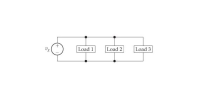 The three loads in the circuit in the figure can be described as
follows: Load 1 is a 230 Ω resistor in series with an inductive
reactance of 90 Ω ; load 2 is a capacitive reactance of 140 Ω in
series with a 140 Ω resistor; and load 3 is a 50 Ω resistor in
series with a capacitive reactance of 40 Ω . The frequency of the
voltage source is 60 Hz.
Part G: Give the power factor...
The three loads in the circuit in the figure can be described as
follows: Load 1 is a 230 Ω resistor in series with an inductive
reactance of 90 Ω ; load 2 is a capacitive reactance of 140 Ω in
series with a 140 Ω resistor; and load 3 is a 50 Ω resistor in
series with a capacitive reactance of 40 Ω . The frequency of the
voltage source is 60 Hz.
Part G: Give the power factor...
Chemically, how does soap work to remove grease? Give some other related examples.
Chemically, how does soap work to remove grease? Give some other related examples.
Chemically, how does soap work to remove grease? Give some other related examples.
Chemically, how does soap work to remove grease? Give some other related examples.
1.) be able to give examples of control in transaction test for detecting the statement related...
1.) be able to give examples of control in transaction test for detecting the statement related to sales and shipments. 2.) Be able to give examples of control in transaction test for completeness and accuracy in cash receipts journal.
For the load depicted below, to use super position how would the loads be divided? What boundary ...
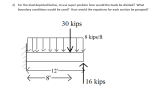 For the load depicted below, to use super position how would the loads be divided? What boundary conditions would be used? How would the equations for each section be grouped? 2) 30 kips 18 kips/ft 12 8'--> 1 16 kips
For the load depicted below, to use super position how would the loads be divided? What boundary conditions would be used? How would the equations for each section be grouped? 2) 30 kips 18 kips/ft 12 8'--> 1 16 kips
For the load depicted below, to use super position how would the loads be divided? What boundary conditions would be used? How would the equations for each section be grouped? 2) 30 kips 18 kips/ft 12 8'--> 1 16 kips
10. If the net force on a system is zero, is the net force also zero? Give examples 11. If the net take on a system is zero, the net force is equal to zero? Give examples
10. If the net force on a system is zero, is the net force also zero? Give examples 11. If the net take on a system is zero, the net force is equal to zero? Give examples
 A generator is supplying two loads at 2800V and 60 Hz. The loads are: Load 1: 10 kVA, at 0.6 pf lagging. Load 2: 12 kW and 10 KVAR inductive a. Calculate the total active and reactive power, and the power factor of the load. S- S, - ST- Pr- PF-
 The three loads in the circuit in the figure can be described as
follows: Load 1 is a 230 Ω resistor in series with an inductive
reactance of 90 Ω ; load 2 is a capacitive reactance of 140 Ω in
series with a 140 Ω resistor; and load 3 is a 50 Ω resistor in
series with a capacitive reactance of 40 Ω . The frequency of the
voltage source is 60 Hz.
Part G: Give the power factor...
The three loads in the circuit in the figure can be described as
follows: Load 1 is a 230 Ω resistor in series with an inductive
reactance of 90 Ω ; load 2 is a capacitive reactance of 140 Ω in
series with a 140 Ω resistor; and load 3 is a 50 Ω resistor in
series with a capacitive reactance of 40 Ω . The frequency of the
voltage source is 60 Hz.
Part G: Give the power factor...
 For the load depicted below, to use super position how would the loads be divided? What boundary conditions would be used? How would the equations for each section be grouped? 2) 30 kips 18 kips/ft 12 8'--> 1 16 kips
For the load depicted below, to use super position how would the loads be divided? What boundary conditions would be used? How would the equations for each section be grouped? 2) 30 kips 18 kips/ft 12 8'--> 1 16 kips
For the load depicted below, to use super position how would the loads be divided? What boundary conditions would be used? How would the equations for each section be grouped? 2) 30 kips 18 kips/ft 12 8'--> 1 16 kips
Most questions answered within 3 hours.
-
Where is the error in this code sequence?
String s1 = "Hello";
String s2 = "ello";...
asked 10 months ago -
Financial data for Joel de Paris, Inc., for last year
follow:
Joel de Paris, Inc.
Balance...
asked 10 months ago -
Consider this reaction:
Al2(SO4)3 (aq)+ BaCl3
(aq) Al2Cl6 (aq)- +
3BaSO4(s) . What is the...
asked 10 months ago -
Suppose that Savneet is considering increasing her
recent random sample from 20 car rentals to 40...
asked 10 months ago -
Trucks arrive at an unloading terminal at an average rate of 120
per hour.
Trucks arrive...
asked 10 months ago -
Why are methanol and ethanol completely soluble in water while
octanol is not very little soluble....
asked 10 months ago -
A facilities manager at a university reads in a research report
that the mean amount of...
asked 10 months ago -
When the CuSO4 is rehydrated by adding water to the anhydrous
compound, is this an endothermic...
asked 10 months ago -
A ray of sunlight is passing from diamond into crown glass; the
angle of incidence is...
asked 10 months ago -
A block of mass 0.249 kg is placed on top of a light, vertical
spring of...
asked 10 months ago -
how do the kidneys compensate in the presences of acidosis
a) trigger hyperventilate
b) reserve acid...
asked 10 months ago -
Question 501 pts
The rental rate of capital to the firm increases. Which of the
following...
asked 10 months ago