
Homework Answers
Add Answer to:
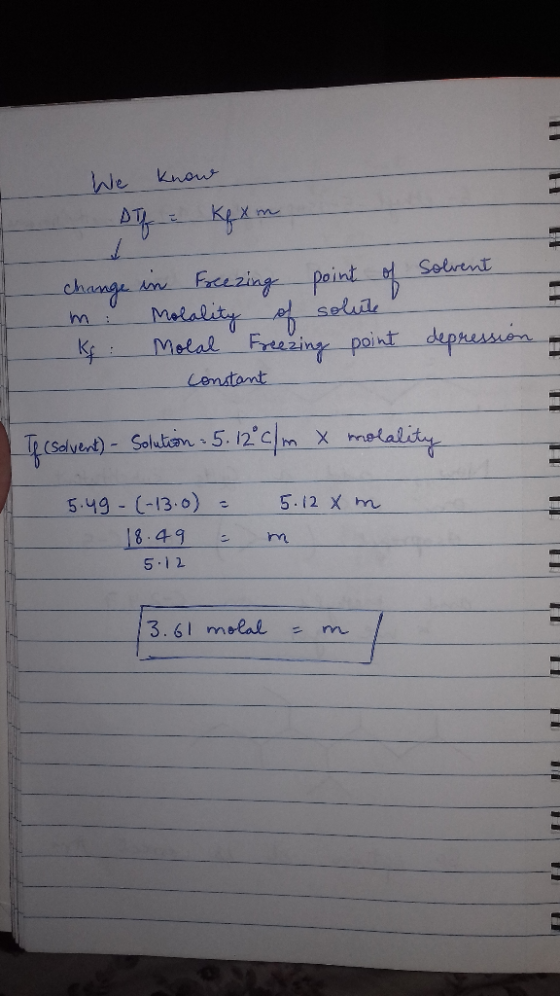
The freezing point of pure benzene is 5.49 °C. The freezing point of a solution made...
What is the freezing point (in K) of a solution made by dissolving 19.831g of CCl4...
What is the freezing point (in K) of a solution made by dissolving 19.831g of CCl4 in 130.0 g of benzene? Pure benzene has a freezing point of 5.5°C and a Kf = 5.12 °C/m. Write your answer in Kelvin with 4 sig figs!
the freezing point of pure benzene is 5.50°C. A student determines that a solution containing 50.0g...
 the freezing point of pure benzene is 5.50°C. A
student determines that a solution containing 50.0g benzene
and.180g of a non-electrolyte has a freezing point of 5.15°C.
Calculate the molality of the non-electrolyte if the freezing point
constant for benzene is 5.10°C/m
The freezing point of pure benzene is 5.50°C. A student determines that a solution containing 50.0 q benzene and 0.180 g of a non-electrolyte has a freezing point of 5.15 °C. Calculate the molality of the non-electrolyte if...
the freezing point of pure benzene is 5.50°C. A
student determines that a solution containing 50.0g benzene
and.180g of a non-electrolyte has a freezing point of 5.15°C.
Calculate the molality of the non-electrolyte if the freezing point
constant for benzene is 5.10°C/m
The freezing point of pure benzene is 5.50°C. A student determines that a solution containing 50.0 q benzene and 0.180 g of a non-electrolyte has a freezing point of 5.15 °C. Calculate the molality of the non-electrolyte if...
A solution made by dissolving 150.0 g of an unknown compound in 425.0 mL of benzene...
A solution made by dissolving 150.0 g of an unknown compound in 425.0 mL of benzene to make a solution which has a freezing point 18.6 °C lower than that of pure benzene. Kf for benzene is 5.12 °C/m and the density of benzene is 0.877 g/mL. b) The molality of the solution is 3.63. How many moles of the unknown compound were dissolved in the solution? C) what is the molar mass of the unknown compound?
The freezing point of benzene, C6H6, is 5.50°C at 1 atmosphere. A nonvolatile, nonelectrolyte that dissolves...
The freezing point of benzene, C6H6, is 5.50°C at 1 atmosphere. A nonvolatile, nonelectrolyte that dissolves in benzene is DDT . A student dissolves 14.18 grams of DDT, C14H9Cl5 (354.5 g/mol), in 159.0 grams of benzene. Use the table of boiling and freezing point constants to answer the questions below. Solvent Formula Kb (°C/m) Kf (°C/m) Water H2O 0.512 1.86 Ethanol CH3CH2OH 1.22 1.99 Chloroform CHCl3 3.67 Benzene C6H6 2.53 5.12 Diethyl ether CH3CH2OCH2CH3 2.02 The molality of the solution...
In one experiment, a student compares the freezing point (6.5 oC) of a pure solvent to...
In one experiment, a student compares the freezing point (6.5 oC) of a pure solvent to the freezing point (1.1oC) of the solvent with a solute. If the kf of the solvent is 5.12 oC/m, what is the molality of the solvent with solute solution?
A solution is made by dissolving 0.585 mol of nonelectrolyte solute in 877 g of benzene....
A solution is made by dissolving 0.585 mol of nonelectrolyte solute in 877 g of benzene. Calculate the freezing point, Tf, and boiling point, Tb, of the solution. Constants can be found in the table of colligative constants. Constants for freezing-point depression and boiling-point elevation calculations at 1 atm: Solvent Formula Kf value* (°C/m) Normal freezing point (°C) Kb value (°C/m) Normal boiling point (°C) water H2O 1.86 0.00 0.512 100.00 benzene C6H6 5.12 5.49 2.53 80.1 cyclohexane C6H12 20.8...
A nonvolatile, non-dissociating solute was dissolved in 12.0 g of benzene (C6H6). The freezing point of...
A nonvolatile, non-dissociating solute was dissolved in 12.0 g of benzene (C6H6). The freezing point of the solution was measured as 1.3 °C, while pure benzene freezes at 5.5 °C. If pure benzene has a vapor pressure of 75 torr, what is the vapor pressure of this solution. For benzene, Kf = 5.12 °C/m and Kb = 2.53 °C/m.
What is the freezing point of a solution of 12.8 g of C10H8 dissolved in 500...
What is the freezing point of a solution of 12.8 g of C10H8 dissolved in 500 g of benzene? The normal freezing point of pure benzene is 5.48 oC and its Kf is 5.12 oC/m.
The freezing point of benzene, C6H6, is 5.500 °C at 1 atmosphere. Kf(benzene) = 5.12 °C/m In...
The freezing point of benzene, C6H6, is 5.500 °C at 1 atmosphere. Kf(benzene) = 5.12 °C/m In a laboratory experiment, students synthesized a new compound and found that when 12.69 grams of the compound were dissolved in 242.9 grams of benzene, the solution began to freeze at 4.745 °C. The compound was also found to be nonvolatile and a non-electrolyte. What is the molecular weight they determined for this compound? __?__ g/mol
The freezing point of benzene, C6H6, is 5.500 °C at 1 atmosphere. Kf(benzene) = 5.12 °C/m In a laboratory ex...
The freezing point of benzene, C6H6, is 5.500 °C at 1 atmosphere. Kf(benzene) = 5.12 °C/m In a laboratory experiment, students synthesized a new compound and found that when 11.70 grams of the compound were dissolved in 269.8 grams of benzene, the solution began to freeze at 4.730 °C. The compound was also found to be nonvolatile and a non-electrolyte. What is the molecular weight they determined for this compound? ___?___ g/mol
 the freezing point of pure benzene is 5.50°C. A
student determines that a solution containing 50.0g benzene
and.180g of a non-electrolyte has a freezing point of 5.15°C.
Calculate the molality of the non-electrolyte if the freezing point
constant for benzene is 5.10°C/m
The freezing point of pure benzene is 5.50°C. A student determines that a solution containing 50.0 q benzene and 0.180 g of a non-electrolyte has a freezing point of 5.15 °C. Calculate the molality of the non-electrolyte if...
the freezing point of pure benzene is 5.50°C. A
student determines that a solution containing 50.0g benzene
and.180g of a non-electrolyte has a freezing point of 5.15°C.
Calculate the molality of the non-electrolyte if the freezing point
constant for benzene is 5.10°C/m
The freezing point of pure benzene is 5.50°C. A student determines that a solution containing 50.0 q benzene and 0.180 g of a non-electrolyte has a freezing point of 5.15 °C. Calculate the molality of the non-electrolyte if...
Most questions answered within 3 hours.
-
Where is the error in this code sequence?
String s1 = "Hello";
String s2 = "ello";...
asked 11 months ago -
Financial data for Joel de Paris, Inc., for last year
follow:
Joel de Paris, Inc.
Balance...
asked 11 months ago -
Consider this reaction:
Al2(SO4)3 (aq)+ BaCl3
(aq) Al2Cl6 (aq)- +
3BaSO4(s) . What is the...
asked 11 months ago -
Suppose that Savneet is considering increasing her
recent random sample from 20 car rentals to 40...
asked 11 months ago -
Trucks arrive at an unloading terminal at an average rate of 120
per hour.
Trucks arrive...
asked 11 months ago -
Why are methanol and ethanol completely soluble in water while
octanol is not very little soluble....
asked 11 months ago -
A facilities manager at a university reads in a research report
that the mean amount of...
asked 11 months ago -
When the CuSO4 is rehydrated by adding water to the anhydrous
compound, is this an endothermic...
asked 11 months ago -
A ray of sunlight is passing from diamond into crown glass; the
angle of incidence is...
asked 11 months ago -
A block of mass 0.249 kg is placed on top of a light, vertical
spring of...
asked 11 months ago -
how do the kidneys compensate in the presences of acidosis
a) trigger hyperventilate
b) reserve acid...
asked 11 months ago -
Question 501 pts
The rental rate of capital to the firm increases. Which of the
following...
asked 11 months ago