
Homework Answers
Answer : preferred stockholders
When company goes into liquidation, first secured debt holders are paid, then creditors, then preferred stock holders and then common stock holders.
So preferred stock holders are paid prior to common stock holders but after payment to debt holders and creditors [Thumbs up please]
Add Answer to:
Question 3 2 pts A corporation's investors in this type of equity instrument must get paid...
Question 3 3. Which of the following investors will get paid first when the issuing company...
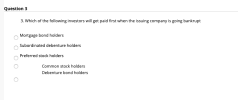 Question 3 3. Which of the following investors will get paid first when the issuing company is going bankrupt Mortgage bond holders 0 Subordinated debenture holders 0 Preferred stock holders OOO Common stock holders Debenture bond holders
Question 3 0.4 pts Which of the following is NOT a part of stockholders' equity? The...
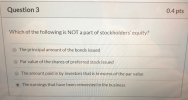 Question 3 0.4 pts Which of the following is NOT a part of stockholders' equity? The principal amount of the bonds issued Par value of the shares of preferred stock issued The amount paid in by investors that is in excess of the par value The earnings that have been reinvested in the business
E15.17 (LO 4) (Stockholders' Equity Section) Bruno Corporation's post-closing trial balance at December 31, 2020, is...
 E15.17 (LO 4) (Stockholders' Equity Section) Bruno Corporation's post-closing trial balance at December 31, 2020, is shown as follows. Bruno Corporation Post-Closing Trial Balance December 31, 2020 Dr. Cr. $ 310,000 $ 480,000 185,000 Accounts payable Accounts receivable Accumulated depreciation-buildings Additional paid-in capital in excess of par-common From treasury stock 1,300,000 160,000 Dr. Cr. 30,000 300,000 1,450,000 190,000 200,000 4,000 Allowance for doubtful accounts Bonds payable Buildings Cash Common stock ($1 par) Dividends payable (preferred stock-cash) Inventory Land Preferred stock...
PLEASE EXPLAIN HOW TO GET THE ANSWER TO THE LAST QUESTION. Consider the case of Turnbull...
 PLEASE EXPLAIN HOW TO GET THE ANSWER TO THE LAST QUESTION.
Consider the case of Turnbull Co. Turnbull Co. has a target capital structure of 58% debt, If its current tax rate is 40%, how much higher will 6% preferred stock, and 36% common equity. It has a Turnbull's weighted average cost of capital (WACC) be if before-tax cost of debt of 11.1%, and its cost of it has to raise additional common equity capital by preferred stock is 12.2%....
PLEASE EXPLAIN HOW TO GET THE ANSWER TO THE LAST QUESTION.
Consider the case of Turnbull Co. Turnbull Co. has a target capital structure of 58% debt, If its current tax rate is 40%, how much higher will 6% preferred stock, and 36% common equity. It has a Turnbull's weighted average cost of capital (WACC) be if before-tax cost of debt of 11.1%, and its cost of it has to raise additional common equity capital by preferred stock is 12.2%....
Investors generally finance their investment opportunities (assets) with a combination of loans (debt) and equity shareholders....
Investors generally finance their investment opportunities (assets) with a combination of loans (debt) and equity shareholders. Suppose owner Alex, as a CEO, purchases an asset (e.g., property real estate) expected to go up in value. Instead of paying full price, Alex finances the asset with a loan from Carter Bank and with cash from two college friends, Sam and Chris. Sam wants to invest without having to worry about daily operations and is happy to be a preferred shareholder (PS)...
Agree or Disagree and Why? Question: overview of financial instruments including but not limited to stocks,...
Agree or Disagree and Why? Question: overview of financial instruments including but not limited to stocks, bonds, and derivative securities – i.e., securities that “derive” their value from other securities (examples include options, futures, swaps, etc.). Emphasis is also placed on the securities markets. How the bond market works. The bond market is where investors go to trade (buy and sell) debt securities, prominently bonds, which may be issued by corporations or governments. It is also known as the debt...
Becket Corporation's accountant has prepared the following balance sheet as of November 10, 2017, the date...
 Becket Corporation's accountant has prepared the following balance sheet as of November 10, 2017, the date on which the company is to release a plan for reorganizing operations under Chapter 11 of the Bankruptcy Reform Act: BECKET CORPORATION Balance Sheet November 10, 2017 Assets Cash $ 24,000 Accounts receivable (net) 73,000 Investments 38,000 Inventory (net realizable value is expected to approximate 600 of cost) 92,000 Land 69,000 Buildings (net) 260,000 Equipment (net) 141,000 Total assets $ 697,000 Liabilities and Equities...
Question 1 3 pts Winston Corporation is evaluating a new project that will require an increase...
 Question 1 3 pts Winston Corporation is evaluating a new project that will require an increase in accounts receivable of $80,000, an increase in inventory of $250,000, and an increase in accounts payable of $160,000. The change in networking capital for this project will be: $330,000 $170,000 +$170,000 -$490,000 MACRS Depreciation Allowances Property Class Year 3-Year 5-Year 7-Year 33.33% 20.00% 14.29% 44.45 32.00 24.49 14.81 19.20 17.49 11.52 12.49 11.52 8.93 5.76 8.92 7.41 8.93 4.46 Question 2 3 pts...
please answer the following multiple choice Which of the following is the amount the borrower must...
 please answer the following multiple choice
Which of the following is the amount the borrower must pay back to the bondholders? 7 A) Market value B) Present value C) Stated interest value D) Principal amount 8. Which of the following describes the term maturity date? A) The date on which each interest payment is made B) The date on which the bond is issued C) The date on which the principal amount is repaid to the bondholder D) The date...
please answer the following multiple choice
Which of the following is the amount the borrower must pay back to the bondholders? 7 A) Market value B) Present value C) Stated interest value D) Principal amount 8. Which of the following describes the term maturity date? A) The date on which each interest payment is made B) The date on which the bond is issued C) The date on which the principal amount is repaid to the bondholder D) The date...
Which of the following does not accurately describe Total Stockholder’s Equity? Represents the portion of business...
Which of the following does not accurately describe Total Stockholder’s Equity? Represents the portion of business assets not claimed by creditors Represents the value of ownership for stockholders Includes common stock and retained earnings Represents how much capital has been generated through issuance of stock All of the following accurately describe retained earnings except… The portion of total equity that is earned through profitable operations The accumulation of undistributed net income The portion of equity that is generated through issuing...
 Question 3 3. Which of the following investors will get paid first when the issuing company is going bankrupt Mortgage bond holders 0 Subordinated debenture holders 0 Preferred stock holders OOO Common stock holders Debenture bond holders
 Question 3 0.4 pts Which of the following is NOT a part of stockholders' equity? The principal amount of the bonds issued Par value of the shares of preferred stock issued The amount paid in by investors that is in excess of the par value The earnings that have been reinvested in the business
 E15.17 (LO 4) (Stockholders' Equity Section) Bruno Corporation's post-closing trial balance at December 31, 2020, is shown as follows. Bruno Corporation Post-Closing Trial Balance December 31, 2020 Dr. Cr. $ 310,000 $ 480,000 185,000 Accounts payable Accounts receivable Accumulated depreciation-buildings Additional paid-in capital in excess of par-common From treasury stock 1,300,000 160,000 Dr. Cr. 30,000 300,000 1,450,000 190,000 200,000 4,000 Allowance for doubtful accounts Bonds payable Buildings Cash Common stock ($1 par) Dividends payable (preferred stock-cash) Inventory Land Preferred stock...
 PLEASE EXPLAIN HOW TO GET THE ANSWER TO THE LAST QUESTION.
Consider the case of Turnbull Co. Turnbull Co. has a target capital structure of 58% debt, If its current tax rate is 40%, how much higher will 6% preferred stock, and 36% common equity. It has a Turnbull's weighted average cost of capital (WACC) be if before-tax cost of debt of 11.1%, and its cost of it has to raise additional common equity capital by preferred stock is 12.2%....
PLEASE EXPLAIN HOW TO GET THE ANSWER TO THE LAST QUESTION.
Consider the case of Turnbull Co. Turnbull Co. has a target capital structure of 58% debt, If its current tax rate is 40%, how much higher will 6% preferred stock, and 36% common equity. It has a Turnbull's weighted average cost of capital (WACC) be if before-tax cost of debt of 11.1%, and its cost of it has to raise additional common equity capital by preferred stock is 12.2%....
 Becket Corporation's accountant has prepared the following balance sheet as of November 10, 2017, the date on which the company is to release a plan for reorganizing operations under Chapter 11 of the Bankruptcy Reform Act: BECKET CORPORATION Balance Sheet November 10, 2017 Assets Cash $ 24,000 Accounts receivable (net) 73,000 Investments 38,000 Inventory (net realizable value is expected to approximate 600 of cost) 92,000 Land 69,000 Buildings (net) 260,000 Equipment (net) 141,000 Total assets $ 697,000 Liabilities and Equities...
 Question 1 3 pts Winston Corporation is evaluating a new project that will require an increase in accounts receivable of $80,000, an increase in inventory of $250,000, and an increase in accounts payable of $160,000. The change in networking capital for this project will be: $330,000 $170,000 +$170,000 -$490,000 MACRS Depreciation Allowances Property Class Year 3-Year 5-Year 7-Year 33.33% 20.00% 14.29% 44.45 32.00 24.49 14.81 19.20 17.49 11.52 12.49 11.52 8.93 5.76 8.92 7.41 8.93 4.46 Question 2 3 pts...
 please answer the following multiple choice
Which of the following is the amount the borrower must pay back to the bondholders? 7 A) Market value B) Present value C) Stated interest value D) Principal amount 8. Which of the following describes the term maturity date? A) The date on which each interest payment is made B) The date on which the bond is issued C) The date on which the principal amount is repaid to the bondholder D) The date...
please answer the following multiple choice
Which of the following is the amount the borrower must pay back to the bondholders? 7 A) Market value B) Present value C) Stated interest value D) Principal amount 8. Which of the following describes the term maturity date? A) The date on which each interest payment is made B) The date on which the bond is issued C) The date on which the principal amount is repaid to the bondholder D) The date...
Most questions answered within 3 hours.
-
Where is the error in this code sequence?
String s1 = "Hello";
String s2 = "ello";...
asked 11 months ago -
Financial data for Joel de Paris, Inc., for last year
follow:
Joel de Paris, Inc.
Balance...
asked 11 months ago -
Consider this reaction:
Al2(SO4)3 (aq)+ BaCl3
(aq) Al2Cl6 (aq)- +
3BaSO4(s) . What is the...
asked 11 months ago -
Suppose that Savneet is considering increasing her
recent random sample from 20 car rentals to 40...
asked 11 months ago -
Trucks arrive at an unloading terminal at an average rate of 120
per hour.
Trucks arrive...
asked 11 months ago -
Why are methanol and ethanol completely soluble in water while
octanol is not very little soluble....
asked 11 months ago -
A facilities manager at a university reads in a research report
that the mean amount of...
asked 11 months ago -
When the CuSO4 is rehydrated by adding water to the anhydrous
compound, is this an endothermic...
asked 11 months ago -
A ray of sunlight is passing from diamond into crown glass; the
angle of incidence is...
asked 11 months ago -
A block of mass 0.249 kg is placed on top of a light, vertical
spring of...
asked 11 months ago -
how do the kidneys compensate in the presences of acidosis
a) trigger hyperventilate
b) reserve acid...
asked 11 months ago -
Question 501 pts
The rental rate of capital to the firm increases. Which of the
following...
asked 11 months ago