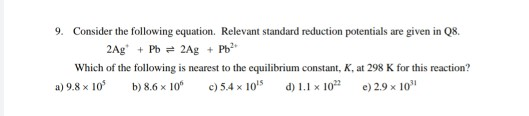
Hi. can some one please explain me the solution for
this question. the correct answer is E. thanks
Homework Answers
from data table:
Eo(Pb2+/Pb(s)) = -0.126 V
Eo(Ag+/Ag(s)) = 0.7996 V
As per given reaction/cell notation,
cathode is (Ag+/Ag(s))
anode is (Pb2+/Pb(s))
Eocell = Eocathode - Eoanode
= (0.7996) - (-0.126)
= 0.9256 V
here, number of electrons being transferred, n = 2
Eo = (2.303*R*T)/(n*F) log Kc
At 25 oC or 298 K, R*T/F = 0.0592
So, Eo = (0.0592/n)*log Kc
0.9256 = (0.0592/2)*log Kc
log Kc = 31.2703
Kc = 1.9*10^31
Answer: e
Add Answer to:
Hi. can some one please explain me the solution for
this question. the correct answer is...
Hi. can some one please explain me the solution for this question. the correct answer is...
 Hi. can some one please explain me the solution for
this question. the correct answer is A. thanks.
9. Consider the following equation. Cr + 3VO2 + 6H* = Cr3+ + 3VO2+ + 3H20 E° = 1.74 V Which of the following is nearest to the equilibrium constant, K, at 300 K for this reaction? a) 5.0 x 1087 b) 1.9 x 1088 c) 5.5 x 1095 d) 1.7 x 1029 e) 2.7 x 1029
Hi. can some one please explain me the solution for
this question. the correct answer is A. thanks.
9. Consider the following equation. Cr + 3VO2 + 6H* = Cr3+ + 3VO2+ + 3H20 E° = 1.74 V Which of the following is nearest to the equilibrium constant, K, at 300 K for this reaction? a) 5.0 x 1087 b) 1.9 x 1088 c) 5.5 x 1095 d) 1.7 x 1029 e) 2.7 x 1029
Hi. can some one please explain me the solution for this question. the correct answer is...
 Hi. can some one please explain me the solution for
this question. the correct answer is C. thanks.
8. Consider the following galvanic cell and standard reduction potentials: Ag (aq) + e → Ag(s) E=0.80 V Pb²+ (aq) + 2e → Pb(s) E = -0.13 V IMA Which one of the following statements is TRUE? a) The cell on the left containing Ag (aq) is the anode. b) The initial reading on the voltmeter would be 0.67 V. c) Oxidation...
Hi. can some one please explain me the solution for
this question. the correct answer is C. thanks.
8. Consider the following galvanic cell and standard reduction potentials: Ag (aq) + e → Ag(s) E=0.80 V Pb²+ (aq) + 2e → Pb(s) E = -0.13 V IMA Which one of the following statements is TRUE? a) The cell on the left containing Ag (aq) is the anode. b) The initial reading on the voltmeter would be 0.67 V. c) Oxidation...
Hi. can some one please explain me the solution for this question. the correct answer is C. thanks. 5. The K for bar...
 Hi. can some one please explain me the solution for
this question. the correct answer is C. thanks.
5. The K for barium sulfate is 1.1 x 10 at 25°C. What is the solubility of barium sulfate (in mol L') in 0.1 Miron(III) sulfate solution? a) 1.1 x 10 b) 2.2 x 10" c) 3.7 x 10 d) 5.5 x 10" e) 10 x 10
Hi. can some one please explain me the solution for
this question. the correct answer is C. thanks.
5. The K for barium sulfate is 1.1 x 10 at 25°C. What is the solubility of barium sulfate (in mol L') in 0.1 Miron(III) sulfate solution? a) 1.1 x 10 b) 2.2 x 10" c) 3.7 x 10 d) 5.5 x 10" e) 10 x 10
Hi. can some one please explain me the solution for this question. the correct answer is...
 Hi. can some one please explain me the solution for
this question. the correct answer is B. thanks.
8. Consider the following concentration cell. Ag (aq) + e → Ag(s) E = 0.80 V 0.1 M Ag Which one of the following statements is TRUE? a) The electrode on the left containing 1 M Ag (aq) is the anode. b) Equilibrium occurs when the [Ag (aq) in both cells is equal. c) The initial reading on the voltmeter would be...
Hi. can some one please explain me the solution for
this question. the correct answer is B. thanks.
8. Consider the following concentration cell. Ag (aq) + e → Ag(s) E = 0.80 V 0.1 M Ag Which one of the following statements is TRUE? a) The electrode on the left containing 1 M Ag (aq) is the anode. b) Equilibrium occurs when the [Ag (aq) in both cells is equal. c) The initial reading on the voltmeter would be...
Hi. can some one please explain me the solution for this question. the correct answer is...
 Hi. can some one please explain me the solution for
this question. the correct answer is D. thanks.
The Ksp for silver chloride is 1.8 x 101 at 25 "C. What is the solubility of silver chloride (in mol L) in 0.025 M tin(IV) chloride solution? 5. a) 8.5 x 10 b) 6.7 x 10 d) 18 x 10 c) 7.2 x 10 e) 1.3 x 10
Hi. can some one please explain me the solution for
this question. the correct answer is D. thanks.
The Ksp for silver chloride is 1.8 x 101 at 25 "C. What is the solubility of silver chloride (in mol L) in 0.025 M tin(IV) chloride solution? 5. a) 8.5 x 10 b) 6.7 x 10 d) 18 x 10 c) 7.2 x 10 e) 1.3 x 10
Hi. can some one please explain me the solution for this question. the correct answer is A. thanks. 6. What is the c...
 Hi. can some one please explain me the solution for
this question. the correct answer is A. thanks.
6. What is the concentration of Co(aq) ions in the solution made by adding water to cobalt(II) nitrate (0.50 mol) and ethylenediamine (3.0 mol) so that the final volume of solution is 3.0 L? The Kb of Co(en)31 is 1.0 x 10¹⁴ a) 1.3 x 10M b) 1.5 x 10 M c) 2.9 x 10-'M d) 3.3 x 10M e) 8.7 x...
Hi. can some one please explain me the solution for
this question. the correct answer is A. thanks.
6. What is the concentration of Co(aq) ions in the solution made by adding water to cobalt(II) nitrate (0.50 mol) and ethylenediamine (3.0 mol) so that the final volume of solution is 3.0 L? The Kb of Co(en)31 is 1.0 x 10¹⁴ a) 1.3 x 10M b) 1.5 x 10 M c) 2.9 x 10-'M d) 3.3 x 10M e) 8.7 x...
Hi. can some one please explain me the solution for this question. the correct answer is...
 Hi. can some one please explain me the solution for
this question. the correct answer is A. thanks.
Questions 1 & 2 refer to the solubility of lead chromate, PbCrO4: PbCrO4(s) = Pb2+ (aq) + Cro4?- (aq) !? 1. The Ksp for PbCrO4 is 2.0 x 10⁻¹⁶ at 25 °C. What is the solubility of PbCrO4 in mol a) 1.4 x 10⁻⁸ b) 2.8 x 10⁸ c) 2.0 x 10⁻¹⁶ d) 7.1 x 10⁷ e) 5.0 x 10¹⁵
Hi. can some one please explain me the solution for
this question. the correct answer is A. thanks.
Questions 1 & 2 refer to the solubility of lead chromate, PbCrO4: PbCrO4(s) = Pb2+ (aq) + Cro4?- (aq) !? 1. The Ksp for PbCrO4 is 2.0 x 10⁻¹⁶ at 25 °C. What is the solubility of PbCrO4 in mol a) 1.4 x 10⁻⁸ b) 2.8 x 10⁸ c) 2.0 x 10⁻¹⁶ d) 7.1 x 10⁷ e) 5.0 x 10¹⁵
Hi. can some one please explain me the solution for this question. the correct answer is...
 Hi. can some one please explain me the solution for
this question. the correct answer is A. thanks.
Questions 1 & 2 refer to the solubility of iron(II) phosphate, Fe:(PO4)2: Fe3(PO4)() = 3Fe (aq) + 2PO4 (aq) 1. The Ksp for Fe:(PO4)2(8) is 1.0 x 10" at 25°C. What is the solubility of Fe:(PO4)2 in mol L? a) 2.5 x 10* b) 3.1 x 10° c)6.3 10 d) 1.0 x 10? e) 4.0 x 10
Hi. can some one please explain me the solution for
this question. the correct answer is A. thanks.
Questions 1 & 2 refer to the solubility of iron(II) phosphate, Fe:(PO4)2: Fe3(PO4)() = 3Fe (aq) + 2PO4 (aq) 1. The Ksp for Fe:(PO4)2(8) is 1.0 x 10" at 25°C. What is the solubility of Fe:(PO4)2 in mol L? a) 2.5 x 10* b) 3.1 x 10° c)6.3 10 d) 1.0 x 10? e) 4.0 x 10
Hi. can some one please explain me the solution for this question. the correct answer is...
 Hi. can some one please explain me the solution for
this question. the correct answer is B. thanks.
6. What is the concentration of Zn(aq) ions in the solution made by adding water to zinc nitrate (0.10 mol) and ammonia (3.0 mol) so that the final volume of solution is 1.5 L? The Kb of Zn(NH).)" is 7.8 x 10° a) 4.9 x 10"M b) 9.5 x 10M c) 6.1 x 10M d) 2.8 x 10M e) 2.3 x 10M
Hi. can some one please explain me the solution for
this question. the correct answer is B. thanks.
6. What is the concentration of Zn(aq) ions in the solution made by adding water to zinc nitrate (0.10 mol) and ammonia (3.0 mol) so that the final volume of solution is 1.5 L? The Kb of Zn(NH).)" is 7.8 x 10° a) 4.9 x 10"M b) 9.5 x 10M c) 6.1 x 10M d) 2.8 x 10M e) 2.3 x 10M
Hi. can some one please explain me the solution for this question. the correct answer is...
 Hi. can some one please explain me the solution for
this question. the correct answer is D. thanks.
i am asking for Q 2. sorry for many pictures.
Questions 1& 2 refer to the solubility of lead chromate, PbCrO4 PbCrO4(s) Pb (aq) CrO4(aq) 2+ The Ksp for PbCrO4 is 2.0 x 10¹⁶ at 25 °C. What is the solubility of PbCrO4 in mol L1? 1. a) 1.4 x 10⁸ b) 2.8 x 10⁸ c) 2.0 x 10⁻¹⁶ d) 7.1 x...
Hi. can some one please explain me the solution for
this question. the correct answer is D. thanks.
i am asking for Q 2. sorry for many pictures.
Questions 1& 2 refer to the solubility of lead chromate, PbCrO4 PbCrO4(s) Pb (aq) CrO4(aq) 2+ The Ksp for PbCrO4 is 2.0 x 10¹⁶ at 25 °C. What is the solubility of PbCrO4 in mol L1? 1. a) 1.4 x 10⁸ b) 2.8 x 10⁸ c) 2.0 x 10⁻¹⁶ d) 7.1 x...
 Hi. can some one please explain me the solution for
this question. the correct answer is A. thanks.
9. Consider the following equation. Cr + 3VO2 + 6H* = Cr3+ + 3VO2+ + 3H20 E° = 1.74 V Which of the following is nearest to the equilibrium constant, K, at 300 K for this reaction? a) 5.0 x 1087 b) 1.9 x 1088 c) 5.5 x 1095 d) 1.7 x 1029 e) 2.7 x 1029
Hi. can some one please explain me the solution for
this question. the correct answer is A. thanks.
9. Consider the following equation. Cr + 3VO2 + 6H* = Cr3+ + 3VO2+ + 3H20 E° = 1.74 V Which of the following is nearest to the equilibrium constant, K, at 300 K for this reaction? a) 5.0 x 1087 b) 1.9 x 1088 c) 5.5 x 1095 d) 1.7 x 1029 e) 2.7 x 1029
 Hi. can some one please explain me the solution for
this question. the correct answer is C. thanks.
8. Consider the following galvanic cell and standard reduction potentials: Ag (aq) + e → Ag(s) E=0.80 V Pb²+ (aq) + 2e → Pb(s) E = -0.13 V IMA Which one of the following statements is TRUE? a) The cell on the left containing Ag (aq) is the anode. b) The initial reading on the voltmeter would be 0.67 V. c) Oxidation...
Hi. can some one please explain me the solution for
this question. the correct answer is C. thanks.
8. Consider the following galvanic cell and standard reduction potentials: Ag (aq) + e → Ag(s) E=0.80 V Pb²+ (aq) + 2e → Pb(s) E = -0.13 V IMA Which one of the following statements is TRUE? a) The cell on the left containing Ag (aq) is the anode. b) The initial reading on the voltmeter would be 0.67 V. c) Oxidation...
 Hi. can some one please explain me the solution for
this question. the correct answer is C. thanks.
5. The K for barium sulfate is 1.1 x 10 at 25°C. What is the solubility of barium sulfate (in mol L') in 0.1 Miron(III) sulfate solution? a) 1.1 x 10 b) 2.2 x 10" c) 3.7 x 10 d) 5.5 x 10" e) 10 x 10
Hi. can some one please explain me the solution for
this question. the correct answer is C. thanks.
5. The K for barium sulfate is 1.1 x 10 at 25°C. What is the solubility of barium sulfate (in mol L') in 0.1 Miron(III) sulfate solution? a) 1.1 x 10 b) 2.2 x 10" c) 3.7 x 10 d) 5.5 x 10" e) 10 x 10
 Hi. can some one please explain me the solution for
this question. the correct answer is B. thanks.
8. Consider the following concentration cell. Ag (aq) + e → Ag(s) E = 0.80 V 0.1 M Ag Which one of the following statements is TRUE? a) The electrode on the left containing 1 M Ag (aq) is the anode. b) Equilibrium occurs when the [Ag (aq) in both cells is equal. c) The initial reading on the voltmeter would be...
Hi. can some one please explain me the solution for
this question. the correct answer is B. thanks.
8. Consider the following concentration cell. Ag (aq) + e → Ag(s) E = 0.80 V 0.1 M Ag Which one of the following statements is TRUE? a) The electrode on the left containing 1 M Ag (aq) is the anode. b) Equilibrium occurs when the [Ag (aq) in both cells is equal. c) The initial reading on the voltmeter would be...
 Hi. can some one please explain me the solution for
this question. the correct answer is D. thanks.
The Ksp for silver chloride is 1.8 x 101 at 25 "C. What is the solubility of silver chloride (in mol L) in 0.025 M tin(IV) chloride solution? 5. a) 8.5 x 10 b) 6.7 x 10 d) 18 x 10 c) 7.2 x 10 e) 1.3 x 10
Hi. can some one please explain me the solution for
this question. the correct answer is D. thanks.
The Ksp for silver chloride is 1.8 x 101 at 25 "C. What is the solubility of silver chloride (in mol L) in 0.025 M tin(IV) chloride solution? 5. a) 8.5 x 10 b) 6.7 x 10 d) 18 x 10 c) 7.2 x 10 e) 1.3 x 10
 Hi. can some one please explain me the solution for
this question. the correct answer is A. thanks.
6. What is the concentration of Co(aq) ions in the solution made by adding water to cobalt(II) nitrate (0.50 mol) and ethylenediamine (3.0 mol) so that the final volume of solution is 3.0 L? The Kb of Co(en)31 is 1.0 x 10¹⁴ a) 1.3 x 10M b) 1.5 x 10 M c) 2.9 x 10-'M d) 3.3 x 10M e) 8.7 x...
Hi. can some one please explain me the solution for
this question. the correct answer is A. thanks.
6. What is the concentration of Co(aq) ions in the solution made by adding water to cobalt(II) nitrate (0.50 mol) and ethylenediamine (3.0 mol) so that the final volume of solution is 3.0 L? The Kb of Co(en)31 is 1.0 x 10¹⁴ a) 1.3 x 10M b) 1.5 x 10 M c) 2.9 x 10-'M d) 3.3 x 10M e) 8.7 x...
 Hi. can some one please explain me the solution for
this question. the correct answer is A. thanks.
Questions 1 & 2 refer to the solubility of lead chromate, PbCrO4: PbCrO4(s) = Pb2+ (aq) + Cro4?- (aq) !? 1. The Ksp for PbCrO4 is 2.0 x 10⁻¹⁶ at 25 °C. What is the solubility of PbCrO4 in mol a) 1.4 x 10⁻⁸ b) 2.8 x 10⁸ c) 2.0 x 10⁻¹⁶ d) 7.1 x 10⁷ e) 5.0 x 10¹⁵
Hi. can some one please explain me the solution for
this question. the correct answer is A. thanks.
Questions 1 & 2 refer to the solubility of lead chromate, PbCrO4: PbCrO4(s) = Pb2+ (aq) + Cro4?- (aq) !? 1. The Ksp for PbCrO4 is 2.0 x 10⁻¹⁶ at 25 °C. What is the solubility of PbCrO4 in mol a) 1.4 x 10⁻⁸ b) 2.8 x 10⁸ c) 2.0 x 10⁻¹⁶ d) 7.1 x 10⁷ e) 5.0 x 10¹⁵
 Hi. can some one please explain me the solution for
this question. the correct answer is A. thanks.
Questions 1 & 2 refer to the solubility of iron(II) phosphate, Fe:(PO4)2: Fe3(PO4)() = 3Fe (aq) + 2PO4 (aq) 1. The Ksp for Fe:(PO4)2(8) is 1.0 x 10" at 25°C. What is the solubility of Fe:(PO4)2 in mol L? a) 2.5 x 10* b) 3.1 x 10° c)6.3 10 d) 1.0 x 10? e) 4.0 x 10
Hi. can some one please explain me the solution for
this question. the correct answer is A. thanks.
Questions 1 & 2 refer to the solubility of iron(II) phosphate, Fe:(PO4)2: Fe3(PO4)() = 3Fe (aq) + 2PO4 (aq) 1. The Ksp for Fe:(PO4)2(8) is 1.0 x 10" at 25°C. What is the solubility of Fe:(PO4)2 in mol L? a) 2.5 x 10* b) 3.1 x 10° c)6.3 10 d) 1.0 x 10? e) 4.0 x 10
 Hi. can some one please explain me the solution for
this question. the correct answer is B. thanks.
6. What is the concentration of Zn(aq) ions in the solution made by adding water to zinc nitrate (0.10 mol) and ammonia (3.0 mol) so that the final volume of solution is 1.5 L? The Kb of Zn(NH).)" is 7.8 x 10° a) 4.9 x 10"M b) 9.5 x 10M c) 6.1 x 10M d) 2.8 x 10M e) 2.3 x 10M
Hi. can some one please explain me the solution for
this question. the correct answer is B. thanks.
6. What is the concentration of Zn(aq) ions in the solution made by adding water to zinc nitrate (0.10 mol) and ammonia (3.0 mol) so that the final volume of solution is 1.5 L? The Kb of Zn(NH).)" is 7.8 x 10° a) 4.9 x 10"M b) 9.5 x 10M c) 6.1 x 10M d) 2.8 x 10M e) 2.3 x 10M
 Hi. can some one please explain me the solution for
this question. the correct answer is D. thanks.
i am asking for Q 2. sorry for many pictures.
Questions 1& 2 refer to the solubility of lead chromate, PbCrO4 PbCrO4(s) Pb (aq) CrO4(aq) 2+ The Ksp for PbCrO4 is 2.0 x 10¹⁶ at 25 °C. What is the solubility of PbCrO4 in mol L1? 1. a) 1.4 x 10⁸ b) 2.8 x 10⁸ c) 2.0 x 10⁻¹⁶ d) 7.1 x...
Hi. can some one please explain me the solution for
this question. the correct answer is D. thanks.
i am asking for Q 2. sorry for many pictures.
Questions 1& 2 refer to the solubility of lead chromate, PbCrO4 PbCrO4(s) Pb (aq) CrO4(aq) 2+ The Ksp for PbCrO4 is 2.0 x 10¹⁶ at 25 °C. What is the solubility of PbCrO4 in mol L1? 1. a) 1.4 x 10⁸ b) 2.8 x 10⁸ c) 2.0 x 10⁻¹⁶ d) 7.1 x...
Most questions answered within 3 hours.
-
Where is the error in this code sequence?
String s1 = "Hello";
String s2 = "ello";...
asked 10 months ago -
Financial data for Joel de Paris, Inc., for last year
follow:
Joel de Paris, Inc.
Balance...
asked 10 months ago -
Consider this reaction:
Al2(SO4)3 (aq)+ BaCl3
(aq) Al2Cl6 (aq)- +
3BaSO4(s) . What is the...
asked 10 months ago -
Suppose that Savneet is considering increasing her
recent random sample from 20 car rentals to 40...
asked 10 months ago -
Trucks arrive at an unloading terminal at an average rate of 120
per hour.
Trucks arrive...
asked 10 months ago -
Why are methanol and ethanol completely soluble in water while
octanol is not very little soluble....
asked 10 months ago -
A facilities manager at a university reads in a research report
that the mean amount of...
asked 10 months ago -
When the CuSO4 is rehydrated by adding water to the anhydrous
compound, is this an endothermic...
asked 10 months ago -
A ray of sunlight is passing from diamond into crown glass; the
angle of incidence is...
asked 10 months ago -
A block of mass 0.249 kg is placed on top of a light, vertical
spring of...
asked 10 months ago -
how do the kidneys compensate in the presences of acidosis
a) trigger hyperventilate
b) reserve acid...
asked 10 months ago -
Question 501 pts
The rental rate of capital to the firm increases. Which of the
following...
asked 10 months ago