
Homework Answers
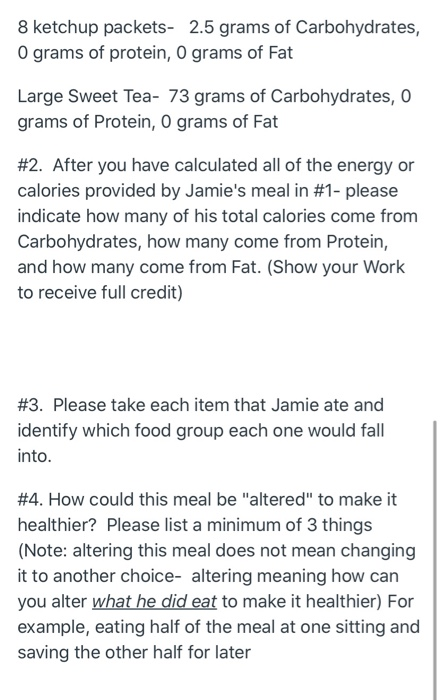
1and 2 . Energy or calories from each food product that Jamie had :-
Big Mac - 46 gm of carbohydrates , 25 gm of protein , 28gm of fat
8 ketchup packets - 2.5gm of carbohydrates
Large sweet tea - 73gm of carbohydrates
1 gm of carbohydrates and protein provides 4kcal
1 gm of fat provides 9kcal
So, Jamie had total carbohydrate of 46+ 2.5×8+ 73= 139gm
Total calories from carbohydrate - 139×4 -556kcal
Total protein of 25gm
Total calories from protein - 25×4 = 100kcal
Total fat -28gm
Calories from fat = 28×9 -224kcal
Total calories - 556+100+224kcal - 880 kcal
3. Big Mac belongs to carbohydrate food group
Large fries ketchup belongs to vegetable group
4. This meal can be altered by having w normal veg burger with all size fries and two ketchups.
Add Answer to:
there are a total of 8 ketchup packets, not 16. that is just where
the picture...
1. A meal of pasta contains 16 grams protein, 80 grams Carb and 8grams fat. a....
1. A meal of pasta contains 16 grams protein, 80 grams Carb and 8grams fat. a. How many Calories does the meal provide from these energy nutrients? (Remember Calories and kcals are the same thing) ________*___________= ________ kcal protein ________*___________ = ________kcal carb ________*___________ = ________kcal fat Total = _______ kcal b. What percentage of the Calories in the meal comes from each of the energy-yielding nutrients? (this relates to the second part of practice question 2) _____________________ = __________%...
Consider the energy associated with the “Big Mac” meal: Big Mac 540 Calories Medium fries:...
Consider the energy associated with the “Big Mac” meal: Big Mac 540 Calories Medium fries: 340 Calories Medium Coke: 220 Calories If you have the Big Mac meal for lunch, how many (i) Calories (ii) calories (iii) Joules have you consumed? Suppose you try to “lose” the calories gained when eating the “Big Mac meal” by exercising – say by doing an equivalent amount of work in the gymnasium by lifting a 50 kg “weight” a vertical distance of...
A meal consisting of a cheeseburger large fries and chocolate shake provides a total of 1120...
A meal consisting of a cheeseburger large fries and chocolate shake provides a total of 1120 kcal. Forty-eight percent of the energy in the meal is from carbohydrate and 13% is from protein. How many calories of fat does the meal contain?
Estimation and Analysis of Daily Caloric Intake The purpose of this Laboratory Experience is to analyze...
Estimation and Analysis of Daily Caloric Intake The purpose of this Laboratory Experience is to analyze your caloric intake to determine the number of calories and the percentage of these calories that come from fat, carbohydrates, and protein. Instructions You must record everything that you eat and drink for 2 days- a weekday and a weekend day. Try to select typical days that will reflect your true eating habits. Simply fill out the first two columns for each day on...
A meal contains 80 g of total carbohydrates, 14 g of alcohol, 24 g of fat,...
A meal contains 80 g of total carbohydrates, 14 g of alcohol, 24 g of fat, 18 g of protein and 18 g of fiber, what percentage of calories are provided by carbohydrate in the meal? Assume that dietary fiber provides an average of 2 kcal/g. (Note: if your calculation says there are 320 kcals from carbs (there arent), then you're not going in the right direction). Please give answer to one decimal point, and show all work! Thank you!
Please answer all A. Carbohydrates contain 4 kcalories per gram, protein contains 4 kcalories per gram,...
Please answer all A. Carbohydrates contain 4 kcalories per gram, protein contains 4 kcalories per gram, and fat contains 9 kcalories per gram. To calculate the percentage of kcalories from protein, carbohydrate or fat, (1) determine the total kcalories in the food (calculate the kcals of protein, carbohydrate and fat and add them together) and (2) to determine the percentages of each divide the kcalories in the individual component (protein, carbohydrate or fat) by the total kcalories in the food,...
Using what you have learned about nutrition labels, label claims, and macronutrient calorie calculations, please answer...
Using what you have learned about nutrition labels, label claims, and macronutrient calorie calculations, please answer the questions below. Each question is worth 7 points, for a total of 70 points. Nutrition Facts 8 servings per container Serving size 2/3 cup (55g) Amount per 2/3 cup Calories 230 % DV* 12% Total Fat 1g 5% Saturated Fat 1g 0% Cholesterol 0 mg 7%. Sodium 160 mg 12% Total carbs 37g 14% Dietary Fiber 4g Protein 3g 1. How many servings...
(10 pts) Cronometer uses the Mifflin-St Jeor equation for estimating energy expenditure (“Calories Burned”). How do...
(10 pts) Cronometer uses the Mifflin-St Jeor equation for estimating energy expenditure (“Calories Burned”). How do the provided energy needs from Cronometer compare with the calories your patient consumed, on average, in Table 1? Is he/she in energy balance, positive energy balance, or negative energy balance based on the Mifflin-St Jeor estimate? Include the numeric values in your answer. what more info do you need? Table 1. Energy and Macronutrients (10 pts) Average Eaten Target Energy 1217 (39%) kcal 60%...
16. All of these areas have the highest malnutrition rates EXCEPT A. Sub-Saharan Africa B. Haiti...
 16. All of these areas have the highest malnutrition rates EXCEPT A. Sub-Saharan Africa B. Haiti C. Portugal D. India 19. Answer the questions, based on this label. (1 pt each) A. If you eat the entire package, how many cups do you Nutrition Facts eat? _2 Serving Size 1 cup (2289) Serving Per Container 2 B. How many calories worth of protein are you eating in one serving? 5 5/4 20 cal How many calories Worth of sugar are...
Kay is an aspiring 800-meter track athlete who has read various nutrition books with the hope...
Kay is an aspiring 800-meter track athlete who has read various nutrition books with the hope of finding the ideal diet for her sport. From her reading she has learned that fats yield more calories per gram than carbohydrates. In addition, she knows that dietary proteins are needed to help her muscles recover from training and additionally can be used for energy. She is now convinced that one of the popular high-fat, high-protein, low-carbohydrate diets is her best choice. Her...
 16. All of these areas have the highest malnutrition rates EXCEPT A. Sub-Saharan Africa B. Haiti C. Portugal D. India 19. Answer the questions, based on this label. (1 pt each) A. If you eat the entire package, how many cups do you Nutrition Facts eat? _2 Serving Size 1 cup (2289) Serving Per Container 2 B. How many calories worth of protein are you eating in one serving? 5 5/4 20 cal How many calories Worth of sugar are...
Most questions answered within 3 hours.
-
Where is the error in this code sequence?
String s1 = "Hello";
String s2 = "ello";...
asked 11 months ago -
Financial data for Joel de Paris, Inc., for last year
follow:
Joel de Paris, Inc.
Balance...
asked 11 months ago -
Consider this reaction:
Al2(SO4)3 (aq)+ BaCl3
(aq) Al2Cl6 (aq)- +
3BaSO4(s) . What is the...
asked 11 months ago -
Suppose that Savneet is considering increasing her
recent random sample from 20 car rentals to 40...
asked 11 months ago -
Trucks arrive at an unloading terminal at an average rate of 120
per hour.
Trucks arrive...
asked 11 months ago -
Why are methanol and ethanol completely soluble in water while
octanol is not very little soluble....
asked 11 months ago -
A facilities manager at a university reads in a research report
that the mean amount of...
asked 11 months ago -
When the CuSO4 is rehydrated by adding water to the anhydrous
compound, is this an endothermic...
asked 11 months ago -
A ray of sunlight is passing from diamond into crown glass; the
angle of incidence is...
asked 11 months ago -
A block of mass 0.249 kg is placed on top of a light, vertical
spring of...
asked 11 months ago -
how do the kidneys compensate in the presences of acidosis
a) trigger hyperventilate
b) reserve acid...
asked 11 months ago -
Question 501 pts
The rental rate of capital to the firm increases. Which of the
following...
asked 11 months ago