Does the order of the reactants change with concentration? (1-2 sentences)
Does the order of the reactants change with concentration? (1-2 sentences)
Homework Answers

Add Answer to:
Does the order of the reactants change with concentration? (1-2
sentences)
9. What does it mean if Keq < 1, at equilibrium? The concentration of reactants is...
 9. What does it mean if Keq < 1, at equilibrium? The concentration of reactants is greater than the concentration of products. b. The concentration of products is greater than the concentration of reactants. The rate of the forward reaction is greater than the rate of the reverse reaction. c. d. The rate of the reverse reaction is greater than the rate of the forward reaction. e. The concentration of products and reactants are about the same. Which of the...
In this lab we will be expressing rate as a change in concentration of reactants over...
 In this lab we will be expressing rate as a change in
concentration of reactants over time. In order to calculate this,
we need to know the initial concentrations of our reagents after
they are combined but before the reaction occurs. This is a
dilution process. Recall that the calculation for a dilution is
accomplished using the relationship M1V1 = M2V2.
If the [S2O3 2- ] is initially 2.49x10⁻⁴ M, and the reaction
takes 145 seconds for the solution to...
In this lab we will be expressing rate as a change in
concentration of reactants over time. In order to calculate this,
we need to know the initial concentrations of our reagents after
they are combined but before the reaction occurs. This is a
dilution process. Recall that the calculation for a dilution is
accomplished using the relationship M1V1 = M2V2.
If the [S2O3 2- ] is initially 2.49x10⁻⁴ M, and the reaction
takes 145 seconds for the solution to...
Which of the following is true regarding the concentration of the reactants for a chemical reaction...
Which of the following is true regarding the concentration of the reactants for a chemical reaction that is at equilibrium. a. Concentration of the reactants will not change because the forward reaction has stopped b. Concentration of the reactants will not change because the intermediate is used up c. Concentration of the reactants will not change because the forward and reverse reacts rates are equal d. Concentration of the reactants will change because this is a dynamic process e. Concentration...
Question 2 If the rate does not change when we double the concentration, therefore, the reaction...
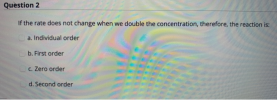 Question 2 If the rate does not change when we double the concentration, therefore, the reaction is: a. Individual order b. First order C. Zero order d. Second order
Does the reaction favor reactants or products? reactants products neither products nor reactants The reversible decomposition...
 Does the reaction favor reactants or products? reactants products neither products nor reactants The reversible decomposition of dinitrogen tetroxide, N204, to nitrogen dioxide, NO2, is shown. For this reaction, = 0.15. Kea = N204 2 NO, nitrogen dioxide dinitrogen tetroxide At equilibrium, is the concentration of reactants or products greater? The concentration of products is greater than the concentration of reactants at equilibrium. The concentration of reactants equals the concentration of products at equilibrium. The concentration of reactants is greater...
Express the rate of this reaction in terms of the change in concentration of each of the reactants and products: A A(g)...
 Express the rate of this reaction in terms of the change in concentration of each of the reactants and products: A A(g)2B(8) C(8) 16.16 When [B] is decreasing at 0.5 mol/L*s, how fast is [A] decreasing?
1. In this lab we will be expressing rate as a change in concentration of reactants...
 1. In this lab we will be expressing rate as a change in concentration of reactants over time. In order to we need to know the initial concentrations of our reagents after they are combined but before the reaction occurs. This is a dilution process. Recall that the calculation for a dilution is accomplished using the relationship MiV1 = M2V2. Complete the table below by calculating the concentrations of l'(aq) and Fe"(aq) in the initial reaction solutions. The stock solutions...
For a catalyzed reaction: a) Does the catalyst change the energy of the reactants? Of the...
 For a catalyzed reaction: a) Does the catalyst change the energy of the reactants? Of the products? If so, how? b) Does the catalyst change the energy of the transition state? If so, how? c) On the graph below, draw the following: • An exothermic reaction indicate by drawing a solid line) • The same exothermic reaction, but with the addition of a catalyst indicate by drawing this as a dashed line) Energy Reaction Progress
Does an enzyme change the equalibrium concentrations of reactants and products? please explain in detail.
Does an enzyme change the equalibrium concentrations of reactants and products? please explain in detail.
For a solution equilibrium, a change in concentration of a reactant or product does not change...
For a solution equilibrium, a change in concentration of a reactant or product does not change Kc. True/False?
 9. What does it mean if Keq < 1, at equilibrium? The concentration of reactants is greater than the concentration of products. b. The concentration of products is greater than the concentration of reactants. The rate of the forward reaction is greater than the rate of the reverse reaction. c. d. The rate of the reverse reaction is greater than the rate of the forward reaction. e. The concentration of products and reactants are about the same. Which of the...
 In this lab we will be expressing rate as a change in
concentration of reactants over time. In order to calculate this,
we need to know the initial concentrations of our reagents after
they are combined but before the reaction occurs. This is a
dilution process. Recall that the calculation for a dilution is
accomplished using the relationship M1V1 = M2V2.
If the [S2O3 2- ] is initially 2.49x10⁻⁴ M, and the reaction
takes 145 seconds for the solution to...
In this lab we will be expressing rate as a change in
concentration of reactants over time. In order to calculate this,
we need to know the initial concentrations of our reagents after
they are combined but before the reaction occurs. This is a
dilution process. Recall that the calculation for a dilution is
accomplished using the relationship M1V1 = M2V2.
If the [S2O3 2- ] is initially 2.49x10⁻⁴ M, and the reaction
takes 145 seconds for the solution to...
 Question 2 If the rate does not change when we double the concentration, therefore, the reaction is: a. Individual order b. First order C. Zero order d. Second order
 Does the reaction favor reactants or products? reactants products neither products nor reactants The reversible decomposition of dinitrogen tetroxide, N204, to nitrogen dioxide, NO2, is shown. For this reaction, = 0.15. Kea = N204 2 NO, nitrogen dioxide dinitrogen tetroxide At equilibrium, is the concentration of reactants or products greater? The concentration of products is greater than the concentration of reactants at equilibrium. The concentration of reactants equals the concentration of products at equilibrium. The concentration of reactants is greater...
 Express the rate of this reaction in terms of the change in concentration of each of the reactants and products: A A(g)2B(8) C(8) 16.16 When [B] is decreasing at 0.5 mol/L*s, how fast is [A] decreasing?
 1. In this lab we will be expressing rate as a change in concentration of reactants over time. In order to we need to know the initial concentrations of our reagents after they are combined but before the reaction occurs. This is a dilution process. Recall that the calculation for a dilution is accomplished using the relationship MiV1 = M2V2. Complete the table below by calculating the concentrations of l'(aq) and Fe"(aq) in the initial reaction solutions. The stock solutions...
 For a catalyzed reaction: a) Does the catalyst change the energy of the reactants? Of the products? If so, how? b) Does the catalyst change the energy of the transition state? If so, how? c) On the graph below, draw the following: • An exothermic reaction indicate by drawing a solid line) • The same exothermic reaction, but with the addition of a catalyst indicate by drawing this as a dashed line) Energy Reaction Progress
Most questions answered within 3 hours.
-
Where is the error in this code sequence?
String s1 = "Hello";
String s2 = "ello";...
asked 11 months ago -
Financial data for Joel de Paris, Inc., for last year
follow:
Joel de Paris, Inc.
Balance...
asked 11 months ago -
Consider this reaction:
Al2(SO4)3 (aq)+ BaCl3
(aq) Al2Cl6 (aq)- +
3BaSO4(s) . What is the...
asked 11 months ago -
Suppose that Savneet is considering increasing her
recent random sample from 20 car rentals to 40...
asked 11 months ago -
Trucks arrive at an unloading terminal at an average rate of 120
per hour.
Trucks arrive...
asked 11 months ago -
Why are methanol and ethanol completely soluble in water while
octanol is not very little soluble....
asked 11 months ago -
A facilities manager at a university reads in a research report
that the mean amount of...
asked 11 months ago -
When the CuSO4 is rehydrated by adding water to the anhydrous
compound, is this an endothermic...
asked 11 months ago -
A ray of sunlight is passing from diamond into crown glass; the
angle of incidence is...
asked 11 months ago -
A block of mass 0.249 kg is placed on top of a light, vertical
spring of...
asked 11 months ago -
how do the kidneys compensate in the presences of acidosis
a) trigger hyperventilate
b) reserve acid...
asked 11 months ago -
Question 501 pts
The rental rate of capital to the firm increases. Which of the
following...
asked 11 months ago