Does an enzyme change the equalibrium concentrations of reactants and products? please explain in detail.
Homework Answers
An enzyme is a bio-catalyst. So, the enzyme is only used to speed up the reaction process. Suppose, a reaction from A to B needs a high activation energy barrier. The utility of a catalyst or enzyme is that it creates an alternative route for the reaction via some intermediate, in which the activation energy barrier is quite low. Like the diagram given-
 RED = without catalyst, GREEN
= with catalyst
RED = without catalyst, GREEN
= with catalyst
Clearly, catalyst creates a low energy path.
Now, if we talk about a reversible reaction A to B then it is inherent property of the reaction that it will have a forward (A to B) as well as a backward reaction (B to A) and they will go simulteneously. If we add catalyst to the reaction medium, then that will create a low energy path for the forward reaction, where the reactant A will go to product B. But, the product can also use the same pathway to come back at reactant according to the microscopic reversibility. So catalyst actually increases the rate of forward reaction as well as the backward reaction.
Now, we know the expression of the equilibrium constant,
 i.e, the ratio of rate constants of forward and backward reaction.
Also, if we consider the reaction,
i.e, the ratio of rate constants of forward and backward reaction.
Also, if we consider the reaction,  ,
then at equilibrium the rate of forward reaction is equal to the
rate of backward reaction. Thus, from chemical kinetics,
,
then at equilibrium the rate of forward reaction is equal to the
rate of backward reaction. Thus, from chemical kinetics,  , [ ] denotes concentration.
therefore we can write,  . Since enzyme increases both kf and kb in
same extent thus, there is no change in the ratio, so
Keq doesnot change and also the ratio of concentrations
of B and A doesn't change. So, the equilibrium concentrations [A]
and [B] doesn't change. Now, you may argue they
are both increasing or decreasing in the same extent. But that is
not possible since, the total concentration in the reaction vessel
is fixed, that can't be altered.
. Since enzyme increases both kf and kb in
same extent thus, there is no change in the ratio, so
Keq doesnot change and also the ratio of concentrations
of B and A doesn't change. So, the equilibrium concentrations [A]
and [B] doesn't change. Now, you may argue they
are both increasing or decreasing in the same extent. But that is
not possible since, the total concentration in the reaction vessel
is fixed, that can't be altered.
Add Answer to:
Does an enzyme change the equalibrium concentrations of reactants
and products? please explain in detail.
1) At equilibrium, there is no overall change in the concentrations of reactants and products. Why,...
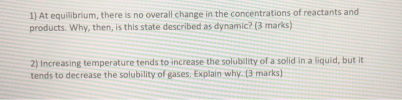 1) At equilibrium, there is no overall change in the concentrations of reactants and products. Why, then, is this state described as dynamic? (3 marks) 2) Increasing temperature tends to increase the solubility of a solid in a liquid, but it tends to decrease the solubility of gases. Explain why. (3 marks)
please explain step by step. 3. Determine the equilibrium concentrations of all the reactants and products...
 please explain step by step.
3. Determine the equilibrium concentrations of all the reactants and products for the equilibrium described below if you start with an initial concentration of hydrogen and nitrogen each at 6.8 x 10⁻²M with no HCN present. You can assume there is sufficient graphite (carbon) present to maintain an equilibrium and that the temperature is constant at 2050K. (15 points) H2(g) + Cs, graphite) + N2(g) - 2HCNG) Kc = 3.43x10⁻³at 2050K Initial concentrations: [H2] =...
please explain step by step.
3. Determine the equilibrium concentrations of all the reactants and products for the equilibrium described below if you start with an initial concentration of hydrogen and nitrogen each at 6.8 x 10⁻²M with no HCN present. You can assume there is sufficient graphite (carbon) present to maintain an equilibrium and that the temperature is constant at 2050K. (15 points) H2(g) + Cs, graphite) + N2(g) - 2HCNG) Kc = 3.43x10⁻³at 2050K Initial concentrations: [H2] =...
NH4NO3(s)<---->N2O(g)+2H2O(g) what would be the change in the concentrations of reactants and products if 1/2 of...
NH4NO3(s)<---->N2O(g)+2H2O(g) what would be the change in the concentrations of reactants and products if 1/2 of the NH4NO3(s) was removed?
Select all of the true statements regarding chemical equilibrium. The concentrations of reactants and products are...
 Select all of the true statements regarding chemical equilibrium. The concentrations of reactants and products are equal. ✓ The concentrations of reactants and products remain constant. Reactants are being converted to products and vice versa. The rates of the forward and reverse reactions are equal.
How is 3M correct? Can someone please explain in detail how this is the answer? For...
How is 3M correct? Can someone please explain in detail how this is the answer? For the reaction 4NH3(g) + 3O2(g) → 2N2(g) + 6H2O(g), K = 1080 at a certain temperature. Initially, all reactants and products have concentrations equal to 12 M. What is the approximate concentration of oxygen at equilibrium? 1. 18 M 2. 6 M 3. 3 M correct 4. 0 M 5. 12 M
The concentrations of reactants and products for a chemical reaction can be calculated if the equillbrium...
 The concentrations of reactants and products for a chemical reaction can be calculated if the equillbrium constant for the reaction and the starting
Does the reaction favor reactants or products? reactants products neither products nor reactants The reversible decomposition...
 Does the reaction favor reactants or products? reactants products neither products nor reactants The reversible decomposition of dinitrogen tetroxide, N204, to nitrogen dioxide, NO2, is shown. For this reaction, = 0.15. Kea = N204 2 NO, nitrogen dioxide dinitrogen tetroxide At equilibrium, is the concentration of reactants or products greater? The concentration of products is greater than the concentration of reactants at equilibrium. The concentration of reactants equals the concentration of products at equilibrium. The concentration of reactants is greater...
A monoprotic acid, HA, is dissolved in water: The equilibrium concentrations of the reactants and products...
A monoprotic acid, HA, is dissolved in water: The equilibrium concentrations of the reactants and products are [HA] = 0.160 M [H ] = 4.00
The equilibrium concentrations of the reactants and products are [HA] = 0.260 M [H ] =...
The equilibrium concentrations of the reactants and products are [HA] = 0.260 M [H ] = 3.00 × 10⁻⁴ M [A–] = 3.00 × 10⁻⁴ M Calculate the Ka value for the acid HA.
1. The initial concentrations of reactants and products for this reaction are given below. N2(g) +...
1. The initial concentrations of reactants and products for this reaction are given below. N2(g) + O2(g) ⇄ 2NO(g) Calculate Q for this reaction. Answer this to one decimal place (e.g. 10.2) The initial concentration of N2 is 1.0 M The initial concentration of O2 is 1.0 M The initial concentration of NO is 2.5 M 2. The reaction below is not at equilibria and Q = 1.7. The equilibrium constant is K = 0.230. 2SO3(g) ⇌ 2SO2(g) + O2(g)...
 1) At equilibrium, there is no overall change in the concentrations of reactants and products. Why, then, is this state described as dynamic? (3 marks) 2) Increasing temperature tends to increase the solubility of a solid in a liquid, but it tends to decrease the solubility of gases. Explain why. (3 marks)
 please explain step by step.
3. Determine the equilibrium concentrations of all the reactants and products for the equilibrium described below if you start with an initial concentration of hydrogen and nitrogen each at 6.8 x 10⁻²M with no HCN present. You can assume there is sufficient graphite (carbon) present to maintain an equilibrium and that the temperature is constant at 2050K. (15 points) H2(g) + Cs, graphite) + N2(g) - 2HCNG) Kc = 3.43x10⁻³at 2050K Initial concentrations: [H2] =...
please explain step by step.
3. Determine the equilibrium concentrations of all the reactants and products for the equilibrium described below if you start with an initial concentration of hydrogen and nitrogen each at 6.8 x 10⁻²M with no HCN present. You can assume there is sufficient graphite (carbon) present to maintain an equilibrium and that the temperature is constant at 2050K. (15 points) H2(g) + Cs, graphite) + N2(g) - 2HCNG) Kc = 3.43x10⁻³at 2050K Initial concentrations: [H2] =...
 Select all of the true statements regarding chemical equilibrium. The concentrations of reactants and products are equal. ✓ The concentrations of reactants and products remain constant. Reactants are being converted to products and vice versa. The rates of the forward and reverse reactions are equal.
 The concentrations of reactants and products for a chemical reaction can be calculated if the equillbrium constant for the reaction and the starting
 Does the reaction favor reactants or products? reactants products neither products nor reactants The reversible decomposition of dinitrogen tetroxide, N204, to nitrogen dioxide, NO2, is shown. For this reaction, = 0.15. Kea = N204 2 NO, nitrogen dioxide dinitrogen tetroxide At equilibrium, is the concentration of reactants or products greater? The concentration of products is greater than the concentration of reactants at equilibrium. The concentration of reactants equals the concentration of products at equilibrium. The concentration of reactants is greater...
Most questions answered within 3 hours.
-
Where is the error in this code sequence?
String s1 = "Hello";
String s2 = "ello";...
asked 10 months ago -
Financial data for Joel de Paris, Inc., for last year
follow:
Joel de Paris, Inc.
Balance...
asked 10 months ago -
Consider this reaction:
Al2(SO4)3 (aq)+ BaCl3
(aq) Al2Cl6 (aq)- +
3BaSO4(s) . What is the...
asked 10 months ago -
Suppose that Savneet is considering increasing her
recent random sample from 20 car rentals to 40...
asked 10 months ago -
Trucks arrive at an unloading terminal at an average rate of 120
per hour.
Trucks arrive...
asked 10 months ago -
Why are methanol and ethanol completely soluble in water while
octanol is not very little soluble....
asked 10 months ago -
A facilities manager at a university reads in a research report
that the mean amount of...
asked 10 months ago -
When the CuSO4 is rehydrated by adding water to the anhydrous
compound, is this an endothermic...
asked 10 months ago -
A ray of sunlight is passing from diamond into crown glass; the
angle of incidence is...
asked 10 months ago -
A block of mass 0.249 kg is placed on top of a light, vertical
spring of...
asked 10 months ago -
how do the kidneys compensate in the presences of acidosis
a) trigger hyperventilate
b) reserve acid...
asked 10 months ago -
Question 501 pts
The rental rate of capital to the firm increases. Which of the
following...
asked 10 months ago