Contrast Mill and Malthus.
Contrast Mill and Malthus.
Homework Answers
The major topic around which the studies and theories of Mills and Malthus is centered is around productive and unproductive labor in contributing towards the wealth creation in a capitalist economy.Malthus put forward the idea that it is what a labor produces that makes the labor productive rather than just producing wealth.In short Malthus proposed that the worker cannot be said to be productive unless he adds to society more than what was paid for their service.Like Malthus Mills regarded all the labors engaged in production activity only as productive.Also unlike Malthus Mills was ignorant of the importance of unproductive labor in a capitalist economy unproductive labor included people participating in private services such as entrepreneurs,landowners,businessmen,,ministers,musicians,teachers etc. Therefore according to Malthus even mothers who did nothing but sit in their home and look after their children was also important to the economy.Another major area of contrast was regarding production with response to labor.Mills saw unproductive labor having an undesirable influence over wealth creation and growth of the society.He believed that such a U/P consumption would end up impoverishing the nation.
Malthus on the other hand regarded unproductive consumption factor very much necessary in a capitalist economy when technology and productivity are at their utmost level.
27. The Classical School of Economic includes a. Adam Smith, John Stuart Mill, David Ricardo b....
27. The Classical School of Economic includes a. Adam Smith, John Stuart Mill, David Ricardo b. Adam Smith, Robert Thomas Malthus, John Maynard Keynes c. William Stanley Jevons, Robert Thomas Malthus, Sir John Steuart d. Sir John Steuart, Adam Smith, David Ricardo
It was obvious even in Malthus’ lifetime that his theory was characterized by several defects and...
It was obvious even in Malthus’ lifetime that his theory was characterized by several defects and weaknesses. Describe these defects, then discuss why, despite them, we still talk about Malthus and his work to this day.
What were Parson (Thomas Robert) Malthus' economic perspectives?
What were Parson (Thomas Robert) Malthus' economic perspectives?
Use the Malthus model to show that improvements in productivity do not lead to long run...
Use the Malthus model to show that improvements in productivity do not lead to long run improvements in living standards within the model.
Explain the connection bwtween Malthus and Darwin.Is there any evidence of Darwinian selection in the pre-industrial...
Explain the connection bwtween Malthus and Darwin.Is there any evidence of Darwinian selection in the pre-industrial world?
Charles Darwin synthesized the research of other naturalists, such as Malthus, Cuvier and Wallace, to develop...
Charles Darwin synthesized the research of other naturalists, such as Malthus, Cuvier and Wallace, to develop his theory of natural selection. Please select one of the naturalists from the list below and describe how his ideas may have influenced Charles Darwin's 1859 publication, "On the Origin of Species by Means of Natural Selection". You can start with your textbook, but feel free to pull from the many internet sources on this topic. Remember to include a cited quotation from one...
1. Individual Problems 22-1 Suppose that a paper mill feeds" a downstream box mill. For the...
 1. Individual Problems 22-1 Suppose that a paper mill feeds" a downstream box mill. For the downstream mill, the marginal profitability of producing boxes declines with volume. For example, the first unit of boxes increases earnings by $20, the second by $18, the third by $16, and so on, until the tenth unit increases profit by just $2. The cost the upstream mill incurs for producing enough paper (one "unit of paper) to make one unit of boxes is $10.50....
Kentucky Lumber and Mill Work Company contracted to supply Rommell Company mill work for use in...
Kentucky Lumber and Mill Work Company contracted to supply Rommell Company mill work for use in the construction of a school building. While the work was in progress, the Kentucky mill was destroyed by fire. For two months thereafter, Kentucky Lumber and Mill Work Company supplied Rommell with mill work purchased by it from a third party. The Kentucky mill did not wish to continue this plan and declared that the contract was ended. Rommell brought an action against Kentucky...
A paper mill is in operation near Saguenay river. The mill discharges 3.8 cfs (ft3/s) of...
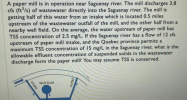 A paper mill is in operation near Saguenay river. The mill discharges 3.8 cfs (ft3/s) of wastewater directly into the Saguenay river. The mill is getting half of this water from an intake which is located 0.5 miles upstream of the wastewater outfall of the mill, and the other half from a nearby well field. On the average, the water upstream of paper mill has TSS concentration of 2.5 mg/L. If the Saguenay river has a flow of 12 cfs...
Based on the information in "Malthus and the Green Revolution," how did the average product of...
Based on the information in "Malthus and the Green Revolution," how did the average product of labor for corn change over time? Over time, the average product of labor for corn has A. decreased due to starvations B. Decreased due to fixed amount of land C.Increased due to fewer fertilizer and tractors D. Increased due to technological advance E. Increased due to population decrease.
 1. Individual Problems 22-1 Suppose that a paper mill feeds" a downstream box mill. For the downstream mill, the marginal profitability of producing boxes declines with volume. For example, the first unit of boxes increases earnings by $20, the second by $18, the third by $16, and so on, until the tenth unit increases profit by just $2. The cost the upstream mill incurs for producing enough paper (one "unit of paper) to make one unit of boxes is $10.50....
 A paper mill is in operation near Saguenay river. The mill discharges 3.8 cfs (ft3/s) of wastewater directly into the Saguenay river. The mill is getting half of this water from an intake which is located 0.5 miles upstream of the wastewater outfall of the mill, and the other half from a nearby well field. On the average, the water upstream of paper mill has TSS concentration of 2.5 mg/L. If the Saguenay river has a flow of 12 cfs...
Most questions answered within 3 hours.
-
Where is the error in this code sequence?
String s1 = "Hello";
String s2 = "ello";...
asked 11 months ago -
Financial data for Joel de Paris, Inc., for last year
follow:
Joel de Paris, Inc.
Balance...
asked 11 months ago -
Consider this reaction:
Al2(SO4)3 (aq)+ BaCl3
(aq) Al2Cl6 (aq)- +
3BaSO4(s) . What is the...
asked 11 months ago -
Suppose that Savneet is considering increasing her
recent random sample from 20 car rentals to 40...
asked 11 months ago -
Trucks arrive at an unloading terminal at an average rate of 120
per hour.
Trucks arrive...
asked 11 months ago -
Why are methanol and ethanol completely soluble in water while
octanol is not very little soluble....
asked 11 months ago -
A facilities manager at a university reads in a research report
that the mean amount of...
asked 11 months ago -
When the CuSO4 is rehydrated by adding water to the anhydrous
compound, is this an endothermic...
asked 11 months ago -
A ray of sunlight is passing from diamond into crown glass; the
angle of incidence is...
asked 11 months ago -
A block of mass 0.249 kg is placed on top of a light, vertical
spring of...
asked 11 months ago -
how do the kidneys compensate in the presences of acidosis
a) trigger hyperventilate
b) reserve acid...
asked 11 months ago -
Question 501 pts
The rental rate of capital to the firm increases. Which of the
following...
asked 11 months ago