
Homework Answers
Add Answer to:
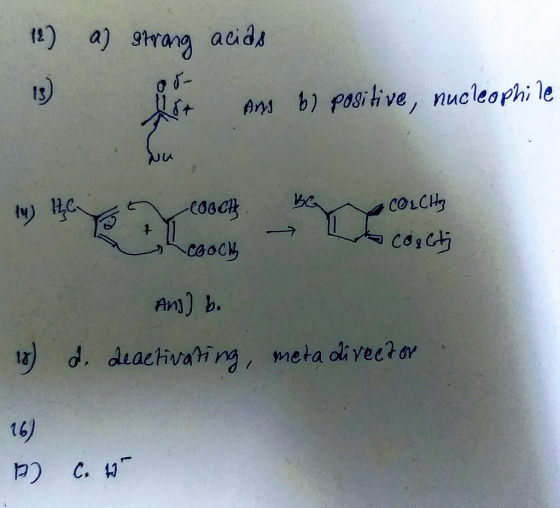
12. Dialkyl ethers (e.g., diethyl ether) are typically unreactive with all of the following classes of...
to form Which of the following possible Birch reduction products would not be expected CH3 CH3...
 to form Which of the following possible Birch reduction products would not be expected CH3 CH3 0 CH3 A. B. C. Which of the following substrates would most likely undergo a successful nucleophilic aromatic substitution reaction with diethylamine? NO2 NO 2 NO 2 A. B. C. D. Which of the following resonance structures does not depict stabilization of the negative charge in the Meisenheimer complex? 0 A. The nitro group has which of the following effects in electrophilic aromatic substitution?...
1) Which of the following is an intermediate in the bromination of toluene? p) Ha BrH...
 1) Which of the following is an intermediate in the bromination of toluene? p) Ha BrH 2 2) Under what reaction conditions would the electrophilic chlorination of aromatic compounds usually occur? A) Cl2, AlCl3 B) C12, CCl4 C) Cl2, H20 D) NaCl, H20 E) NaCI, CH3OH 3) 3) Which of the following is the strongest activating group in electrophilic aromatic substitution reactions? A) -CO2CH3 B)-NO2 C) -OCH3 D) -CH2CH3 E) -N(CH3)2 4) _ 4) In electrophilic aromatic substitution reactions the...
5. All electron-donating groups are activating groups and all are ortho-para directors with the exception of...
 5. All electron-donating groups are activating groups and all are ortho-para directors with the exception of substituents, all electron-withdrawing groups are deactivating groups and all are meta directors. A. hydroxyl B. amino C. halogens D. alkoxyl 6. Hydrogen abstraction from the methyl group of methylbenzene (toluene) produces a radical called the radical. A. allylic B. free C. halogen D. benzyllic 7. The stability of benzyllic radicals can be explained by theory. A. resonance B. bond order C. inductive D. molecular...
Predict the products formed in the following reactions. Predict the product(s) formed in the following reactions....
 Predict the products formed in the following reactions.
Predict the product(s) formed in the following reactions. If there is no reaction, write “No Rxn" as the answer for the major product and leave the minor product box blank. If there is no minor product in the reaction, then leave the minor product box blank. If there are multiple products, make sure the products are in the appropriate box. (24 points, 4 points each) Note: Do not over complicate some questions...
Predict the products formed in the following reactions.
Predict the product(s) formed in the following reactions. If there is no reaction, write “No Rxn" as the answer for the major product and leave the minor product box blank. If there is no minor product in the reaction, then leave the minor product box blank. If there are multiple products, make sure the products are in the appropriate box. (24 points, 4 points each) Note: Do not over complicate some questions...
Arrange the following compounds in increasing order of their reactivity to electrophiles. (least reactive first) A....
 Arrange the following compounds in increasing order of their reactivity to electrophiles. (least reactive first) A. CH CHO (benzaldehyde) B. C&HOCH, (anisole) C. C HBr (bromobenzene) D. CH3CH, (toluene) 1) A<C<D<B 2) A<D<C< B 3 ) C<A<B<D 4) C<A<D<B Nitration of chlorobenzene occurs: 1) faster than nitration of benzene and gives the ortho and para products. 2) faster than nitration of benzene and gives the meta product. 3) slower than nitration of benzene and gives the ortho and para products....
A. Consider the following pairs of structures. Designate each chirality center as (R) or (S) and...
 A. Consider the following pairs of structures. Designate each
chirality center as (R) or (S) and identify the
relationship between them by describing them as representing
enantiomers, diastereomers, constitutional isomers, or two
molecules of the same compound. Use handheld molecular models to
check your answers.
B. Tartaric acid
[HO2CCH(OH)CH(OH)CO2H] was an important
compound in the history of stereochemistry. Two naturally occurring
forms of tartaric acid are optically inactive. One optically
inactive form has a melting point of 210 − 212 °...
A. Consider the following pairs of structures. Designate each
chirality center as (R) or (S) and identify the
relationship between them by describing them as representing
enantiomers, diastereomers, constitutional isomers, or two
molecules of the same compound. Use handheld molecular models to
check your answers.
B. Tartaric acid
[HO2CCH(OH)CH(OH)CO2H] was an important
compound in the history of stereochemistry. Two naturally occurring
forms of tartaric acid are optically inactive. One optically
inactive form has a melting point of 210 − 212 °...
use the notes provided to help answer the question above. will rate well The second step...
 use the notes provided to help answer the question
above. will rate well
The second step of the synthesis transformation of the chlorosulfonyl functional group into a sulfonamide) is an example of a a. Nucleophilic displacement (substitution) b Elimination C. Electrophilic aromatic substitution d. Acid hydrolysis Esterification e. THE SULFONIC ACID GROUP AND ITS DERIVATIVES Sulfonic acids are organic analogs of sulfuric acid, a very strong acid. They are highly corrosive, react vigorously with water, and can cause skin bums....
use the notes provided to help answer the question
above. will rate well
The second step of the synthesis transformation of the chlorosulfonyl functional group into a sulfonamide) is an example of a a. Nucleophilic displacement (substitution) b Elimination C. Electrophilic aromatic substitution d. Acid hydrolysis Esterification e. THE SULFONIC ACID GROUP AND ITS DERIVATIVES Sulfonic acids are organic analogs of sulfuric acid, a very strong acid. They are highly corrosive, react vigorously with water, and can cause skin bums....
 to form Which of the following possible Birch reduction products would not be expected CH3 CH3 0 CH3 A. B. C. Which of the following substrates would most likely undergo a successful nucleophilic aromatic substitution reaction with diethylamine? NO2 NO 2 NO 2 A. B. C. D. Which of the following resonance structures does not depict stabilization of the negative charge in the Meisenheimer complex? 0 A. The nitro group has which of the following effects in electrophilic aromatic substitution?...
 1) Which of the following is an intermediate in the bromination of toluene? p) Ha BrH 2 2) Under what reaction conditions would the electrophilic chlorination of aromatic compounds usually occur? A) Cl2, AlCl3 B) C12, CCl4 C) Cl2, H20 D) NaCl, H20 E) NaCI, CH3OH 3) 3) Which of the following is the strongest activating group in electrophilic aromatic substitution reactions? A) -CO2CH3 B)-NO2 C) -OCH3 D) -CH2CH3 E) -N(CH3)2 4) _ 4) In electrophilic aromatic substitution reactions the...
 5. All electron-donating groups are activating groups and all are ortho-para directors with the exception of substituents, all electron-withdrawing groups are deactivating groups and all are meta directors. A. hydroxyl B. amino C. halogens D. alkoxyl 6. Hydrogen abstraction from the methyl group of methylbenzene (toluene) produces a radical called the radical. A. allylic B. free C. halogen D. benzyllic 7. The stability of benzyllic radicals can be explained by theory. A. resonance B. bond order C. inductive D. molecular...
 Predict the products formed in the following reactions.
Predict the product(s) formed in the following reactions. If there is no reaction, write “No Rxn" as the answer for the major product and leave the minor product box blank. If there is no minor product in the reaction, then leave the minor product box blank. If there are multiple products, make sure the products are in the appropriate box. (24 points, 4 points each) Note: Do not over complicate some questions...
Predict the products formed in the following reactions.
Predict the product(s) formed in the following reactions. If there is no reaction, write “No Rxn" as the answer for the major product and leave the minor product box blank. If there is no minor product in the reaction, then leave the minor product box blank. If there are multiple products, make sure the products are in the appropriate box. (24 points, 4 points each) Note: Do not over complicate some questions...
 Arrange the following compounds in increasing order of their reactivity to electrophiles. (least reactive first) A. CH CHO (benzaldehyde) B. C&HOCH, (anisole) C. C HBr (bromobenzene) D. CH3CH, (toluene) 1) A<C<D<B 2) A<D<C< B 3 ) C<A<B<D 4) C<A<D<B Nitration of chlorobenzene occurs: 1) faster than nitration of benzene and gives the ortho and para products. 2) faster than nitration of benzene and gives the meta product. 3) slower than nitration of benzene and gives the ortho and para products....
 A. Consider the following pairs of structures. Designate each
chirality center as (R) or (S) and identify the
relationship between them by describing them as representing
enantiomers, diastereomers, constitutional isomers, or two
molecules of the same compound. Use handheld molecular models to
check your answers.
B. Tartaric acid
[HO2CCH(OH)CH(OH)CO2H] was an important
compound in the history of stereochemistry. Two naturally occurring
forms of tartaric acid are optically inactive. One optically
inactive form has a melting point of 210 − 212 °...
A. Consider the following pairs of structures. Designate each
chirality center as (R) or (S) and identify the
relationship between them by describing them as representing
enantiomers, diastereomers, constitutional isomers, or two
molecules of the same compound. Use handheld molecular models to
check your answers.
B. Tartaric acid
[HO2CCH(OH)CH(OH)CO2H] was an important
compound in the history of stereochemistry. Two naturally occurring
forms of tartaric acid are optically inactive. One optically
inactive form has a melting point of 210 − 212 °...
 use the notes provided to help answer the question
above. will rate well
The second step of the synthesis transformation of the chlorosulfonyl functional group into a sulfonamide) is an example of a a. Nucleophilic displacement (substitution) b Elimination C. Electrophilic aromatic substitution d. Acid hydrolysis Esterification e. THE SULFONIC ACID GROUP AND ITS DERIVATIVES Sulfonic acids are organic analogs of sulfuric acid, a very strong acid. They are highly corrosive, react vigorously with water, and can cause skin bums....
use the notes provided to help answer the question
above. will rate well
The second step of the synthesis transformation of the chlorosulfonyl functional group into a sulfonamide) is an example of a a. Nucleophilic displacement (substitution) b Elimination C. Electrophilic aromatic substitution d. Acid hydrolysis Esterification e. THE SULFONIC ACID GROUP AND ITS DERIVATIVES Sulfonic acids are organic analogs of sulfuric acid, a very strong acid. They are highly corrosive, react vigorously with water, and can cause skin bums....
Most questions answered within 3 hours.
-
Where is the error in this code sequence?
String s1 = "Hello";
String s2 = "ello";...
asked 10 months ago -
Financial data for Joel de Paris, Inc., for last year
follow:
Joel de Paris, Inc.
Balance...
asked 10 months ago -
Consider this reaction:
Al2(SO4)3 (aq)+ BaCl3
(aq) Al2Cl6 (aq)- +
3BaSO4(s) . What is the...
asked 10 months ago -
Suppose that Savneet is considering increasing her
recent random sample from 20 car rentals to 40...
asked 10 months ago -
Trucks arrive at an unloading terminal at an average rate of 120
per hour.
Trucks arrive...
asked 10 months ago -
Why are methanol and ethanol completely soluble in water while
octanol is not very little soluble....
asked 10 months ago -
A facilities manager at a university reads in a research report
that the mean amount of...
asked 10 months ago -
When the CuSO4 is rehydrated by adding water to the anhydrous
compound, is this an endothermic...
asked 10 months ago -
A ray of sunlight is passing from diamond into crown glass; the
angle of incidence is...
asked 10 months ago -
A block of mass 0.249 kg is placed on top of a light, vertical
spring of...
asked 10 months ago -
how do the kidneys compensate in the presences of acidosis
a) trigger hyperventilate
b) reserve acid...
asked 10 months ago -
Question 501 pts
The rental rate of capital to the firm increases. Which of the
following...
asked 10 months ago