You have been asked to implement a new blood glucose monitoring software application. Provide a communication...
You have been asked to implement a new blood glucose monitoring software application. Provide a communication plan that includes who, what, when, and how.
Homework Answers
Ans) Continuous glucose monitoring automatically tracks blood glucose levels, also called blood sugar, throughout the day and night. You can also review how your glucose changes over a few hours or days to see trends.
How:
- A CGM works through a tiny sensor inserted under your skin,
usually on your belly or arm. The sensor measures your interstitial
glucose level, which is the glucose found in the fluid between the
cells.
- The sensor tests glucose every few minutes. A transmitter wirelessly sends the information to a monitor.
The monitor may be part of an insulin pump or a separate device, which you might carry in a pocket or purse. Some CGMs send information directly to a smartphone or tablet.
Drawing of a continuous glucose monitor. A transmitter patch on
the belly covers a tiny glucose sensor under the skin. The
transmitter sends data to a small receiver with a viewing screen,
which is clipped to a belt. The CGM receiver shown here is part of
an insulin pump.
A tiny CGM sensor under the skin checks glucose. A transmitter
sends data to a receiver. The CGM receiver may be part of an
insulin pump, as shown here, or a separate device.
CGMs are always on and recording glucose levels—whether you’re
showering, working, exercising, or sleeping. Many CGMs have special
features that work with information from your glucose readings:
An alarm can sound when your glucose level goes too low or too
high.
You can note your meals, physical activity, and medicines in a CGM
device, too, alongside your glucose levels.
You can download data to a computer or smart device to more easily
see your glucose trends.
Some models can send information right away to a second person’s
smartphone—perhaps a parent, partner, or caregiver. For example, if
a child’s glucose drops dangerously low overnight, the CGM could be
set to wake a parent in the next room.
Currently, one CGM model is approved for treatment decisions, the Dexcom G5 Mobile. That means you can make changes to your diabetes care plan based on CGM results alone. With other models, you must first confirm a CGM reading with a finger-stick blood glucose test before you take insulin or treat hypoglycemia.
Special Requirements Needed to Use a CGM
Twice a day, you may need to check the CGM itself. You’ll test a
drop of blood on a standard glucose meter. The glucose reading
should be similar on both devices.
You’ll also need to replace the CGM sensor every 3 to 7 days, depending on the model.
For safety it’s important to take action when a CGM alarm sounds about high or low blood glucose. You should follow your treatment plan to bring your glucose into the target range, or get help.
A woman holding a blood glucose test meter and a smartphone used
to log results. On the table is a finger-prick tool, called a
lancet, which is used to draw a drop of blood.
CGM glucose readings need to be checked against a standard glucose
meter twice a day.
Who can use a CGM?
Most people who use CGMs have type 1 diabetes. Research is underway
to learn how CGMs might help people with type 2 diabetes.
CGMs are approved for use by adults and children with a doctor’s prescription. Some models may be used for children as young as age 2. Your doctor may recommend a CGM if you or your child:
are on intensive insulin therapy, also called tight blood sugar
control
have hypoglycemia unawareness
often have high or low blood glucose
Your doctor may suggest using a CGM system all the time or only for
a few days to help adjust your diabetes care plan.
What are the benefits of a CGM?
Compared with a standard blood glucose meter, using a CGM system
can help you
better manage your glucose levels every day
have fewer low blood glucose emergencies
need fewer finger sticks
A graphic on the CGM screen shows whether your glucose is rising or
dropping—and how quickly—so you can choose the best way to reach
your target glucose level.
Over time, good management of glucose greatly helps people with diabetes stay healthy and prevent complications of the disease. People who gain the largest benefit from a CGM are those who use it every day or nearly every day.
Add Answer to:
You have been asked to implement a new blood glucose monitoring
software application. Provide a communication...
6) [18 marks] You have been asked to implement a circuit for a graphics application. This...
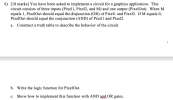 6) [18 marks] You have been asked to implement a circuit for a graphics application. This circuit consists of three inputs (Pixell, Pixel2, and M) and one output (PixelOut). When M equals 1, PixelOut should equal the disjunction (OR) of Pixell and Pixe12. If M equals 0, PixelOut should equal the conjunction (AND) of Pixell and Pixel2. a. Construct a truth table to describe the behavior of the circuit, b. Write the logic function for PixelOut c. Show how to...
You have been hired by Tesla to develop a new marketing plan that includes not only...
You have been hired by Tesla to develop a new marketing plan that includes not only the key elements of the marketing mix, but also how you would implement them. You are asked to present your 1-2 page Executive Summary to the Senior Executive team.
23. On your new job you have been asked to design a monitoring system for a...
 23. On your new job you have been asked to design a monitoring system for a water treatment process. You have chosen a dissolved-oxygen (DO) detector that operates at a frequency of 30 Hz. You have found that there is a significant source of noise at 5.0 kHz, with roughly the same amplitude as the measurement signal. You decide to minimize (90% reduction) the noise at this wavelength by building an RC filter. Diagram the signals in terms of amplitude...
You have been asked to provide a 15-minute presentation at the first faculty meeting for elementary...
You have been asked to provide a 15-minute presentation at the first faculty meeting for elementary school teachers on the detection of children who are living with an alcoholic. The principal is concerned about an increase in the number of families with alcoholics in her district, and she would like to inform teachers about the importance of early intervention. Sketch a brief teaching plan, learner assessment, and teacher motivation activities. Specify what you would include in your presentation and how...
You have been asked to develop an application that accepts a sentence from the user and...
You have been asked to develop an application that accepts a sentence from the user and calculates and displays the number of vowels, consonants and spaces in that sentence. The application should run once and then ask the user if they would like to run it again. NB. The only acceptable characters are space, vowels and consonants. You are not expected to code for this. It is relevant only when testing the application. Your application should be developed using instantiable...
As the Senior Business Analyst at M1 Consulting Inc., you have been asked to provide the...
As the Senior Business Analyst at M1 Consulting Inc., you have been asked to provide the senior management team with an analysis of a specific small business the firm may be looking to invest in, or purchase. What type of business are they – profit/non, public/private, industry, ownership type, etc.? How long have they been in business? What is the company’s core business? Product, service, or both? What other secondary businesses are they involved in? Who are the main customers?...
create a context diagram of the application described below. You have been asked to create a...
create a context diagram of the application described below. You have been asked to create a Contact Management application that will allow users to track their contacts. Your answers to the following questions should be framed within the context of this application. You have full control over the design of the application - the only restriction is that it must be realistic, it must address the standard functionality that one would expect from this type of application, and it must...
You have been asked to provide a salary recommendation for a new position in your organization. To inform your recommend...
You have been asked to provide a salary recommendation for a new position in your organization. To inform your recommendation, you conduct a search of job postings from the past 12 months to determine an appropriate salary range that reflects current industry standards (Table 1).
You have been asked by your company to hire a new worker for your unit. You...
You have been asked by your company to hire a new worker for your unit. You have been given responsibility for conducting the recruitment and selection. How would you approach hiring a new worker for your unit? What particular methods and sources will you use and why? What methods will you use to make a final decision and why?
You have been asked to develop a mobile phone application that allows users to inventory items...
You have been asked to develop a mobile phone application that allows users to inventory items in their home for insurance purposes (in case of theft or fire.) Users can create categories and subcategories of items (Electronics, Computers, Furniture, etc.) and then list items within each category. The software should allow the user to create a description of the item, take a photo, and input the purchase price. Other information may be required of specific types of objects (a TV...
 6) [18 marks] You have been asked to implement a circuit for a graphics application. This circuit consists of three inputs (Pixell, Pixel2, and M) and one output (PixelOut). When M equals 1, PixelOut should equal the disjunction (OR) of Pixell and Pixe12. If M equals 0, PixelOut should equal the conjunction (AND) of Pixell and Pixel2. a. Construct a truth table to describe the behavior of the circuit, b. Write the logic function for PixelOut c. Show how to...
 23. On your new job you have been asked to design a monitoring system for a water treatment process. You have chosen a dissolved-oxygen (DO) detector that operates at a frequency of 30 Hz. You have found that there is a significant source of noise at 5.0 kHz, with roughly the same amplitude as the measurement signal. You decide to minimize (90% reduction) the noise at this wavelength by building an RC filter. Diagram the signals in terms of amplitude...
Most questions answered within 3 hours.
-
Where is the error in this code sequence?
String s1 = "Hello";
String s2 = "ello";...
asked 10 months ago -
Financial data for Joel de Paris, Inc., for last year
follow:
Joel de Paris, Inc.
Balance...
asked 10 months ago -
Consider this reaction:
Al2(SO4)3 (aq)+ BaCl3
(aq) Al2Cl6 (aq)- +
3BaSO4(s) . What is the...
asked 10 months ago -
Suppose that Savneet is considering increasing her
recent random sample from 20 car rentals to 40...
asked 10 months ago -
Trucks arrive at an unloading terminal at an average rate of 120
per hour.
Trucks arrive...
asked 10 months ago -
Why are methanol and ethanol completely soluble in water while
octanol is not very little soluble....
asked 10 months ago -
A facilities manager at a university reads in a research report
that the mean amount of...
asked 10 months ago -
When the CuSO4 is rehydrated by adding water to the anhydrous
compound, is this an endothermic...
asked 10 months ago -
A ray of sunlight is passing from diamond into crown glass; the
angle of incidence is...
asked 10 months ago -
A block of mass 0.249 kg is placed on top of a light, vertical
spring of...
asked 10 months ago -
how do the kidneys compensate in the presences of acidosis
a) trigger hyperventilate
b) reserve acid...
asked 10 months ago -
Question 501 pts
The rental rate of capital to the firm increases. Which of the
following...
asked 10 months ago