Why does inhibition of Bad and FOXO protect cells from apoptosis?
Why does inhibition of Bad and FOXO protect cells from apoptosis?
Homework Answers
Members of the class O of forkhead box transcription factors (FOXO) have important roles in metabolism, cellular proliferation, stress resistance, and apoptosis. The activity of FOXOs is tightly regulated by posttranslational modification, including phosphorylation, acetylation, and ubiquitylation. Activation of cell survival pathways such as phosphoinositide-3-kinase/AKT/IKK or RAS/mitogen-activated protein kinase phosphorylates FOXOs at different sites which regulate FOXOs nuclear localization or degradation. FOXO transcription factors are upregulated in a number of cell types including hepatocytes, fibroblasts, osteoblasts, keratinocytes, endothelial cells, pericytes, and cardiac myocytes. They are involved in a number of pathologic and physiologic processes that include proliferation, apoptosis, autophagy, metabolism, inflammation, cytokine expression, immunity, differentiation, and resistance to oxidative stress. These processes impact a number of clinical conditions such as carcinogenesis, diabetes, diabetic complications, cardiovascular disease, host response, and wound healing. Dysfunction in the cardiovascular system can lead to the progression of a number of disease entities that can involve cancer, diabetes, cardiac ischemia, neurodegeneration, and immune system dysfunction. In order for new therapeutic avenues to overcome some of the limitations of present clinical treatments for these disorders, future investigations must focus upon novel cellular processes that control cellular development, proliferation, metabolism, and inflammation. In this respect, members of the mammalian forkhead transcription factors of the O class (FoxOs) have increasingly become recognized as important and exciting targets for disorders of the cardiovascular system. In the present review, we describe the role of these transcription factors in the cardiovascular system during processes that involve angiogenesis, cardiovascular development, hypertension, cellular metabolism, oxidative stress, stem cell proliferation, immune system regulation, and cancer.
Cell survival requires the active inhibition of apoptosis, which is accomplished by inhibiting the expression of pro-apoptotic factors as well as promoting the expression of anti-apoptotic factors. The PI3K pathway, activated by many survival factors, leads to the activation of Akt, an important player in survival signaling. PTEN negatively regulates the PI3K/Akt pathway. Activated Akt phosphorylates and inhibits the pro-apoptotic Bcl-2 family members Bad, Bax, caspase-9, GSK-3, and FoxO1. Many growth factors and cytokines induce anti-apoptotic Bcl-2 family members. The Jaks and Src phosphorylate and activate Stat3, which in turn induces the expression of Bcl-xL and Bcl-2. Erk1/2 and PKC activate p90RSK, which activates CREB and induces the expression of Bcl-xL and Bcl-2. These Bcl-2 family members protect the integrity of mitochondria, preventing cytochrome c release and the subsequent activation of caspase-9. TNF-α may activate both pro-apoptotic and anti-apoptotic pathways; TNF-α can induce apoptosis by activating caspase-8 and -10, but can also inhibit apoptosis via NF-κB, which induces the expression of anti-apoptotic genes such as Bcl-2. cIAP1/2 inhibit TNF-α signaling by binding to TRAF2. FLIP inhibits the activation of caspase-8.
Apoptosis: Apoptosis is utilized by human cells to terminate cell growth for and resorb appendages like...
 Apoptosis: Apoptosis is utilized by human cells to terminate cell growth for and resorb appendages like vestigial tails in human development. 3) How does the body know where to resorb these structures and how far back to apoptize the cells that make them up? 4) How does the body know when to turn this apoptotic signaling on during development so these events don't happen too soon or too late?
Why might inhibition of LDH in cancer cells lead to cancer cell death? Explain why conjugating...
Why might inhibition of LDH in cancer cells lead to cancer cell death? Explain why conjugating an LDH inhibitor to glucose leads to preferential targeting of cancer cells?
6. Apoptosis differs from necrosis in that necrosis a causes cells to swell and burst, whereas...
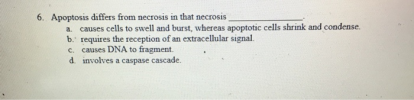 6. Apoptosis differs from necrosis in that necrosis a causes cells to swell and burst, whereas apoptotic cells shrink and condense. b. requires the reception of an extracellular signal. c. causes DNA to fragment. d. involves a caspase cascade.
11) Which of these cells are the least likely to be removed by apoptosis? a) Harmful...
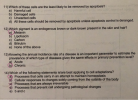 11) Which of these cells are the least likely to be removed by apoptosis? a) Harmful cell b) Damaged cells c) Unwanted cells d) All these cells should be removed by apoptosis unless apoptosis control is deranged. 12) Which pigment is an endogenous brown or dark brown present in the skin and hair? a) Melanin b) Lipofuscin c) Carbon d) Bilirubin e) None of the above 13) Knowing the annual incidence rate of a disease is an important parameter to...
_______________________ are enzymes routinely found in cells that are necessary for apoptosis to occur.
_______________________ are enzymes routinely found in cells that are necessary for apoptosis to occur.
What is apoptosis? a means of initiating DNA replication during growth a means of removing unneeded...
What is apoptosis? a means of initiating DNA replication during growth a means of removing unneeded proteins from a cell a process used by cancer cells to migrate through the body a process in which cells direct their own destruction When does a cell use apoptosis? Antibodies produced by the immune system use apoptosis to destroy foreign organisms. After a cell has become cancerous, it will rapidly begin the process of apoptosis. Existing cells go through apoptosis to produce new...
Cell death (apoptosis) is a structured and organized process. Describe why the process of shrinking and...
Cell death (apoptosis) is a structured and organized process. Describe why the process of shrinking and fragmenting virally infected cells, as opposed to breaking open the cell membrane to cause death, is beneficial to the rest of the body. Predict reactions to the arrest of apoptosis within in an organism. Justify your answers with examples.
what is ERISA?who does it protect and why is it important.
what is ERISA?who does it protect and why is it important.
1. Why do cancer cells spread throughout the body? Select all that apply (Think: how are...
1. Why do cancer cells spread throughout the body? Select all that apply (Think: how are cancer cells different than normal cells?) __________ a. They enrich nutrients at the original site b. They have loose adherence c. They travel through blood vessels d. They do not respond to contact inhibition e. They are fragile and damage easily f. They readily respond to signals for apoptosis 2. Benign cells have which characteristics? Select all that...
i need help in proposing experiment to show why T3 induces apoptosis in tail muscle and...
i need help in proposing experiment to show why T3 induces apoptosis in tail muscle and cell growth in limb muscle in tadpoles/amphibians. can you pleass provide diffent examples ? The thyroid hormone triiodothyronine (T3) causes apoptosis of muscle cells in the tail BUT causes muscle cell growth and differentiation in the limbs of tadpoles. You are to design an experiment that will allow you to show exactly how T3 induces such contradictory effects in these different muscle cells. Finally,...
 Apoptosis: Apoptosis is utilized by human cells to terminate cell growth for and resorb appendages like vestigial tails in human development. 3) How does the body know where to resorb these structures and how far back to apoptize the cells that make them up? 4) How does the body know when to turn this apoptotic signaling on during development so these events don't happen too soon or too late?
 6. Apoptosis differs from necrosis in that necrosis a causes cells to swell and burst, whereas apoptotic cells shrink and condense. b. requires the reception of an extracellular signal. c. causes DNA to fragment. d. involves a caspase cascade.
 11) Which of these cells are the least likely to be removed by apoptosis? a) Harmful cell b) Damaged cells c) Unwanted cells d) All these cells should be removed by apoptosis unless apoptosis control is deranged. 12) Which pigment is an endogenous brown or dark brown present in the skin and hair? a) Melanin b) Lipofuscin c) Carbon d) Bilirubin e) None of the above 13) Knowing the annual incidence rate of a disease is an important parameter to...
Most questions answered within 3 hours.
-
Where is the error in this code sequence?
String s1 = "Hello";
String s2 = "ello";...
asked 11 months ago -
Financial data for Joel de Paris, Inc., for last year
follow:
Joel de Paris, Inc.
Balance...
asked 11 months ago -
Consider this reaction:
Al2(SO4)3 (aq)+ BaCl3
(aq) Al2Cl6 (aq)- +
3BaSO4(s) . What is the...
asked 11 months ago -
Suppose that Savneet is considering increasing her
recent random sample from 20 car rentals to 40...
asked 11 months ago -
Trucks arrive at an unloading terminal at an average rate of 120
per hour.
Trucks arrive...
asked 11 months ago -
Why are methanol and ethanol completely soluble in water while
octanol is not very little soluble....
asked 11 months ago -
A facilities manager at a university reads in a research report
that the mean amount of...
asked 11 months ago -
When the CuSO4 is rehydrated by adding water to the anhydrous
compound, is this an endothermic...
asked 11 months ago -
A ray of sunlight is passing from diamond into crown glass; the
angle of incidence is...
asked 11 months ago -
A block of mass 0.249 kg is placed on top of a light, vertical
spring of...
asked 11 months ago -
how do the kidneys compensate in the presences of acidosis
a) trigger hyperventilate
b) reserve acid...
asked 11 months ago -
Question 501 pts
The rental rate of capital to the firm increases. Which of the
following...
asked 11 months ago