
Homework Answers
ANSWER :- COMMON NAME IS BREWER'S YEAST, BAKER'S YEAST
KINGDOM IS ; FUNGUS
CLASS IS; SACHHAROMYCETES
Saccharomyces cerevisiae is a single-celled eukaryote.
Saccharomyces cerevisiae is a species of yeast. It has been used in
wine making, baking, and brewing It is believed to have been
originally isolated from the skin of grapes. It is the
microorganism that is most commonly use for fermentation. S.
cerevisiae cells are round to ovoid, 5–10 micrometer in diameter.
It evaluates by a process called budding that is a division
process.
Brewing
Saccharomyces cerevisiae is valueable for brewing beer, when it is
sometimes called a top-fermenting or top-cropping yeast. it is
called top- fermenting yeast because during the fermentation
process its hydrophobic surface causes the flocs to adhere to CO2
and rise to the top of the fermentation vessel.
Baking
S. cerevisiae is used in baking; the carbon dioxide gas evaluated
by the fermentation is used as a leavening agent in bread and other
baked goods. Historically, this use was closely linked to the
brewing industry's use of yeast, as bakers took or bought the barm
or yeast-filled foam from brewing ale from the brewers.
Add Answer to:
accessible for review under the Lab menu button on BlacRBoard What is the comman name for...
1. You are working in a lab as a Bio 199 student. Your professor asks you...
 1. You are working in a lab as a Bio 199 student. Your professor asks you to use a microscope to observe the interaction between two proteins. Which of the following techniques are appropriate? A. FRAP, Fluorescence recovery after photobleaching B. FRET, Fluorescence resonance energy transfer C. Proximity ligation analysis D. FRET and proximity ligation analysis E. All of the answers are correct 2. Which two organelles appear most similar when viewed under an electron microscope? A. nucleus and lysosome...
BIOS242, Week 7, Lab2 Name: Questions: In this lab you used a dichotomous tree to identify...
 BIOS242, Week 7, Lab2 Name: Questions: In this lab you used a dichotomous tree to identify your unknown bacteria. Please describe what a dichotomous tree is, how it is used, and the importance of such a tree. Grading Rubric: Activity Points Case Studies Identify bacteria in all of the assigned case studies Case Studies: 3 points each Question: 3 point 15 bles Complete Work Sheet All Lab Deliverables 15
NAME: LAB DAY/TIME: testosten LABORATORY 4 POST LAB: LABORATORY 4 UUUUUUUUUUUUUUUUUUUU Review questions 1. Do platelets...
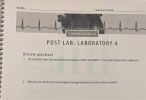 NAME: LAB DAY/TIME: testosten LABORATORY 4 POST LAB: LABORATORY 4 UUUUUUUUUUUUUUUUUUUU Review questions 1. Do platelets have the same features/shape as RBCs and WBCs? If so, what makes them different? 2. Why do you think men have higher average hematocrit values than women?
Dala lol lab meeting) Course/Section LAB ANALYSIS Instructor Partner's Name (if applicable) Review Questions 1-23 pertain...
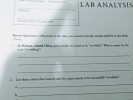 Dala lol lab meeting) Course/Section LAB ANALYSIS Instructor Partner's Name (if applicable) Review Questions 1-23 pertain to the video you viewed in the lab, entitled EARTH: A New Wild Home) 1. In Sichuan, central China giant pandas are raised to be re-wilded." What is meant by the "re-wilding term 2. List three criteria that must be met for a giant panda to be successfully "re-wilded.
MLT213 Pre-Lab Name____________________ Lab 8 RPR 1.The RPR test is a “non-treponemal” test. What does that...
MLT213 Pre-Lab Name____________________ Lab 8 RPR 1.The RPR test is a “non-treponemal” test. What does that mean? How does that influence the way the test result is reported? 2. When you read the RPR test you will observe clumping, yet this test is not categorized as an agglutination test. How is it categorized? 3. What is the active ingredient in the RPR test reagent? 4. What laboratory test is performed if a RPR is “reactive”? 5. Name two reasons why...
Question 18 Exercise 7: Stone Tool Technology Review the photo in the Image Library on p....
 Question 18 Exercise 7: Stone Tool Technology Review the photo in the Image Library on p. 453 and answer the questions in this exercise. (2001) What type of tool is this? O Direct Percussion O Chopper O Hammer Stone O Flake D Question 19 Exercise 7: Stone Tool Technology (Q003) What tool technology does this tool belong to? Acheulean O Mousterian O Upper Palaeolithic O Oldowan Question 20 Exercise 7: Stone Tool Technology (2004) Which of the following fossil species...
Review Questions 12 NAME LAB SECTION NO DATE In which phase of meiosis does cross -over...
 Review Questions 12 NAME LAB SECTION NO DATE In which phase of meiosis does cross -over occur 2. In which phase of meiosis do the ser chromatics of the checosomessere completely from each other 3. In which phase of meiosis does a clear enw become organised around each group of chromatis? 4. What are chromosomal homologues (homologous chromosomes 5. What is a cell equator? 6. Which phase of meiosis takes the longest to complete? 7. What same is given to...
Procedure: 1. Cladogram Of The Basic Animal Groups Covered in This Lab. Section 1 Questions on...
 Procedure: 1. Cladogram Of The Basic Animal Groups Covered in This Lab. Section 1 Questions on the cladogram and reading. After reading the introduction information and look at the cladogram (figure 1) answer questions 1 to 19 on the answer sheet. Note that you will need to use the terms described in the introduction to the lab so make sure that you have read this material thoroughly before starting Chordata opoda Annelida Mollusca Echinodermata notocord shell adult I radial symmetry...
please answer the questions thank you Name: Lab Section: Date: Experiment VII: Buffers Review Questions (23...
 please answer the questions thank you
Name: Lab Section: Date: Experiment VII: Buffers Review Questions (23 pts) 1. (3 pts). A solution is prepared by mixing 25.0 mL 0.45 M NaCH,coo and 30.0 mL 0.38 M CH,COOH is prepared. Calculate the pH of this solution if the K, 1.76 x 10 for acetic acid. 2. (3 pts)How many grams of sodium lactate, NaCsHsOs, should be added to 1.00 L of 0.150 M lactic acid, HCsHsOs, to form a buffer solution...
please answer the questions thank you
Name: Lab Section: Date: Experiment VII: Buffers Review Questions (23 pts) 1. (3 pts). A solution is prepared by mixing 25.0 mL 0.45 M NaCH,coo and 30.0 mL 0.38 M CH,COOH is prepared. Calculate the pH of this solution if the K, 1.76 x 10 for acetic acid. 2. (3 pts)How many grams of sodium lactate, NaCsHsOs, should be added to 1.00 L of 0.150 M lactic acid, HCsHsOs, to form a buffer solution...
CH 112 Date Section Instructor Name Team Pre-Lab Questions 1. What is the difference between an...
 CH 112 Date Section Instructor Name Team Pre-Lab Questions 1. What is the difference between an Arrhenius base and a Brønsted-Lowry base? 2. Why are acid-base reactions called neutralization reactions? 3. What does the pH of a solution tell you? : Properties of Acids and Bases Acid Base Neutral af with Unknown
 1. You are working in a lab as a Bio 199 student. Your professor asks you to use a microscope to observe the interaction between two proteins. Which of the following techniques are appropriate? A. FRAP, Fluorescence recovery after photobleaching B. FRET, Fluorescence resonance energy transfer C. Proximity ligation analysis D. FRET and proximity ligation analysis E. All of the answers are correct 2. Which two organelles appear most similar when viewed under an electron microscope? A. nucleus and lysosome...
 BIOS242, Week 7, Lab2 Name: Questions: In this lab you used a dichotomous tree to identify your unknown bacteria. Please describe what a dichotomous tree is, how it is used, and the importance of such a tree. Grading Rubric: Activity Points Case Studies Identify bacteria in all of the assigned case studies Case Studies: 3 points each Question: 3 point 15 bles Complete Work Sheet All Lab Deliverables 15
 NAME: LAB DAY/TIME: testosten LABORATORY 4 POST LAB: LABORATORY 4 UUUUUUUUUUUUUUUUUUUU Review questions 1. Do platelets have the same features/shape as RBCs and WBCs? If so, what makes them different? 2. Why do you think men have higher average hematocrit values than women?
 Dala lol lab meeting) Course/Section LAB ANALYSIS Instructor Partner's Name (if applicable) Review Questions 1-23 pertain to the video you viewed in the lab, entitled EARTH: A New Wild Home) 1. In Sichuan, central China giant pandas are raised to be re-wilded." What is meant by the "re-wilding term 2. List three criteria that must be met for a giant panda to be successfully "re-wilded.
 Question 18 Exercise 7: Stone Tool Technology Review the photo in the Image Library on p. 453 and answer the questions in this exercise. (2001) What type of tool is this? O Direct Percussion O Chopper O Hammer Stone O Flake D Question 19 Exercise 7: Stone Tool Technology (Q003) What tool technology does this tool belong to? Acheulean O Mousterian O Upper Palaeolithic O Oldowan Question 20 Exercise 7: Stone Tool Technology (2004) Which of the following fossil species...
 Review Questions 12 NAME LAB SECTION NO DATE In which phase of meiosis does cross -over occur 2. In which phase of meiosis do the ser chromatics of the checosomessere completely from each other 3. In which phase of meiosis does a clear enw become organised around each group of chromatis? 4. What are chromosomal homologues (homologous chromosomes 5. What is a cell equator? 6. Which phase of meiosis takes the longest to complete? 7. What same is given to...
 Procedure: 1. Cladogram Of The Basic Animal Groups Covered in This Lab. Section 1 Questions on the cladogram and reading. After reading the introduction information and look at the cladogram (figure 1) answer questions 1 to 19 on the answer sheet. Note that you will need to use the terms described in the introduction to the lab so make sure that you have read this material thoroughly before starting Chordata opoda Annelida Mollusca Echinodermata notocord shell adult I radial symmetry...
 please answer the questions thank you
Name: Lab Section: Date: Experiment VII: Buffers Review Questions (23 pts) 1. (3 pts). A solution is prepared by mixing 25.0 mL 0.45 M NaCH,coo and 30.0 mL 0.38 M CH,COOH is prepared. Calculate the pH of this solution if the K, 1.76 x 10 for acetic acid. 2. (3 pts)How many grams of sodium lactate, NaCsHsOs, should be added to 1.00 L of 0.150 M lactic acid, HCsHsOs, to form a buffer solution...
please answer the questions thank you
Name: Lab Section: Date: Experiment VII: Buffers Review Questions (23 pts) 1. (3 pts). A solution is prepared by mixing 25.0 mL 0.45 M NaCH,coo and 30.0 mL 0.38 M CH,COOH is prepared. Calculate the pH of this solution if the K, 1.76 x 10 for acetic acid. 2. (3 pts)How many grams of sodium lactate, NaCsHsOs, should be added to 1.00 L of 0.150 M lactic acid, HCsHsOs, to form a buffer solution...
 CH 112 Date Section Instructor Name Team Pre-Lab Questions 1. What is the difference between an Arrhenius base and a Brønsted-Lowry base? 2. Why are acid-base reactions called neutralization reactions? 3. What does the pH of a solution tell you? : Properties of Acids and Bases Acid Base Neutral af with Unknown
Most questions answered within 3 hours.
-
Where is the error in this code sequence?
String s1 = "Hello";
String s2 = "ello";...
asked 10 months ago -
Financial data for Joel de Paris, Inc., for last year
follow:
Joel de Paris, Inc.
Balance...
asked 10 months ago -
Consider this reaction:
Al2(SO4)3 (aq)+ BaCl3
(aq) Al2Cl6 (aq)- +
3BaSO4(s) . What is the...
asked 10 months ago -
Suppose that Savneet is considering increasing her
recent random sample from 20 car rentals to 40...
asked 10 months ago -
Trucks arrive at an unloading terminal at an average rate of 120
per hour.
Trucks arrive...
asked 10 months ago -
Why are methanol and ethanol completely soluble in water while
octanol is not very little soluble....
asked 10 months ago -
A facilities manager at a university reads in a research report
that the mean amount of...
asked 10 months ago -
When the CuSO4 is rehydrated by adding water to the anhydrous
compound, is this an endothermic...
asked 10 months ago -
A ray of sunlight is passing from diamond into crown glass; the
angle of incidence is...
asked 10 months ago -
A block of mass 0.249 kg is placed on top of a light, vertical
spring of...
asked 10 months ago -
how do the kidneys compensate in the presences of acidosis
a) trigger hyperventilate
b) reserve acid...
asked 10 months ago -
Question 501 pts
The rental rate of capital to the firm increases. Which of the
following...
asked 10 months ago