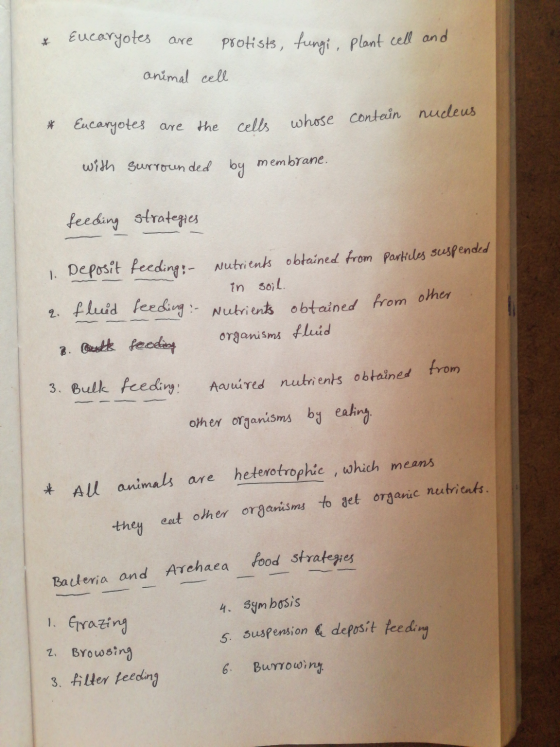
Bacteria and Archaea can use all 6 feeding strategies, but Eukaryotes can only use _ and...
Homework Answers
Add Answer to:
Bacteria and Archaea can use all 6 feeding strategies, but
Eukaryotes can only use _ and...
Which of the following statements is not true regarding the differences between bacteria, archaea, and eukaryotes?...
 Which of the following statements is not true regarding the differences between bacteria, archaea, and eukaryotes? a) Flagella are found on bacteria, archaea and eukaryotes yet they all vary in b Bacteria and archaea have circular chromosomes in a nucleoid region ) The cell walls of bacteria and archaea both contain the complex d) Ribosomal RNA sequencing revealed that the structure of the ribosomal structure whereas eukaryotes have linear chromosomes that are enclosed in a nuclear membrane macromolecule peptidoglycan, whereas...
Bacteria and archaea are both prokaryotes. But Carl Woese proposed that archaea are closer to eukaryotes....
Bacteria and archaea are both prokaryotes. But Carl Woese proposed that archaea are closer to eukaryotes. What’s the evidence for his theory?
Combine, into one tree, the phylogeny given in class for the Bacteria and Archaea and Eukaryotes...
 Combine, into one tree, the phylogeny given in class for the
Bacteria and Archaea and Eukaryotes with the phylogeny given for
Eukaryotes.
(i.e. make one tree that relates: Cyanobacteria,
Chloroplasts, Rhizobium, Mitochondria, E. coli, Lokiarchaeota,
TACK, Euryarchaeota, SAR, Red Algae, Green algae and Plants, Fungi,
and Metazoans.)
SAR Cilliates, Diatoms Brown Algae, etc. -Red Algae Plants + Green Algae Fungi Metazoans (Animals) – Eukaryotes Modern Cyanobacteria Lokiarchaeota Euryarchaeota Chloroplasts - TACK Archaea Rhizobium - Mitochondria - E.coli
Combine, into one tree, the phylogeny given in class for the
Bacteria and Archaea and Eukaryotes with the phylogeny given for
Eukaryotes.
(i.e. make one tree that relates: Cyanobacteria,
Chloroplasts, Rhizobium, Mitochondria, E. coli, Lokiarchaeota,
TACK, Euryarchaeota, SAR, Red Algae, Green algae and Plants, Fungi,
and Metazoans.)
SAR Cilliates, Diatoms Brown Algae, etc. -Red Algae Plants + Green Algae Fungi Metazoans (Animals) – Eukaryotes Modern Cyanobacteria Lokiarchaeota Euryarchaeota Chloroplasts - TACK Archaea Rhizobium - Mitochondria - E.coli
1 Describe/diagram the evolutionary relationship of prokaryotes to eukaryotes (and bacteria to archaea) 2 Describe the...
1 Describe/diagram the evolutionary relationship of prokaryotes to eukaryotes (and bacteria to archaea) 2 Describe the variation in modes of nutrition among prokaryotes 3 Describe the processes of prokaryotic reproduction, including both vertical and horizontal gene transfer 4 Described the ecological importance of prokaryotes (including positive and negative impacts on humans)
43.Lipopolysaccharides (LPS) are found in: a. Gram-positive bacteria b. Gram-negative bacteria c. all Bacteria d. Archaea...
43.Lipopolysaccharides (LPS) are found in: a. Gram-positive bacteria b. Gram-negative bacteria c. all Bacteria d. Archaea e. Eukaryotes ------------------------- 44. There are similarities and differences between Gram-negative and Gram-positive bacteria. Which of the following is not true? a. The cell wall of Gram-negative cells is composed of only one or two layers of peptidoglycan whereas the cell walls of Grampositive bacteria have many peptidoglycan layers b. Only Gram-positive bacterial cells have a periplasm 2/6/18 8 c. The cell membranes of...
Why is Streptomycin only effective against bacteria, and not archaea as well? I thought its mechanism...
 Why is Streptomycin only effective against bacteria,
and not archaea as well? I thought its mechanism of action had to
do with its binding site on the 30S ribosomal subunit, but archaea
have this as well, so why is it not effective against both?
For reference, I was asked to explain how the mode of
action of each antibiotic relates to the organisms in each
domain.
is down partenere a cyclo acteria on the basis of sensitivity to antimicrobial chemicals....
Why is Streptomycin only effective against bacteria,
and not archaea as well? I thought its mechanism of action had to
do with its binding site on the 30S ribosomal subunit, but archaea
have this as well, so why is it not effective against both?
For reference, I was asked to explain how the mode of
action of each antibiotic relates to the organisms in each
domain.
is down partenere a cyclo acteria on the basis of sensitivity to antimicrobial chemicals....
Bacteria contains only one RNA polymerase. Both bacteria and eukaryotes only have one RNA polymerase. Question...
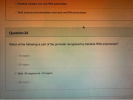 Bacteria contains only one RNA polymerase. Both bacteria and eukaryotes only have one RNA polymerase. Question 26 Which of the following is part of the promoter recognized by bacteria RNA polymerase? -10 region -35 region Both -35 regiona dn -10 region. -40 region
How do the genomes of Archaea and Bacteria compare? Drag and drop the phrases on the...
 How do the genomes of Archaea and Bacteria compare? Drag and
drop the phrases on the left to complete the sentences on the
right.
Part D Genome size of Archaea versus Bacteria How do the genomes of Archaea and Bacteria compare? Drag and drop the phrases on the left to complete the sentences on the right. Reset Help is/are larger than 1. Just by knowing that the Thaumarchaeota are Archaea, it isare smaller than those of s possible to predict...
How do the genomes of Archaea and Bacteria compare? Drag and
drop the phrases on the left to complete the sentences on the
right.
Part D Genome size of Archaea versus Bacteria How do the genomes of Archaea and Bacteria compare? Drag and drop the phrases on the left to complete the sentences on the right. Reset Help is/are larger than 1. Just by knowing that the Thaumarchaeota are Archaea, it isare smaller than those of s possible to predict...
QUESTION 19 All of the following describes organisms in the domains Bacteria and or Archaea except...
 QUESTION 19 All of the following describes organisms in the domains Bacteria and or Archaea except O Cell wall O Multicellular O Single celled O Prokaryotic
) Mollusks use a variety of different feeding/digestive strategies depending on the class. For the classes...
) Mollusks use a variety of different feeding/digestive strategies depending on the class. For the classes gatropoda and bivalvia: i) provide the path of food through each animal using a simple flow chart (x-> y -> z) containing all relevant structures or parts ii) explain in one or two sentences why this difference in feeding strategies makes sense for the lifestyles of the two classes iii) What are the primary differences between the digestion of mollusks and the digestion of...
 Which of the following statements is not true regarding the differences between bacteria, archaea, and eukaryotes? a) Flagella are found on bacteria, archaea and eukaryotes yet they all vary in b Bacteria and archaea have circular chromosomes in a nucleoid region ) The cell walls of bacteria and archaea both contain the complex d) Ribosomal RNA sequencing revealed that the structure of the ribosomal structure whereas eukaryotes have linear chromosomes that are enclosed in a nuclear membrane macromolecule peptidoglycan, whereas...
 Combine, into one tree, the phylogeny given in class for the
Bacteria and Archaea and Eukaryotes with the phylogeny given for
Eukaryotes.
(i.e. make one tree that relates: Cyanobacteria,
Chloroplasts, Rhizobium, Mitochondria, E. coli, Lokiarchaeota,
TACK, Euryarchaeota, SAR, Red Algae, Green algae and Plants, Fungi,
and Metazoans.)
SAR Cilliates, Diatoms Brown Algae, etc. -Red Algae Plants + Green Algae Fungi Metazoans (Animals) – Eukaryotes Modern Cyanobacteria Lokiarchaeota Euryarchaeota Chloroplasts - TACK Archaea Rhizobium - Mitochondria - E.coli
Combine, into one tree, the phylogeny given in class for the
Bacteria and Archaea and Eukaryotes with the phylogeny given for
Eukaryotes.
(i.e. make one tree that relates: Cyanobacteria,
Chloroplasts, Rhizobium, Mitochondria, E. coli, Lokiarchaeota,
TACK, Euryarchaeota, SAR, Red Algae, Green algae and Plants, Fungi,
and Metazoans.)
SAR Cilliates, Diatoms Brown Algae, etc. -Red Algae Plants + Green Algae Fungi Metazoans (Animals) – Eukaryotes Modern Cyanobacteria Lokiarchaeota Euryarchaeota Chloroplasts - TACK Archaea Rhizobium - Mitochondria - E.coli
 Why is Streptomycin only effective against bacteria,
and not archaea as well? I thought its mechanism of action had to
do with its binding site on the 30S ribosomal subunit, but archaea
have this as well, so why is it not effective against both?
For reference, I was asked to explain how the mode of
action of each antibiotic relates to the organisms in each
domain.
is down partenere a cyclo acteria on the basis of sensitivity to antimicrobial chemicals....
Why is Streptomycin only effective against bacteria,
and not archaea as well? I thought its mechanism of action had to
do with its binding site on the 30S ribosomal subunit, but archaea
have this as well, so why is it not effective against both?
For reference, I was asked to explain how the mode of
action of each antibiotic relates to the organisms in each
domain.
is down partenere a cyclo acteria on the basis of sensitivity to antimicrobial chemicals....
 Bacteria contains only one RNA polymerase. Both bacteria and eukaryotes only have one RNA polymerase. Question 26 Which of the following is part of the promoter recognized by bacteria RNA polymerase? -10 region -35 region Both -35 regiona dn -10 region. -40 region
 How do the genomes of Archaea and Bacteria compare? Drag and
drop the phrases on the left to complete the sentences on the
right.
Part D Genome size of Archaea versus Bacteria How do the genomes of Archaea and Bacteria compare? Drag and drop the phrases on the left to complete the sentences on the right. Reset Help is/are larger than 1. Just by knowing that the Thaumarchaeota are Archaea, it isare smaller than those of s possible to predict...
How do the genomes of Archaea and Bacteria compare? Drag and
drop the phrases on the left to complete the sentences on the
right.
Part D Genome size of Archaea versus Bacteria How do the genomes of Archaea and Bacteria compare? Drag and drop the phrases on the left to complete the sentences on the right. Reset Help is/are larger than 1. Just by knowing that the Thaumarchaeota are Archaea, it isare smaller than those of s possible to predict...
 QUESTION 19 All of the following describes organisms in the domains Bacteria and or Archaea except O Cell wall O Multicellular O Single celled O Prokaryotic
Most questions answered within 3 hours.
-
Where is the error in this code sequence?
String s1 = "Hello";
String s2 = "ello";...
asked 10 months ago -
Financial data for Joel de Paris, Inc., for last year
follow:
Joel de Paris, Inc.
Balance...
asked 10 months ago -
Consider this reaction:
Al2(SO4)3 (aq)+ BaCl3
(aq) Al2Cl6 (aq)- +
3BaSO4(s) . What is the...
asked 10 months ago -
Suppose that Savneet is considering increasing her
recent random sample from 20 car rentals to 40...
asked 10 months ago -
Trucks arrive at an unloading terminal at an average rate of 120
per hour.
Trucks arrive...
asked 10 months ago -
Why are methanol and ethanol completely soluble in water while
octanol is not very little soluble....
asked 10 months ago -
A facilities manager at a university reads in a research report
that the mean amount of...
asked 10 months ago -
When the CuSO4 is rehydrated by adding water to the anhydrous
compound, is this an endothermic...
asked 10 months ago -
A ray of sunlight is passing from diamond into crown glass; the
angle of incidence is...
asked 10 months ago -
A block of mass 0.249 kg is placed on top of a light, vertical
spring of...
asked 10 months ago -
how do the kidneys compensate in the presences of acidosis
a) trigger hyperventilate
b) reserve acid...
asked 10 months ago -
Question 501 pts
The rental rate of capital to the firm increases. Which of the
following...
asked 10 months ago