You are testing a diffraction gradient for isolating green light (510 nm). Determine the angle at...
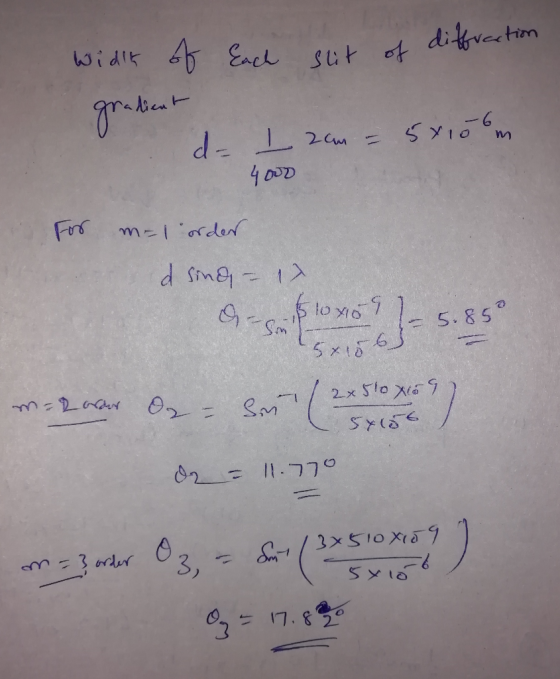
You are testing a diffraction gradient for isolating green light (510 nm). Determine the angle at which the green light leaves from a diffraction gradient for orders 1, 2 and 3 if the gradient has 4000 groves over a 2 cm width. Assume the sines are added in the equation. Assume light is hitting the surface at 0° to the normal
Homework Answers
Add Answer to:
You are testing a diffraction gradient for isolating green light
(510 nm). Determine the angle at...
(a) White light is spread out into its spectral components by a diffraction grating. If the...
 (a) White light is spread out into its spectral components by a diffraction grating. If the grating has 2,070 grooves per centimeter, at what angle (in degrees) does red light of wavelength 640 nm appear in first order? (Assume that the light is incident normally on the gratings.) (b) What If? What is the angular separation (in degrees) between the first-order maximum for 640 nm red light and the first-order maximum for green light of wavelength 525 nm? 11. (-/1...
You send coherent 550 nm light through a diffraction grating that has slits of equal widths...
You send coherent 550 nm light through a diffraction grating that has slits of equal widths and constant separation between adjacent slits. You expect to see the fourth-order interference maximum at an angle of 66.6∘ with respect to the normal to the grating. However, that order is missing because 66.6∘ is also the angle for the third diffraction minimum (as measured from the central diffraction maximum) for each slit. a. Find the center-to-center distance between adjacent slits. b. Find the...
2. You have a diffraction grating with 2500 lines/cm. You also have a light source that...
2. You have a diffraction grating with 2500 lines/cm. You also have a light source that emits light at 2 different wavelengths, 540 nm and 690 nm, at the same time. The screen for your experiment is 1.2 meters from the diffraction grating. A. What is the line spacing for the grating? B. What is the difference in the angle of the 2nd bright fringe for each wavelength for this grating? C. Which wavelength is closer to the center of...
Problem #4 (2 points) Double-slit interference and diffraction combined Light of wave length 440 nm passes...
 Problem #4 (2 points) Double-slit interference and diffraction combined Light of wave length 440 nm passes through a double slit, yielding the diffraction pattern of intensity | versus diffraction angle 0 as shown in the figure below. Calculate (a) the slit width and (b) the slit separation. (c) Verify the displayed intensities of the m=1 and m= 2 interference fringes. Intensity (mW/cm) oo Deflection (degrees)
(a) A narrow beam of light containing red (660 nm) and green (550 nm) wavelengths goes...
 (a) A narrow beam of light containing red (660 nm) and green (550 nm) wavelengths goes from polystyrene to air, striking the surface at a 33.0 incident angle. What is the angle in degrees) between the colors when they emerge? (b) How far would they have to travel in m) to be separated by 1.00 mm? m + C-16.66 Points) DETAILS MY NOTES ASK YOUR TEACHER A converging lens has a focal length of 46.0 cm. If an object is...
(a) A narrow beam of light containing red (660 nm) and green (550 nm) wavelengths goes...
 (a) A narrow beam of light containing red (660 nm) and green (550 nm) wavelengths goes from polystyrene to air, striking the surface at a 30.5 incident angle. What is the angle (in degrees) between the colors when they emerge? Cm (b) How far would they have to travel (in m) to be separated by 1.00 mm? m Submit Answer 10. (-/6,66 Points] DETAILS MY NOTES ASK YOUR TEACHER A converging lens has a focal length of 46.0 cm. If...
Green light (2 = 552 nm) strikes a single slit at normal incidence. Part A What...
 Green light (2 = 552 nm) strikes a single slit at normal incidence. Part A What width slit will produce a central maximum that is 2.50 cm wide on a screen 2.20 m from the slit? Express your answer to three significant figures. VO ΑΣΦ ? W= um Submit Request Answer Provide Feedback Next >
The below interference/diffraction pattern for two slits is observed on a screen that is 1.5 meters from the slits. Here, red light with a wavelength of 700 nm (7.0x10⁻⁷ m) that is normally incident...
 The below interference/diffraction pattern for two slits is observed on a screen that is 1.5 meters from the slits. Here, red light with a wavelength of 700 nm (7.0x10⁻⁷ m) that is normally incident on these slits yields this pattern. 9 mm 4 mm Using the locations of interference maxima (e.g., the m-2 maxima lies 4.0 mm from the center of the pattern), determine the distance between these two slits (in millimeters). For the above pattern, using the location of...
1. Monochromatic blue light of wavelength 440-nm passes through a 3300 lines/cm diffraction grating and the...
 1. Monochromatic blue light of wavelength 440-nm passes through a 3300 lines/cm diffraction grating and the interference pattern is observed on a screen. (a) Determine the interference angle for the 2nd order bright fringe. (5 points) (b) If a screen is 0.75-m away, how far (in cm) is the 2nd order bright fringe from the center? Show all steps. [3 points) (c) Sketch the path taken by this light to reach the center, the 1st and 2nd order bright fringes....
1. Monochromatic blue light of wavelength 440-nm passes through a 3300 lines/cm diffraction grating and the...
 1. Monochromatic blue light of wavelength 440-nm passes through a 3300 lines/cm diffraction grating and the interference pattern is observed on a screen. (a) Determine the interference angle for the 2nd order bright fringe. 15 points) (b) If a screen is 0.75-m away, how far (in cm) is the 2nd order bright fringe from the center? Show all steps. [3 points) (c) Sketch the path taken by this light to reach the center, the 1st and 2nd order bright fringes....
 (a) White light is spread out into its spectral components by a diffraction grating. If the grating has 2,070 grooves per centimeter, at what angle (in degrees) does red light of wavelength 640 nm appear in first order? (Assume that the light is incident normally on the gratings.) (b) What If? What is the angular separation (in degrees) between the first-order maximum for 640 nm red light and the first-order maximum for green light of wavelength 525 nm? 11. (-/1...
 Problem #4 (2 points) Double-slit interference and diffraction combined Light of wave length 440 nm passes through a double slit, yielding the diffraction pattern of intensity | versus diffraction angle 0 as shown in the figure below. Calculate (a) the slit width and (b) the slit separation. (c) Verify the displayed intensities of the m=1 and m= 2 interference fringes. Intensity (mW/cm) oo Deflection (degrees)
 (a) A narrow beam of light containing red (660 nm) and green (550 nm) wavelengths goes from polystyrene to air, striking the surface at a 33.0 incident angle. What is the angle in degrees) between the colors when they emerge? (b) How far would they have to travel in m) to be separated by 1.00 mm? m + C-16.66 Points) DETAILS MY NOTES ASK YOUR TEACHER A converging lens has a focal length of 46.0 cm. If an object is...
 (a) A narrow beam of light containing red (660 nm) and green (550 nm) wavelengths goes from polystyrene to air, striking the surface at a 30.5 incident angle. What is the angle (in degrees) between the colors when they emerge? Cm (b) How far would they have to travel (in m) to be separated by 1.00 mm? m Submit Answer 10. (-/6,66 Points] DETAILS MY NOTES ASK YOUR TEACHER A converging lens has a focal length of 46.0 cm. If...
 Green light (2 = 552 nm) strikes a single slit at normal incidence. Part A What width slit will produce a central maximum that is 2.50 cm wide on a screen 2.20 m from the slit? Express your answer to three significant figures. VO ΑΣΦ ? W= um Submit Request Answer Provide Feedback Next >
 The below interference/diffraction pattern for two slits is observed on a screen that is 1.5 meters from the slits. Here, red light with a wavelength of 700 nm (7.0x10⁻⁷ m) that is normally incident on these slits yields this pattern. 9 mm 4 mm Using the locations of interference maxima (e.g., the m-2 maxima lies 4.0 mm from the center of the pattern), determine the distance between these two slits (in millimeters). For the above pattern, using the location of...
 1. Monochromatic blue light of wavelength 440-nm passes through a 3300 lines/cm diffraction grating and the interference pattern is observed on a screen. (a) Determine the interference angle for the 2nd order bright fringe. (5 points) (b) If a screen is 0.75-m away, how far (in cm) is the 2nd order bright fringe from the center? Show all steps. [3 points) (c) Sketch the path taken by this light to reach the center, the 1st and 2nd order bright fringes....
 1. Monochromatic blue light of wavelength 440-nm passes through a 3300 lines/cm diffraction grating and the interference pattern is observed on a screen. (a) Determine the interference angle for the 2nd order bright fringe. 15 points) (b) If a screen is 0.75-m away, how far (in cm) is the 2nd order bright fringe from the center? Show all steps. [3 points) (c) Sketch the path taken by this light to reach the center, the 1st and 2nd order bright fringes....
Most questions answered within 3 hours.
-
Where is the error in this code sequence?
String s1 = "Hello";
String s2 = "ello";...
asked 11 months ago -
Financial data for Joel de Paris, Inc., for last year
follow:
Joel de Paris, Inc.
Balance...
asked 11 months ago -
Consider this reaction:
Al2(SO4)3 (aq)+ BaCl3
(aq) Al2Cl6 (aq)- +
3BaSO4(s) . What is the...
asked 11 months ago -
Suppose that Savneet is considering increasing her
recent random sample from 20 car rentals to 40...
asked 11 months ago -
Trucks arrive at an unloading terminal at an average rate of 120
per hour.
Trucks arrive...
asked 11 months ago -
Why are methanol and ethanol completely soluble in water while
octanol is not very little soluble....
asked 11 months ago -
A facilities manager at a university reads in a research report
that the mean amount of...
asked 11 months ago -
When the CuSO4 is rehydrated by adding water to the anhydrous
compound, is this an endothermic...
asked 11 months ago -
A ray of sunlight is passing from diamond into crown glass; the
angle of incidence is...
asked 11 months ago -
A block of mass 0.249 kg is placed on top of a light, vertical
spring of...
asked 11 months ago -
how do the kidneys compensate in the presences of acidosis
a) trigger hyperventilate
b) reserve acid...
asked 11 months ago -
Question 501 pts
The rental rate of capital to the firm increases. Which of the
following...
asked 11 months ago