
Homework Answers
Add Answer to:
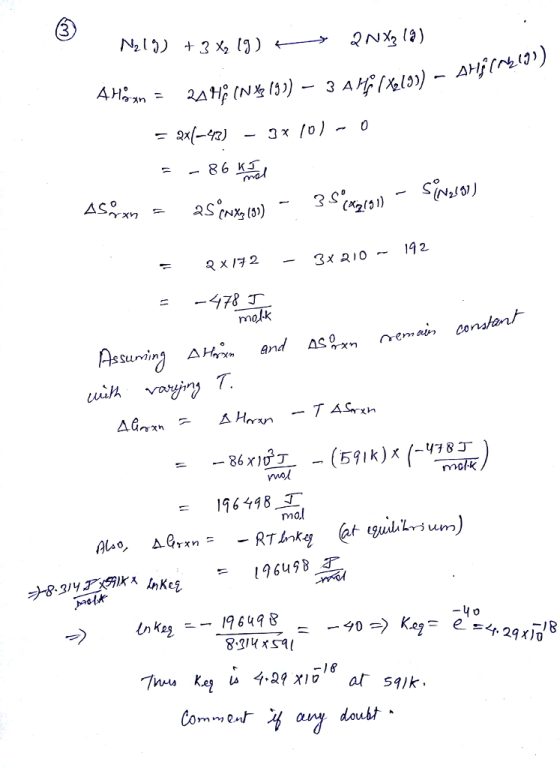
3. (12 pts) Consider the reaction N2(g)+3X2(g) 2NX,(g) H(kJ/mol 0.00.0 210 43 172 S° (J/mol.K) 192...
Find ΔrG for the following (in kJ mol-1) N2 (g) + 3 H2 (g) ⇌ 2...
Find ΔrG for the following (in kJ mol-1) N2 (g) + 3 H2 (g) ⇌ 2 NH3 (g) The conditions for this reaction are: Temp: 298k P - NH3 = 0.95 bar P - H2 = 1.95 bar P - N2 = 1.25 bar NH3(g) ?H ∙(kJ mol-1) = -45.9 ?G ∙(kJ mol-1) = -16.4 S ∙(J K-1 mol-1)192.8 N2(g) ?H ∙(kJ mol-1) = 0 ?G ∙(kJ mol-1) = 0 S ∙(J K-1 mol-1)191.6 H2(g) ?H ∙(kJ mol-1) = 0...
For the reaction N2(g) + O2(g)2NO(g) H° = 180.6 kJ and S° = 24.9 J/K The...
For the reaction N2(g) + O2(g)2NO(g) H° = 180.6 kJ and S° = 24.9 J/K The equilibrium constant for this reaction at 259.0 K is . Assume that H° and S° are independent of temperature.
Consider the following reaction, for which ∆H° = -113.1 kJ/mol and ∆S° = -145.34 J/mol·K. 2NO(g)...
Consider the following reaction, for which ∆H° = -113.1 kJ/mol and ∆S° = -145.34 J/mol·K. 2NO(g) + O2(g) ⇌ 2NO2(g) Assume ∆H° and ∆S° do not vary appreciably with change in temperature. This reaction will only be spontaneous at a temperature _____(i)_____ than ______(ii)_____. (i) lower (ii) 298.15 K (i) higher (ii) 1285 K (i) higher (ii) 1285 K (i) lower (ii) 778 K (i) higher (ii) 778 K
For the reaction N2(g) + O2(g)2NO(g) H° = 181 kJ and S° = 24.9 J/K G°...
For the reaction N2(g) + O2(g)2NO(g) H° = 181 kJ and S° = 24.9 J/K G° would be negative at temperatures (above, below) K. Enter above or below in the first box and enter the temperature in the second box. Assume that H° and S° are constant.
A reaction has and △H°298 = 106 kJ/mol and △S°298 = 326 J /mol K at...
A reaction has and △H°298 = 106 kJ/mol and △S°298 = 326 J /mol K at 298 K. Calculate △G in kJ/mol.
For the reaction H^2 (g) + S(s) right arrow H^2 (g), delta?degree = - 20.2 kJ/mol...
 For the reaction H^2 (g) + S(s) right arrow H^2 (g), delta?degree = - 20.2 kJ/mol and deltaSdegree = + 43.1 J/K-mol. Calculate deltaGdegree at 500degreeC. For the reaction H^2 (g) + S(s) right arrow H^2S(g), delta?degree = - 20.2 kJ/mol and deltaSdegree = + 43.1 J/K mol. Use the deltaGdegree value calculated at 500degreeC. Calculate deltaG for this reaction at 1500degreeC if P(H^2, g) = P(H^2S, g) = 10.0 atm. Show all standard calculation.
2. The reaction N2 (g)+3 F2 (g)2 NF3 (g), has AH° is -248.6 kJ mol and...
 2. The reaction N2 (g)+3 F2 (g)2 NF3 (g), has AH° is -248.6 kJ mol and ArS° is -278.7J K mol. Calculate the temperature at which the reaction will be at equilibrium. Assume A,H° and A,S are independent of temperature.
For a given reaction, Delta H = -19.9 kJ/mol and Delta S = -55.5 J/K-mol. Calculate...
 For a given reaction, Delta H = -19.9 kJ/mol and Delta S = -55.5 J/K-mol. Calculate the temperature in K where Delta G = 0. Assume that Delta H and Delta S do not vary with temperature. Also, what is the equilibrium constant at that temperature?
Given the following data: H3PO4(aq) H+ H2PO4-(aq) ∆Hof(kJ/mol) -1288.3 0 -1285 ∆S (J/mol.K ) 158.2 0...
Given the following data: H3PO4(aq) H+ H2PO4-(aq) ∆Hof(kJ/mol) -1288.3 0 -1285 ∆S (J/mol.K ) 158.2 0 89 (ΔGo = ΔHo -T ΔS; lnK = ΔGo/-RT) Calculate: 1. Standard free energy 2. K phosphoric acid and 3. Comment on the thermodynamic factors ( calculated ∆Ho and ∆S) that account/s for the fact that H3PO4 is a weak acid.
1)Consider the reaction B2H6(g) + 3 O2(g) → B2O3(s) + 3 H2O(g) ∆H = -2035 kJ/mol...
1)Consider the reaction B2H6(g) + 3 O2(g) → B2O3(s) + 3 H2O(g) ∆H = -2035 kJ/mol Calculate the amount of heat released when 37.1 g of diborane is burned. 2) Consider the reaction B2H6(g) + 3 O2(g) → B2O3(s) + 3 H2O(g) ∆H = -2035 kJ How much heat is released when a mixture of 9.71 g B2H6 and 1.53 g O2 is burned? 3)Consider the reaction B2H6(g) + 3 O2(g) → B2O3(s) + 3 H2O(g) ∆H = -2035 kJ...
 For the reaction H^2 (g) + S(s) right arrow H^2 (g), delta?degree = - 20.2 kJ/mol and deltaSdegree = + 43.1 J/K-mol. Calculate deltaGdegree at 500degreeC. For the reaction H^2 (g) + S(s) right arrow H^2S(g), delta?degree = - 20.2 kJ/mol and deltaSdegree = + 43.1 J/K mol. Use the deltaGdegree value calculated at 500degreeC. Calculate deltaG for this reaction at 1500degreeC if P(H^2, g) = P(H^2S, g) = 10.0 atm. Show all standard calculation.
 2. The reaction N2 (g)+3 F2 (g)2 NF3 (g), has AH° is -248.6 kJ mol and ArS° is -278.7J K mol. Calculate the temperature at which the reaction will be at equilibrium. Assume A,H° and A,S are independent of temperature.
 For a given reaction, Delta H = -19.9 kJ/mol and Delta S = -55.5 J/K-mol. Calculate the temperature in K where Delta G = 0. Assume that Delta H and Delta S do not vary with temperature. Also, what is the equilibrium constant at that temperature?
Most questions answered within 3 hours.
-
Where is the error in this code sequence?
String s1 = "Hello";
String s2 = "ello";...
asked 11 months ago -
Financial data for Joel de Paris, Inc., for last year
follow:
Joel de Paris, Inc.
Balance...
asked 11 months ago -
Consider this reaction:
Al2(SO4)3 (aq)+ BaCl3
(aq) Al2Cl6 (aq)- +
3BaSO4(s) . What is the...
asked 11 months ago -
Suppose that Savneet is considering increasing her
recent random sample from 20 car rentals to 40...
asked 11 months ago -
Trucks arrive at an unloading terminal at an average rate of 120
per hour.
Trucks arrive...
asked 11 months ago -
Why are methanol and ethanol completely soluble in water while
octanol is not very little soluble....
asked 11 months ago -
A facilities manager at a university reads in a research report
that the mean amount of...
asked 11 months ago -
When the CuSO4 is rehydrated by adding water to the anhydrous
compound, is this an endothermic...
asked 11 months ago -
A ray of sunlight is passing from diamond into crown glass; the
angle of incidence is...
asked 11 months ago -
A block of mass 0.249 kg is placed on top of a light, vertical
spring of...
asked 11 months ago -
how do the kidneys compensate in the presences of acidosis
a) trigger hyperventilate
b) reserve acid...
asked 11 months ago -
Question 501 pts
The rental rate of capital to the firm increases. Which of the
following...
asked 11 months ago