
Homework Answers
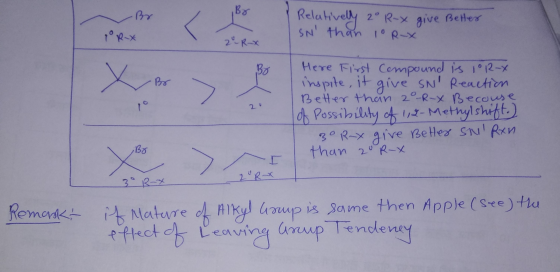
н.W. 10-E2, E1, Sn1 and Sn2 Each substrate undergoes E2 elimination with NaOCHs. Draw the ß-hydrogens,...
 н.W. 10-E2, E1, Sn1 and Sn2 Each substrate undergoes E2 elimination with NaOCHs. Draw the ß-hydrogens, then draw each possible elimination product, and identify the major isomer. The first is shown as an example. Notice he base is a strong base which promotes 2nd order mechanisms Br Br major No need to draw all beta-hydrogens if they are equivalent. minor NaOCH Br Br Br Br
For SN1 reactions, a chiral substrate will yield a mixture of enantiomers. In this reaction, there...
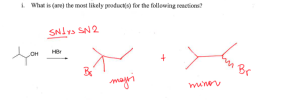 For SN1 reactions, a chiral substrate will yield a
mixture of enantiomers. In this reaction, there is only one
SN1 product given as the major product even though the
substrate is chiral. Why does the SN1 product not
exhibit stereochemistry?
i. What is (are) the most likely product(s) for the following reactions? SNdys SN 2 HBO from t he majo muno
For SN1 reactions, a chiral substrate will yield a
mixture of enantiomers. In this reaction, there is only one
SN1 product given as the major product even though the
substrate is chiral. Why does the SN1 product not
exhibit stereochemistry?
i. What is (are) the most likely product(s) for the following reactions? SNdys SN 2 HBO from t he majo muno
Using the compounds shown below, choose the best SN1 substrate? OCH3
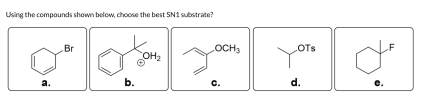 Using the compounds shown below, choose the best SN1 substrate? OCH3
What structural characteristics are desirable for a substrate that can react in both SN1 and SN2...
What structural characteristics are desirable for a substrate that can react in both SN1 and SN2 reactions?
isnt it an primary substrate ? why its an SN1 rxn ? and how MeSH c)...
 isnt it an primary substrate ? why its an SN1 rxn ? and how
MeSH c) a ci
isnt it an primary substrate ? why its an SN1 rxn ? and how
MeSH c) a ci
6. Describe the suitability of the following substrate for an Sn1 and SN2 reaction (is it...
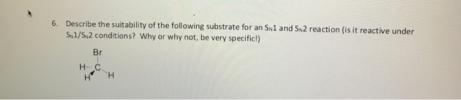 6. Describe the suitability of the following substrate for an Sn1 and SN2 reaction (is it reactive under S,1/S, 2 conditions? Why or why not, be very specific!) HC Η Η
for the following SN1 reaction draw the major organic product identify the nucleophile substrate and and...
 for the following SN1 reaction draw the major organic product
identify the nucleophile substrate and and leaving group and
determine the rate limiting step
Organic Chemistry (solvent) 0 H2O is the substrate, C,HeBr is the nucleophile, and Br is the leaving group
for the following SN1 reaction draw the major organic product
identify the nucleophile substrate and and leaving group and
determine the rate limiting step
Organic Chemistry (solvent) 0 H2O is the substrate, C,HeBr is the nucleophile, and Br is the leaving group
For the following Sn1 reaction, draw the major organic product, identify the nucleophile, substrate, and leaving...
 For the following Sn1 reaction, draw the major organic product, identify the nucleophile, substrate, and leaving group, and determine the rate limiting step. Нас ma H20 (solvent) Нас CHE Select the statement that properly identifies the nucleophile, substrate, and leaving group, O Br is the substrate, CyH5Br is the nucleophile, and H20 is the leaving group. 0 H2O is the substrate, C7H15Br is the nucleophile, and Br is the leaving group. O C7H15Br is the substrate, H20 is the nucleophile,...
CI Cl 5. Explain why Ph "Ph undergoes a faster SN1 reaction than PC Cl 6....
 CI Cl 5. Explain why Ph "Ph undergoes a faster SN1 reaction than PC Cl 6. Explain why Ph Ph undergoes an SN1 reaction but not an E1 reaction
3. Elaborate a comparative table between SN1 and SN2 reactions, based on: trends of substrate reactivity,...
3. Elaborate a comparative table between SN1 and SN2 reactions, based on: trends of substrate reactivity, strength of nucleophile, stereochemistry of product, number of steps.
 н.W. 10-E2, E1, Sn1 and Sn2 Each substrate undergoes E2 elimination with NaOCHs. Draw the ß-hydrogens, then draw each possible elimination product, and identify the major isomer. The first is shown as an example. Notice he base is a strong base which promotes 2nd order mechanisms Br Br major No need to draw all beta-hydrogens if they are equivalent. minor NaOCH Br Br Br Br
 For SN1 reactions, a chiral substrate will yield a
mixture of enantiomers. In this reaction, there is only one
SN1 product given as the major product even though the
substrate is chiral. Why does the SN1 product not
exhibit stereochemistry?
i. What is (are) the most likely product(s) for the following reactions? SNdys SN 2 HBO from t he majo muno
For SN1 reactions, a chiral substrate will yield a
mixture of enantiomers. In this reaction, there is only one
SN1 product given as the major product even though the
substrate is chiral. Why does the SN1 product not
exhibit stereochemistry?
i. What is (are) the most likely product(s) for the following reactions? SNdys SN 2 HBO from t he majo muno
 Using the compounds shown below, choose the best SN1 substrate? OCH3
 isnt it an primary substrate ? why its an SN1 rxn ? and how
MeSH c) a ci
isnt it an primary substrate ? why its an SN1 rxn ? and how
MeSH c) a ci
 6. Describe the suitability of the following substrate for an Sn1 and SN2 reaction (is it reactive under S,1/S, 2 conditions? Why or why not, be very specific!) HC Η Η
 for the following SN1 reaction draw the major organic product
identify the nucleophile substrate and and leaving group and
determine the rate limiting step
Organic Chemistry (solvent) 0 H2O is the substrate, C,HeBr is the nucleophile, and Br is the leaving group
for the following SN1 reaction draw the major organic product
identify the nucleophile substrate and and leaving group and
determine the rate limiting step
Organic Chemistry (solvent) 0 H2O is the substrate, C,HeBr is the nucleophile, and Br is the leaving group
 For the following Sn1 reaction, draw the major organic product, identify the nucleophile, substrate, and leaving group, and determine the rate limiting step. Нас ma H20 (solvent) Нас CHE Select the statement that properly identifies the nucleophile, substrate, and leaving group, O Br is the substrate, CyH5Br is the nucleophile, and H20 is the leaving group. 0 H2O is the substrate, C7H15Br is the nucleophile, and Br is the leaving group. O C7H15Br is the substrate, H20 is the nucleophile,...
 CI Cl 5. Explain why Ph "Ph undergoes a faster SN1 reaction than PC Cl 6. Explain why Ph Ph undergoes an SN1 reaction but not an E1 reaction
Most questions answered within 3 hours.
-
Where is the error in this code sequence?
String s1 = "Hello";
String s2 = "ello";...
asked 10 months ago -
Financial data for Joel de Paris, Inc., for last year
follow:
Joel de Paris, Inc.
Balance...
asked 10 months ago -
Consider this reaction:
Al2(SO4)3 (aq)+ BaCl3
(aq) Al2Cl6 (aq)- +
3BaSO4(s) . What is the...
asked 10 months ago -
Suppose that Savneet is considering increasing her
recent random sample from 20 car rentals to 40...
asked 10 months ago -
Trucks arrive at an unloading terminal at an average rate of 120
per hour.
Trucks arrive...
asked 10 months ago -
Why are methanol and ethanol completely soluble in water while
octanol is not very little soluble....
asked 10 months ago -
A facilities manager at a university reads in a research report
that the mean amount of...
asked 10 months ago -
When the CuSO4 is rehydrated by adding water to the anhydrous
compound, is this an endothermic...
asked 10 months ago -
A ray of sunlight is passing from diamond into crown glass; the
angle of incidence is...
asked 10 months ago -
A block of mass 0.249 kg is placed on top of a light, vertical
spring of...
asked 10 months ago -
how do the kidneys compensate in the presences of acidosis
a) trigger hyperventilate
b) reserve acid...
asked 10 months ago -
Question 501 pts
The rental rate of capital to the firm increases. Which of the
following...
asked 10 months ago