1. Specify the basic structure of a MOF and identify those parts in the MOF you...
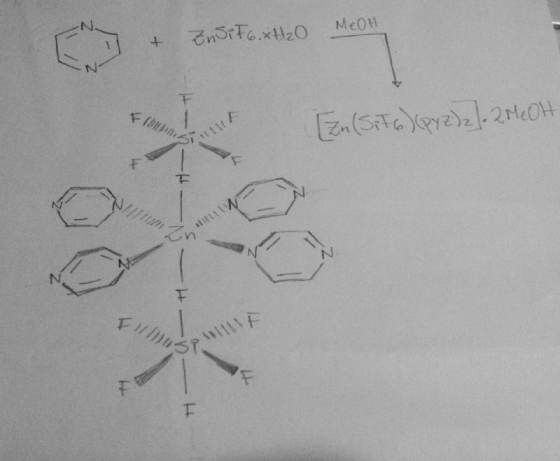
1. Specify the basic structure of a MOF and identify those parts in the MOF you are making and sketch its structure.
NO FORMULA PROVIDED
The lab is below-->
A. Preparation of pyrazine solution
-
Dissolve 0.52 g of pyrazine in 6 mL of methanol.
-
Transfer the solution to a 10 mL volumetric flask.
-
Add enough methanol to fill the volumetric flask to the line marked on the neck.
B. Preparation of ZnSIF6·xH2O
-
Dissolve 0.62 g of ZnSIF6·xH2O in 6 mL of methanol.
-
Transfer the solution to a 10 mL volumetric flask.
-
Add enough methanol to fill the volumetric flask to the line marked on the neck.
Part II. Layering
-
Add 1 mL of the ZnSIF6·xH2O solution into a test tube using a syringe (Fig. 1).
-
Using a new, clean syringe, add 1 mL of the pyrazine solution to the test tube using the following
method:
-
Place the syringe at an angle with the tip pressed against the wall of the test tube (Fig. 2).
-
SLOWLY press the top of the syringe to add the solution into the test tube. The solution should flow
down the side of the glass.
-
-
You should see a line between the 2 clear layers.
-
Cover your test tubes with Parafilm.
Homework Answers
The metal-organic frameworks (MOFs) are crystalline and porous three-dimensional materials, formed by coordinated covalent bonds of metal clusters linked to organic molecules.
These materials have a large number of applications, for example, catalysis, adsorption, encapsulation of additives, gas separation, and others.
The reaction of ZnSiF6·xH2O and pyrazine in Methanol solution produces {[Zn(SiF6)(pyrazine)2]· 2MeOH}. This product is colorless single crystals that produce an open three-dimensional framework.
The Zinc center is octahedrally coordinated with 4 nitrogens atoms of 4 pyrazine molecules acting as ligands. These pyrazine molecules act as bridges between de Zn ions.
Two SiF6(-2) ions are linked to the Zn center, these groups act as bridges between Zn centers.
Add Answer to:
1. Specify the basic structure of a MOF and identify
those parts in the MOF you...
How do I calculate the concentrations for my data sheet lab. I have not started my...
 How do I calculate the concentrations for my data sheet lab. I
have not started my lab yet but I just need to see how i would
calculate it with absorbance. Do i just use Beer's law or is there
any other method of solving the concentrations.
7. Weigh 1.45-1.55 g of copper(I) sulfate pentahydrate in a 50 mL beaker. 8. Dissolve the copper(II) sulfate pentahydrate in -15 mL of water 9. Add the aqueous solution of copper(II) to a...
How do I calculate the concentrations for my data sheet lab. I
have not started my lab yet but I just need to see how i would
calculate it with absorbance. Do i just use Beer's law or is there
any other method of solving the concentrations.
7. Weigh 1.45-1.55 g of copper(I) sulfate pentahydrate in a 50 mL beaker. 8. Dissolve the copper(II) sulfate pentahydrate in -15 mL of water 9. Add the aqueous solution of copper(II) to a...
Electrolytes, Concentration and Dilution of Solutions n this part of the experiment, you will make a dilution of a stock solution of known concentration and calculate the concentration of the di...
 Electrolytes, Concentration and Dilution of Solutions n this part of the experiment, you will make a dilution of a stock solution of known concentration and calculate the concentration of the dilute solution. DILUTION OF A STOCK SOLUTION PART C: Measurements and Observations Procedure Check out a 100-mL volumetric flask from your instructor. Fill test tube about 2/3 concentration of the active ingredient from its label including units. Record 1. orlt O " concentration of active ingredient. full of "Magic 2....
Which of the following best describes what you will do in this lab? Question 1 options:...
Which of the following best describes what you will do in this lab? Question 1 options: determine the concentration of nickel ions in an unknown solution. Construct a calibration curve. Be able to use a spectrophotometer. determine the concentration of nickel ions in a known solid. Be able to apply beer's law in order to observe how spectrophotometry works Be able to derive beer's law carry out solution preparation and dilutions. Question 2 (1 point) Which of the following best...
Calculate initial concentration of Fe+3 for tubes 1-3. Show your work. Procedure A. Determination of B...
 Calculate initial concentration of Fe+3 for tubes 1-3. Show your
work.
Procedure A. Determination of B for Beer's Law 1. Using a buret, add 4.00 mL of 0.0025 M Fe(NO3)s (which is in 0.1 M HNOs) to a 100- mL volumetric flask. Add enough deionized water to bring the total volume to the mark on the neck of the flask. Stopper and shake the flask. Label this flask “Diluted Fe.” spectrophotometer tubes (cuvettes), they are too small to use at...
Calculate initial concentration of Fe+3 for tubes 1-3. Show your
work.
Procedure A. Determination of B for Beer's Law 1. Using a buret, add 4.00 mL of 0.0025 M Fe(NO3)s (which is in 0.1 M HNOs) to a 100- mL volumetric flask. Add enough deionized water to bring the total volume to the mark on the neck of the flask. Stopper and shake the flask. Label this flask “Diluted Fe.” spectrophotometer tubes (cuvettes), they are too small to use at...
a.)Suppose you were preparing 1.0 L of a bleaching solution in a volumetric flask, and it...
a.)Suppose you were preparing 1.0 L of a bleaching solution in a volumetric flask, and it calls for 0.26 mol of NaOCl. If all you had available was a jug of bleach that contained 0.74 M NaOCl, what volume of bleach would you need to add to the volumetric flask before you added enough water to reach the 1.0 L line? Express the volume in milliliters to two significant figures b.) You need to prepare a 2.40 M solution of...
i need help with #3 please! SAFETY NOTES: Bromobenene and acetophenone are irritants. Wear gloves and...
 i need help with #3 please!
SAFETY NOTES: Bromobenene and acetophenone are irritants. Wear gloves and avoid contact with skin, eyes, and clothing • MHC) is dritating to the skin avoid contact with the skin, eyes, and clothing Diethyl ether, usually referred to simply as "ether", is volatile and flammable. Keep a safe distance from hot electrical devices WASTE DISPOSAL *** A itrate is the liquid that passed through the Hirsch funnel, ending up in the bottom of the sidearm...
i need help with #3 please!
SAFETY NOTES: Bromobenene and acetophenone are irritants. Wear gloves and avoid contact with skin, eyes, and clothing • MHC) is dritating to the skin avoid contact with the skin, eyes, and clothing Diethyl ether, usually referred to simply as "ether", is volatile and flammable. Keep a safe distance from hot electrical devices WASTE DISPOSAL *** A itrate is the liquid that passed through the Hirsch funnel, ending up in the bottom of the sidearm...
1. You are provided with 1M solution of CuSO4. 2. Calculate how many grams of CuSO4...
 1. You are provided with 1M solution of CuSO4. 2. Calculate how many grams of CuSO4 are dissolved in 100 mL of water to prepare this solution. Show your work in the space provided below. (Molar mass of CuSO4 = 159.6086 g/mol) (1 mark) Scso this . cutissu 159.6 خرداكولات و 3. Using a suitable transfer pipette transfer V. mL of your 1M Cuso. solution into a 100 ml volumetric flask. CV C 2V2 4. Using the equation CiV1=C2V2 calculate...
I am stuck on how to find concentration for standards and unknowns. Any kind of help would be appreciated. The correct...
 I am stuck on how to find concentration for standards and
unknowns. Any kind of help would be appreciated.
The corrected absorbance is = Blank - absorbance
1. Prepare the BCA working reagent. Use a graduated cylinder and add 30 ml of the BCA reagent into a 50 ml Erlenmeyer flask. Use the appropriate micropipette to add 600 uL of the CuSO4 solution into the flask and mix by swirling the flask. Record the exact mass of albumin and the...
I am stuck on how to find concentration for standards and
unknowns. Any kind of help would be appreciated.
The corrected absorbance is = Blank - absorbance
1. Prepare the BCA working reagent. Use a graduated cylinder and add 30 ml of the BCA reagent into a 50 ml Erlenmeyer flask. Use the appropriate micropipette to add 600 uL of the CuSO4 solution into the flask and mix by swirling the flask. Record the exact mass of albumin and the...
QUESTIONS TO ANSWER: Prepare a table of all chemicals used with the structure and purpose of...
 QUESTIONS TO ANSWER:
Prepare a table of all chemicals used with the structure and
purpose of each.
Calculate the theoretical yield by finding limiting reactant of
the experiment by converting reactants to product (remember to show
all calculations used)
Calculate the percent yield using the limiting reactant
Calculate the Rf for triphenylmethanol. If there are two dots,
determine which one is triphenylmethanol.. ( I did not provide
data. Please let me know how I Would do this if I did)...
QUESTIONS TO ANSWER:
Prepare a table of all chemicals used with the structure and
purpose of each.
Calculate the theoretical yield by finding limiting reactant of
the experiment by converting reactants to product (remember to show
all calculations used)
Calculate the percent yield using the limiting reactant
Calculate the Rf for triphenylmethanol. If there are two dots,
determine which one is triphenylmethanol.. ( I did not provide
data. Please let me know how I Would do this if I did)...
Prelab Questions 1. a. (10) Determine the a) mass of the solute and b) volume of conc. HCl you are going to a) wei...
 Prelab Questions 1. a. (10) Determine the a) mass of the solute and b) volume of conc. HCl you are going to a) weigh out and b) measure with a graduated cylinder to create 1L of 100.0 ppm stock solution of Acetylsalicylic acid (ASA) (from the pure powder) in a 2%(W/V) HCI. Show your calculation. C at:.. HALI Procedure - External Standards 1. First make 2% V/v HCI. You will make this three times. Transfer to two plastic containers (use...
 How do I calculate the concentrations for my data sheet lab. I
have not started my lab yet but I just need to see how i would
calculate it with absorbance. Do i just use Beer's law or is there
any other method of solving the concentrations.
7. Weigh 1.45-1.55 g of copper(I) sulfate pentahydrate in a 50 mL beaker. 8. Dissolve the copper(II) sulfate pentahydrate in -15 mL of water 9. Add the aqueous solution of copper(II) to a...
How do I calculate the concentrations for my data sheet lab. I
have not started my lab yet but I just need to see how i would
calculate it with absorbance. Do i just use Beer's law or is there
any other method of solving the concentrations.
7. Weigh 1.45-1.55 g of copper(I) sulfate pentahydrate in a 50 mL beaker. 8. Dissolve the copper(II) sulfate pentahydrate in -15 mL of water 9. Add the aqueous solution of copper(II) to a...
 Electrolytes, Concentration and Dilution of Solutions n this part of the experiment, you will make a dilution of a stock solution of known concentration and calculate the concentration of the dilute solution. DILUTION OF A STOCK SOLUTION PART C: Measurements and Observations Procedure Check out a 100-mL volumetric flask from your instructor. Fill test tube about 2/3 concentration of the active ingredient from its label including units. Record 1. orlt O " concentration of active ingredient. full of "Magic 2....
 Calculate initial concentration of Fe+3 for tubes 1-3. Show your
work.
Procedure A. Determination of B for Beer's Law 1. Using a buret, add 4.00 mL of 0.0025 M Fe(NO3)s (which is in 0.1 M HNOs) to a 100- mL volumetric flask. Add enough deionized water to bring the total volume to the mark on the neck of the flask. Stopper and shake the flask. Label this flask “Diluted Fe.” spectrophotometer tubes (cuvettes), they are too small to use at...
Calculate initial concentration of Fe+3 for tubes 1-3. Show your
work.
Procedure A. Determination of B for Beer's Law 1. Using a buret, add 4.00 mL of 0.0025 M Fe(NO3)s (which is in 0.1 M HNOs) to a 100- mL volumetric flask. Add enough deionized water to bring the total volume to the mark on the neck of the flask. Stopper and shake the flask. Label this flask “Diluted Fe.” spectrophotometer tubes (cuvettes), they are too small to use at...
 i need help with #3 please!
SAFETY NOTES: Bromobenene and acetophenone are irritants. Wear gloves and avoid contact with skin, eyes, and clothing • MHC) is dritating to the skin avoid contact with the skin, eyes, and clothing Diethyl ether, usually referred to simply as "ether", is volatile and flammable. Keep a safe distance from hot electrical devices WASTE DISPOSAL *** A itrate is the liquid that passed through the Hirsch funnel, ending up in the bottom of the sidearm...
i need help with #3 please!
SAFETY NOTES: Bromobenene and acetophenone are irritants. Wear gloves and avoid contact with skin, eyes, and clothing • MHC) is dritating to the skin avoid contact with the skin, eyes, and clothing Diethyl ether, usually referred to simply as "ether", is volatile and flammable. Keep a safe distance from hot electrical devices WASTE DISPOSAL *** A itrate is the liquid that passed through the Hirsch funnel, ending up in the bottom of the sidearm...
 1. You are provided with 1M solution of CuSO4. 2. Calculate how many grams of CuSO4 are dissolved in 100 mL of water to prepare this solution. Show your work in the space provided below. (Molar mass of CuSO4 = 159.6086 g/mol) (1 mark) Scso this . cutissu 159.6 خرداكولات و 3. Using a suitable transfer pipette transfer V. mL of your 1M Cuso. solution into a 100 ml volumetric flask. CV C 2V2 4. Using the equation CiV1=C2V2 calculate...
 I am stuck on how to find concentration for standards and
unknowns. Any kind of help would be appreciated.
The corrected absorbance is = Blank - absorbance
1. Prepare the BCA working reagent. Use a graduated cylinder and add 30 ml of the BCA reagent into a 50 ml Erlenmeyer flask. Use the appropriate micropipette to add 600 uL of the CuSO4 solution into the flask and mix by swirling the flask. Record the exact mass of albumin and the...
I am stuck on how to find concentration for standards and
unknowns. Any kind of help would be appreciated.
The corrected absorbance is = Blank - absorbance
1. Prepare the BCA working reagent. Use a graduated cylinder and add 30 ml of the BCA reagent into a 50 ml Erlenmeyer flask. Use the appropriate micropipette to add 600 uL of the CuSO4 solution into the flask and mix by swirling the flask. Record the exact mass of albumin and the...
 QUESTIONS TO ANSWER:
Prepare a table of all chemicals used with the structure and
purpose of each.
Calculate the theoretical yield by finding limiting reactant of
the experiment by converting reactants to product (remember to show
all calculations used)
Calculate the percent yield using the limiting reactant
Calculate the Rf for triphenylmethanol. If there are two dots,
determine which one is triphenylmethanol.. ( I did not provide
data. Please let me know how I Would do this if I did)...
QUESTIONS TO ANSWER:
Prepare a table of all chemicals used with the structure and
purpose of each.
Calculate the theoretical yield by finding limiting reactant of
the experiment by converting reactants to product (remember to show
all calculations used)
Calculate the percent yield using the limiting reactant
Calculate the Rf for triphenylmethanol. If there are two dots,
determine which one is triphenylmethanol.. ( I did not provide
data. Please let me know how I Would do this if I did)...
 Prelab Questions 1. a. (10) Determine the a) mass of the solute and b) volume of conc. HCl you are going to a) weigh out and b) measure with a graduated cylinder to create 1L of 100.0 ppm stock solution of Acetylsalicylic acid (ASA) (from the pure powder) in a 2%(W/V) HCI. Show your calculation. C at:.. HALI Procedure - External Standards 1. First make 2% V/v HCI. You will make this three times. Transfer to two plastic containers (use...
Most questions answered within 3 hours.
-
Where is the error in this code sequence?
String s1 = "Hello";
String s2 = "ello";...
asked 10 months ago -
Financial data for Joel de Paris, Inc., for last year
follow:
Joel de Paris, Inc.
Balance...
asked 10 months ago -
Consider this reaction:
Al2(SO4)3 (aq)+ BaCl3
(aq) Al2Cl6 (aq)- +
3BaSO4(s) . What is the...
asked 10 months ago -
Suppose that Savneet is considering increasing her
recent random sample from 20 car rentals to 40...
asked 10 months ago -
Trucks arrive at an unloading terminal at an average rate of 120
per hour.
Trucks arrive...
asked 10 months ago -
Why are methanol and ethanol completely soluble in water while
octanol is not very little soluble....
asked 10 months ago -
A facilities manager at a university reads in a research report
that the mean amount of...
asked 10 months ago -
When the CuSO4 is rehydrated by adding water to the anhydrous
compound, is this an endothermic...
asked 10 months ago -
A ray of sunlight is passing from diamond into crown glass; the
angle of incidence is...
asked 10 months ago -
A block of mass 0.249 kg is placed on top of a light, vertical
spring of...
asked 10 months ago -
how do the kidneys compensate in the presences of acidosis
a) trigger hyperventilate
b) reserve acid...
asked 10 months ago -
Question 501 pts
The rental rate of capital to the firm increases. Which of the
following...
asked 10 months ago