A proton traveling at 31.8° with respect to the direction of a magnetic field of strength...
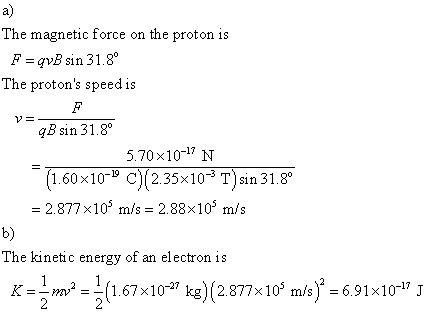
A proton traveling at 31.8° with respect to the direction of a magnetic field of strength 2.35 mT experiences a magnetic force of 5.70 × 10⁻¹⁷ N. Calculate (a) the proton's speed and (b) its kinetic energy in electron-volts.
Homework Answers
Add Answer to:
A proton traveling at 31.8° with respect to the direction of a
magnetic field of strength...
A proton traveling at 25.5° with respect to the direction of a magnetic field of strength...
A proton traveling at 25.5° with respect to the direction of a magnetic field of strength 2.07 mT experiences a magnetic force of 5.12 × 10⁻¹⁷ N. Calculate (a) the proton's speed and (b) its kinetic energy in electron-volts.
A proton traveling at 23.4° with respect to the direction of a magnetic field of strength...
A proton traveling at 23.4° with respect to the direction of a magnetic field of strength 2.01 mT experiences a magnetic force of 9.03 × 10⁻¹⁷ N. Calculate (a) the proton's speed and (b) its kinetic energy in electron-volts.
PRINTER VERSION « BACK NEXT Chapter 28, Problem 001 A proton traveling at 22.1. with respect...
 PRINTER VERSION « BACK NEXT Chapter 28, Problem 001 A proton traveling at 22.1. with respect to the direction of a magnetic field of strength 3.36 mT experiences a magnetic force of 9.62 x 10⁻¹⁷ N. Calculate (a) the proton's speed and (b) its kinetic energy in electron-volts. (a) Number Units (b) Number Units Click if you would like to Show Work for this question: Open Show Work SHOW HINT
A group of particles is traveling in a magnetic field of unknown magnitude and direction. You...
A group of particles is traveling in a magnetic field of unknown magnitude and direction. You observe that a proton moving at 1.60 km/s in the +x-direction experiences a force of 2.10×10⁻¹⁶ N in the +y-direction, and an electron moving at 4.70 km/s in the −z-direction experiences a force of 8.60×10⁻¹⁶ N in the +y-direction. What is the magnitude of the magnetic field? What is the direction of the magnetic field? (in the xz-plane) What is the magnitude of the...
A group of particles is traveling in a magnetic field of unknown magnitude and direction. You...
A group of particles is traveling in a magnetic field of unknown magnitude and direction. You observe that a proton moving at 1.70 km/s in the +x-direction experiences a force of 2.06×10⁻¹⁶ N in the +y-direction, and an electron moving at 4.40 km/s in the −z-direction experiences a force of 8.10×10⁻¹⁶ N in the +y-direction. 1) What is the magnitude of the magnetic field? 2) What is the direction of the magnetic field? (in the xz-plane) 3) What is the...
A group of particles is traveling in a magnetic field of unknown magnitude and direction. You...
A group of particles is traveling in a magnetic field of unknown magnitude and direction. You observe that a proton moving at 1.70 km/s in the +x-direction experiences a force of 2.06×10⁻¹⁶ N in the +y-direction, and an electron moving at 4.60 km/s in the −z-direction experiences a force of 8.20×10⁻¹⁶ N in the +y-direction. A. What is the magnitude of the magnetic field? ans 1.35 T B. What is the direction of the magnetic field? (in the xz-plane) ans...
A group of particles is traveling in a magnetic field of unknown magnitude and direction. You...
 A group of particles is traveling in a magnetic field of unknown magnitude and direction. You observe that a proton moving at 1.70 km/s in the direction experiences a force of 2.08 10- N in the y direction, and an electron moving at 4.50 km/s in the direction experiences a form of 8.40 10-18 N in the direction. Part A You may want to review (Page) For related problem solving tips and strategies, you may want to view a Video...
(a) A proton, traveling with a velocity of 3.5 106 m/s due east, experiences a magnetic...
(a) A proton, traveling with a velocity of 3.5 106 m/s due east, experiences a magnetic force that has a maximum magnitude of 7.1 10-14 N and a direction of due south. What are the magnitude and direction of the magnetic field causing the force? magnitude T (b) Repeat part (a) assuming the proton is replaced by an electron. magnitude T
An electron traveling due east in a region that contains only a magnetic field experiences a...
An electron traveling due east in a region that contains only a magnetic field experiences a vertically downward force, toward the surface of the earth. A) What is the direction of the magnetic field? B) If it is a proton, what will be the direction of the magnetic field? Please explain the difference between electron and proton due to the current direction.
A proton moving at 3500 m/s in a 2.35 T magnetic field experiences a magnetic force...
A proton moving at 3500 m/s in a 2.35 T magnetic field experiences a magnetic force of 1.20×10⁻¹⁵ N. What angle does the velocity of the electron make with the magnetic field? State all possible answers.
 PRINTER VERSION « BACK NEXT Chapter 28, Problem 001 A proton traveling at 22.1. with respect to the direction of a magnetic field of strength 3.36 mT experiences a magnetic force of 9.62 x 10⁻¹⁷ N. Calculate (a) the proton's speed and (b) its kinetic energy in electron-volts. (a) Number Units (b) Number Units Click if you would like to Show Work for this question: Open Show Work SHOW HINT
 A group of particles is traveling in a magnetic field of unknown magnitude and direction. You observe that a proton moving at 1.70 km/s in the direction experiences a force of 2.08 10- N in the y direction, and an electron moving at 4.50 km/s in the direction experiences a form of 8.40 10-18 N in the direction. Part A You may want to review (Page) For related problem solving tips and strategies, you may want to view a Video...
Most questions answered within 3 hours.
-
Where is the error in this code sequence?
String s1 = "Hello";
String s2 = "ello";...
asked 11 months ago -
Financial data for Joel de Paris, Inc., for last year
follow:
Joel de Paris, Inc.
Balance...
asked 11 months ago -
Consider this reaction:
Al2(SO4)3 (aq)+ BaCl3
(aq) Al2Cl6 (aq)- +
3BaSO4(s) . What is the...
asked 11 months ago -
Suppose that Savneet is considering increasing her
recent random sample from 20 car rentals to 40...
asked 11 months ago -
Trucks arrive at an unloading terminal at an average rate of 120
per hour.
Trucks arrive...
asked 11 months ago -
Why are methanol and ethanol completely soluble in water while
octanol is not very little soluble....
asked 11 months ago -
A facilities manager at a university reads in a research report
that the mean amount of...
asked 11 months ago -
When the CuSO4 is rehydrated by adding water to the anhydrous
compound, is this an endothermic...
asked 11 months ago -
A ray of sunlight is passing from diamond into crown glass; the
angle of incidence is...
asked 11 months ago -
A block of mass 0.249 kg is placed on top of a light, vertical
spring of...
asked 11 months ago -
how do the kidneys compensate in the presences of acidosis
a) trigger hyperventilate
b) reserve acid...
asked 11 months ago -
Question 501 pts
The rental rate of capital to the firm increases. Which of the
following...
asked 11 months ago