
Homework Answers

Add Answer to:
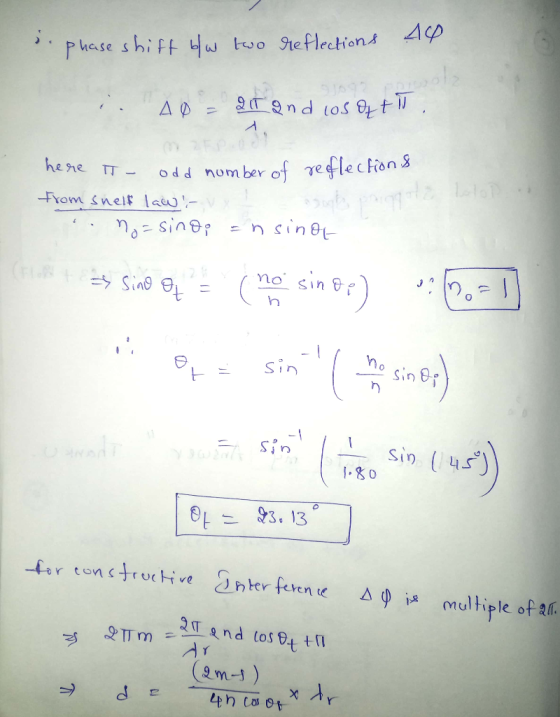
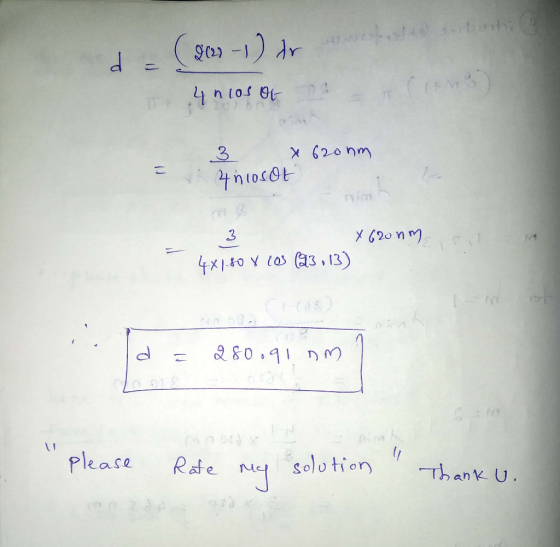
2.) The image of a red (620 nm) text display is to be mirrored into the...
The circled answers are INCORRECT. Please help and explain. O COPILULU 2 = 600 nm The...
 The circled answers are INCORRECT. Please help and explain.
O COPILULU 2 = 600 nm The next two questions are about the following situation: Blue light (a = 475 nm in air) travels from air (n=1) into a thin plastic film (n=1.4), which is on top of a thick glass plate (n=1.5). 13. Find t, the minimum (non-zero) thickness of the film, which gives destructive interference. n = 1.4 n = 1.5 t = 85 nm t = 107 nm...
The circled answers are INCORRECT. Please help and explain.
O COPILULU 2 = 600 nm The next two questions are about the following situation: Blue light (a = 475 nm in air) travels from air (n=1) into a thin plastic film (n=1.4), which is on top of a thick glass plate (n=1.5). 13. Find t, the minimum (non-zero) thickness of the film, which gives destructive interference. n = 1.4 n = 1.5 t = 85 nm t = 107 nm...
Bob places a neutrally charged conducting ball next to a large, charged plate. The conducting ball...
 Bob places a neutrally charged conducting ball next to a large, charged plate. The conducting ball is weakly attracted to the plate. What is the net charge on the plate? 1. a) Positive b) Negative c) Neutral (i.e., zero charge) d) Either positive or negative, but it is impossible to tell which A +1 C charge is at the origin, and a second +1 C charge is at position (x,y)-(2 m, 0). How much work is required to move the...
Question 5: How would dust and oil on the glass plates affect the results? EXPERIMENT 10 THIN FILM I...
 Question 5:
How would dust and oil on the glass plates affect the
results?
EXPERIMENT 10 THIN FILM INTERFERENCE Light from a monochromatic source is shined downward on two glass plates that are separated at one end by a hair. Light that is reflected from the top and bottom surfaces of the wedge-shaped thin film of air undergoes interference, and a series of dark and light lines are seen. By counting the number of dark or light lines over a...
Question 5:
How would dust and oil on the glass plates affect the
results?
EXPERIMENT 10 THIN FILM INTERFERENCE Light from a monochromatic source is shined downward on two glass plates that are separated at one end by a hair. Light that is reflected from the top and bottom surfaces of the wedge-shaped thin film of air undergoes interference, and a series of dark and light lines are seen. By counting the number of dark or light lines over a...
microbiology help TOT Zoo Add Page Insert Table Chart Text Shape Media Comment These questions will...
 microbiology help
TOT Zoo Add Page Insert Table Chart Text Shape Media Comment These questions will serve in lieu of a lab report for Exercise 15, 16, and 17 You will find the answer to these questions in the background, procedure, results and interpretation sections of manual Exercise 15, 16, and 17, videos, Actions of Selective and Differential Media Chart, and the Principle/Theory article in homework section.) General Questions 1. What is the purpose (function) of selective media? (How does...
microbiology help
TOT Zoo Add Page Insert Table Chart Text Shape Media Comment These questions will serve in lieu of a lab report for Exercise 15, 16, and 17 You will find the answer to these questions in the background, procedure, results and interpretation sections of manual Exercise 15, 16, and 17, videos, Actions of Selective and Differential Media Chart, and the Principle/Theory article in homework section.) General Questions 1. What is the purpose (function) of selective media? (How does...
QUESTIONS TO ANSWER: Prepare a table of all chemicals used with the structure and purpose of...
 QUESTIONS TO ANSWER:
Prepare a table of all chemicals used with the structure and
purpose of each.
Calculate the theoretical yield by finding limiting reactant of
the experiment by converting reactants to product (remember to show
all calculations used)
Calculate the percent yield using the limiting reactant
Calculate the Rf for triphenylmethanol. If there are two dots,
determine which one is triphenylmethanol.. ( I did not provide
data. Please let me know how I Would do this if I did)...
QUESTIONS TO ANSWER:
Prepare a table of all chemicals used with the structure and
purpose of each.
Calculate the theoretical yield by finding limiting reactant of
the experiment by converting reactants to product (remember to show
all calculations used)
Calculate the percent yield using the limiting reactant
Calculate the Rf for triphenylmethanol. If there are two dots,
determine which one is triphenylmethanol.. ( I did not provide
data. Please let me know how I Would do this if I did)...
 The circled answers are INCORRECT. Please help and explain.
O COPILULU 2 = 600 nm The next two questions are about the following situation: Blue light (a = 475 nm in air) travels from air (n=1) into a thin plastic film (n=1.4), which is on top of a thick glass plate (n=1.5). 13. Find t, the minimum (non-zero) thickness of the film, which gives destructive interference. n = 1.4 n = 1.5 t = 85 nm t = 107 nm...
The circled answers are INCORRECT. Please help and explain.
O COPILULU 2 = 600 nm The next two questions are about the following situation: Blue light (a = 475 nm in air) travels from air (n=1) into a thin plastic film (n=1.4), which is on top of a thick glass plate (n=1.5). 13. Find t, the minimum (non-zero) thickness of the film, which gives destructive interference. n = 1.4 n = 1.5 t = 85 nm t = 107 nm...
 Bob places a neutrally charged conducting ball next to a large, charged plate. The conducting ball is weakly attracted to the plate. What is the net charge on the plate? 1. a) Positive b) Negative c) Neutral (i.e., zero charge) d) Either positive or negative, but it is impossible to tell which A +1 C charge is at the origin, and a second +1 C charge is at position (x,y)-(2 m, 0). How much work is required to move the...
 Question 5:
How would dust and oil on the glass plates affect the
results?
EXPERIMENT 10 THIN FILM INTERFERENCE Light from a monochromatic source is shined downward on two glass plates that are separated at one end by a hair. Light that is reflected from the top and bottom surfaces of the wedge-shaped thin film of air undergoes interference, and a series of dark and light lines are seen. By counting the number of dark or light lines over a...
Question 5:
How would dust and oil on the glass plates affect the
results?
EXPERIMENT 10 THIN FILM INTERFERENCE Light from a monochromatic source is shined downward on two glass plates that are separated at one end by a hair. Light that is reflected from the top and bottom surfaces of the wedge-shaped thin film of air undergoes interference, and a series of dark and light lines are seen. By counting the number of dark or light lines over a...
 microbiology help
TOT Zoo Add Page Insert Table Chart Text Shape Media Comment These questions will serve in lieu of a lab report for Exercise 15, 16, and 17 You will find the answer to these questions in the background, procedure, results and interpretation sections of manual Exercise 15, 16, and 17, videos, Actions of Selective and Differential Media Chart, and the Principle/Theory article in homework section.) General Questions 1. What is the purpose (function) of selective media? (How does...
microbiology help
TOT Zoo Add Page Insert Table Chart Text Shape Media Comment These questions will serve in lieu of a lab report for Exercise 15, 16, and 17 You will find the answer to these questions in the background, procedure, results and interpretation sections of manual Exercise 15, 16, and 17, videos, Actions of Selective and Differential Media Chart, and the Principle/Theory article in homework section.) General Questions 1. What is the purpose (function) of selective media? (How does...
 QUESTIONS TO ANSWER:
Prepare a table of all chemicals used with the structure and
purpose of each.
Calculate the theoretical yield by finding limiting reactant of
the experiment by converting reactants to product (remember to show
all calculations used)
Calculate the percent yield using the limiting reactant
Calculate the Rf for triphenylmethanol. If there are two dots,
determine which one is triphenylmethanol.. ( I did not provide
data. Please let me know how I Would do this if I did)...
QUESTIONS TO ANSWER:
Prepare a table of all chemicals used with the structure and
purpose of each.
Calculate the theoretical yield by finding limiting reactant of
the experiment by converting reactants to product (remember to show
all calculations used)
Calculate the percent yield using the limiting reactant
Calculate the Rf for triphenylmethanol. If there are two dots,
determine which one is triphenylmethanol.. ( I did not provide
data. Please let me know how I Would do this if I did)...
Most questions answered within 3 hours.
-
Where is the error in this code sequence?
String s1 = "Hello";
String s2 = "ello";...
asked 11 months ago -
Financial data for Joel de Paris, Inc., for last year
follow:
Joel de Paris, Inc.
Balance...
asked 11 months ago -
Consider this reaction:
Al2(SO4)3 (aq)+ BaCl3
(aq) Al2Cl6 (aq)- +
3BaSO4(s) . What is the...
asked 11 months ago -
Suppose that Savneet is considering increasing her
recent random sample from 20 car rentals to 40...
asked 11 months ago -
Trucks arrive at an unloading terminal at an average rate of 120
per hour.
Trucks arrive...
asked 11 months ago -
Why are methanol and ethanol completely soluble in water while
octanol is not very little soluble....
asked 11 months ago -
A facilities manager at a university reads in a research report
that the mean amount of...
asked 11 months ago -
When the CuSO4 is rehydrated by adding water to the anhydrous
compound, is this an endothermic...
asked 11 months ago -
A ray of sunlight is passing from diamond into crown glass; the
angle of incidence is...
asked 11 months ago -
A block of mass 0.249 kg is placed on top of a light, vertical
spring of...
asked 11 months ago -
how do the kidneys compensate in the presences of acidosis
a) trigger hyperventilate
b) reserve acid...
asked 11 months ago -
Question 501 pts
The rental rate of capital to the firm increases. Which of the
following...
asked 11 months ago