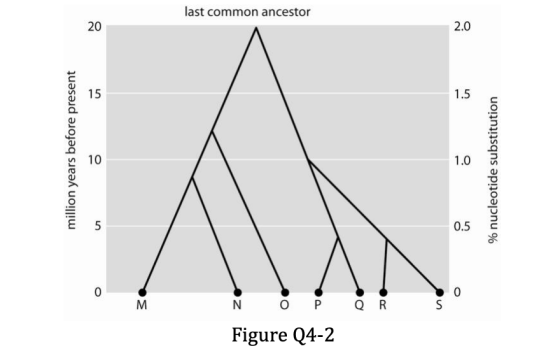
A hypothetical phylogenetic tree is shown in Figure Q4-2. Use this tree to answer the following question.
1. How many years ago did species M and N diverge from their last common ancestor? Are M and N more or less closely related to each other than P and S? In looking for functionally important nucleotide sequences, is it more informative to compare the genome sequences of M and N or those of M and Q? Explain.
Homework Answers
Answer:
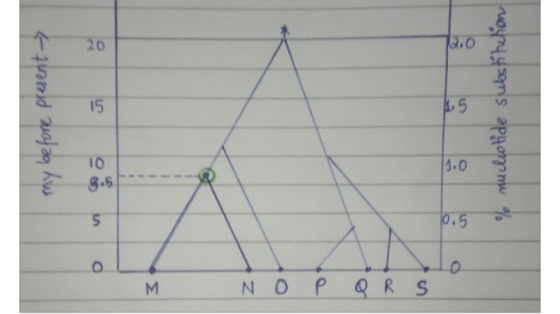
From the graph,
Species M and N separated from their last common ancestor about 8.5 million years ago.
|
Functionally important nucleotide sequences are critical for survival and are retained during evolution. This means, such sequences would be present in the same form even in those species which separated from their common ancestor long ago. Species M and Q diverged from their common ancestor about 20 million years ago (mya), whereas species M and N separated 8.5 mya . Thus, M and Q separated long ago than M and N. |
| Hence, in looking for functionally important nucleotide sequences, is it more informative to compare the genome sequences of M and Q. |
Add Answer to:
A hypothetical phylogenetic tree is shown in Figure Q4-2. Use
this tree to answer the following...
Which node of the phylogenetic tree in Figure 1 represents the most recent common ancestor of...
 Which node of the phylogenetic tree in Figure 1 represents the
most recent common ancestor of echidnas and Asian elephants? (Node
A B C or D)
According to the phylogenetic tree of chordates in Figure 1,
how would you describe the relatedness of the outgroup species to
other chordates?
a) The painted tunicate is more
closely related to lampreys than to sharks
b) The painted tunicate is not as
highly evolved as the remainder of the chordates
c) The painted...
Which node of the phylogenetic tree in Figure 1 represents the
most recent common ancestor of echidnas and Asian elephants? (Node
A B C or D)
According to the phylogenetic tree of chordates in Figure 1,
how would you describe the relatedness of the outgroup species to
other chordates?
a) The painted tunicate is more
closely related to lampreys than to sharks
b) The painted tunicate is not as
highly evolved as the remainder of the chordates
c) The painted...
20. Refer l the figure, which shows the phylogenetic tree of major groups of living organisms....
 20. Refer l the figure, which shows the phylogenetic tree of major groups of living organisms. Based on the figure, which statement about the endosymbiotic origin of eukaryotic mitochondria is true? Some prokaryotic archaea possess mitochondria. Mitochondria are derived from endosymbiotic bacteria. Bacteria is more closely related to Eukarya than to Archaea. Mammals possess chloroplasts, which become functional during starvation The common ancestor of Archaea and Eukarya possessed mitochondria. Remaining: 3:03:00 Start: 8:53 PM MacBook Air esc
Question 1:Construct a phylogenetic tree for the following species of shark listed in the table below,...
 Question 1:Construct a phylogenetic tree for
the following species of shark listed in the table below, using the
cytochrome b gene. Use the round stingray (Urolophus
concentricus) as an outgroup to root your tree.
Common name
Latin name
Order
Great White shark
Carcharodon carcharias
order Lamniformes
Shortfin mako shark
Isurus oxyrhyncus
order Lamniformes
Longfin mako shark
Isurus paucus
order Lamniformes
Salmon shark
Lamna ditropis
order Lamniformes
Porbeagle shark
Lamna nasus
order Lamniformes
Pelagic thresher shark
Alopias pelagicus
order Lamniformes
Common...
Question 1:Construct a phylogenetic tree for
the following species of shark listed in the table below, using the
cytochrome b gene. Use the round stingray (Urolophus
concentricus) as an outgroup to root your tree.
Common name
Latin name
Order
Great White shark
Carcharodon carcharias
order Lamniformes
Shortfin mako shark
Isurus oxyrhyncus
order Lamniformes
Longfin mako shark
Isurus paucus
order Lamniformes
Salmon shark
Lamna ditropis
order Lamniformes
Porbeagle shark
Lamna nasus
order Lamniformes
Pelagic thresher shark
Alopias pelagicus
order Lamniformes
Common...
Answer the following questions: 1. (2 points) This species concept can be functionally applied most easily...
 Answer the following questions: 1. (2 points) This species concept can be functionally applied most easily to the most species, but is potentially quite inaccurate in many instances: 2. (2 points) This occurs when there is easy, unlimited, uniform access to all necessary resources: 3. (2 points) This group(s) keeps embryos in a protective, waterproof shell with an internal food source: 4. (2 points) This group has roots, stems, and leaves but no seeds: 5. (2 points) This animal uses...
please explain Use the following information to answer the next two questions. Giardia intestinalis can cause...
 please explain
Use the following information to answer the next two questions. Giardia intestinalis can cause disease in several different mammalian species, including humans. Giardia organisms (G. intestinalis) that infect humans are similar morphologically to those that infect other mammals, thus they have been considered a single species. However, G. intestinalis has been divided into different subgroups based on their host and a few other characteristics. In 1999, a DNA sequence comparison study tested the hypothesis that these subgroups actually...
please explain
Use the following information to answer the next two questions. Giardia intestinalis can cause disease in several different mammalian species, including humans. Giardia organisms (G. intestinalis) that infect humans are similar morphologically to those that infect other mammals, thus they have been considered a single species. However, G. intestinalis has been divided into different subgroups based on their host and a few other characteristics. In 1999, a DNA sequence comparison study tested the hypothesis that these subgroups actually...
phylogenic tree help 11. For this question, refer to FIG. 24.2 (p. 487) "The family tree...
 phylogenic tree help
11. For this question, refer to FIG. 24.2 (p. 487) "The family tree of the lesser and great apes."This figure shows the derivation of "earlobes". Assume that evolution has not reversed this character state in any of the descendants of this ancestor which evolved earlobes. Given this, what do we know about earlobes? Orangutan Gibbon (14 species in 4 genera) Gorilla Bonobo Chimpanzee Human ebepodeny Robust canine teeth Prosimians: Bushbabies New World Old World and lemurs monkeys...
phylogenic tree help
11. For this question, refer to FIG. 24.2 (p. 487) "The family tree of the lesser and great apes."This figure shows the derivation of "earlobes". Assume that evolution has not reversed this character state in any of the descendants of this ancestor which evolved earlobes. Given this, what do we know about earlobes? Orangutan Gibbon (14 species in 4 genera) Gorilla Bonobo Chimpanzee Human ebepodeny Robust canine teeth Prosimians: Bushbabies New World Old World and lemurs monkeys...
For each of the following scenarios, list one or more options from the word bank that...
 For each of the following scenarios, list one or more options
from the word bank that are appropriate
Answer the following questions: 1. (2 points) This species concept can be functionally applied most easily to the most species, but is potentially quite inaccurate in many instances: 2. (2 points) This occurs when there is easy, unlimited, uniform access to all necessary resources: 3.(2 points) This group(s) keeps embryos in a protective, waterproof shell with an internal food source: 4. (2...
For each of the following scenarios, list one or more options
from the word bank that are appropriate
Answer the following questions: 1. (2 points) This species concept can be functionally applied most easily to the most species, but is potentially quite inaccurate in many instances: 2. (2 points) This occurs when there is easy, unlimited, uniform access to all necessary resources: 3.(2 points) This group(s) keeps embryos in a protective, waterproof shell with an internal food source: 4. (2...
On the assumption that humans and chimpanzees last shared a common ancestor 6 million years ago...
 On the assumption that humans and chimpanzees last shared a
common ancestor 6 million years ago (6 Mya), when did modern humans
and Neanderthals last share a common ancestor? Your data are the
mitochondrial genome sequence differences and the tree inferred
from those numbers of substitutions, on the slide near the end of
Jon's lecture # 4 (L4). Please give your answer in units of
millions of years, to the nearest tenth of a million (i.e., in the
form X.Y)....
On the assumption that humans and chimpanzees last shared a
common ancestor 6 million years ago (6 Mya), when did modern humans
and Neanderthals last share a common ancestor? Your data are the
mitochondrial genome sequence differences and the tree inferred
from those numbers of substitutions, on the slide near the end of
Jon's lecture # 4 (L4). Please give your answer in units of
millions of years, to the nearest tenth of a million (i.e., in the
form X.Y)....
Figure 21 CO ah--o-o __ d. HCOO-C-CHE . HC- cy 18) In Figure 2.1, which is...
 Figure 21 CO ah--o-o __ d. HCOO-C-CHE . HC- cy 18) In Figure 2.1, which is an alcohol? B) b A) a 9c D) E) e Figure 23 HONCHO -CH- OH 19) What kind of bond is at the arrow in Figure 2.37 A) hydrogen bond B) ionic bond C) peptide bond D) double covalent bond E) disulfide bridge 20) Starch, dextran, glycogen, and cellulose are polymers of A) amino acids. B) acids. C) nucleic acids. D) glucose. E) fatty...
4. In a lake governed by the food web shown in the image to the right, 500 brown trout are added from fisheries. Which of the following outcomes would most likely be expected? A. Tadpole populat...
 4. In a lake governed by the food web shown in the image to the right, 500 brown trout are added from fisheries. Which of the following outcomes would most likely be expected? A. Tadpole population will increase B. Duck population will decrease C. Algae population will increase D. Lilly Pad population will decrease E. Caddis Fly larvae will increase 5. Which of the following pieces of evidence most strongly supports a common ancestor of all life on Earth? A....
 Which node of the phylogenetic tree in Figure 1 represents the
most recent common ancestor of echidnas and Asian elephants? (Node
A B C or D)
According to the phylogenetic tree of chordates in Figure 1,
how would you describe the relatedness of the outgroup species to
other chordates?
a) The painted tunicate is more
closely related to lampreys than to sharks
b) The painted tunicate is not as
highly evolved as the remainder of the chordates
c) The painted...
Which node of the phylogenetic tree in Figure 1 represents the
most recent common ancestor of echidnas and Asian elephants? (Node
A B C or D)
According to the phylogenetic tree of chordates in Figure 1,
how would you describe the relatedness of the outgroup species to
other chordates?
a) The painted tunicate is more
closely related to lampreys than to sharks
b) The painted tunicate is not as
highly evolved as the remainder of the chordates
c) The painted...
 20. Refer l the figure, which shows the phylogenetic tree of major groups of living organisms. Based on the figure, which statement about the endosymbiotic origin of eukaryotic mitochondria is true? Some prokaryotic archaea possess mitochondria. Mitochondria are derived from endosymbiotic bacteria. Bacteria is more closely related to Eukarya than to Archaea. Mammals possess chloroplasts, which become functional during starvation The common ancestor of Archaea and Eukarya possessed mitochondria. Remaining: 3:03:00 Start: 8:53 PM MacBook Air esc
 Question 1:Construct a phylogenetic tree for
the following species of shark listed in the table below, using the
cytochrome b gene. Use the round stingray (Urolophus
concentricus) as an outgroup to root your tree.
Common name
Latin name
Order
Great White shark
Carcharodon carcharias
order Lamniformes
Shortfin mako shark
Isurus oxyrhyncus
order Lamniformes
Longfin mako shark
Isurus paucus
order Lamniformes
Salmon shark
Lamna ditropis
order Lamniformes
Porbeagle shark
Lamna nasus
order Lamniformes
Pelagic thresher shark
Alopias pelagicus
order Lamniformes
Common...
Question 1:Construct a phylogenetic tree for
the following species of shark listed in the table below, using the
cytochrome b gene. Use the round stingray (Urolophus
concentricus) as an outgroup to root your tree.
Common name
Latin name
Order
Great White shark
Carcharodon carcharias
order Lamniformes
Shortfin mako shark
Isurus oxyrhyncus
order Lamniformes
Longfin mako shark
Isurus paucus
order Lamniformes
Salmon shark
Lamna ditropis
order Lamniformes
Porbeagle shark
Lamna nasus
order Lamniformes
Pelagic thresher shark
Alopias pelagicus
order Lamniformes
Common...
 Answer the following questions: 1. (2 points) This species concept can be functionally applied most easily to the most species, but is potentially quite inaccurate in many instances: 2. (2 points) This occurs when there is easy, unlimited, uniform access to all necessary resources: 3. (2 points) This group(s) keeps embryos in a protective, waterproof shell with an internal food source: 4. (2 points) This group has roots, stems, and leaves but no seeds: 5. (2 points) This animal uses...
 please explain
Use the following information to answer the next two questions. Giardia intestinalis can cause disease in several different mammalian species, including humans. Giardia organisms (G. intestinalis) that infect humans are similar morphologically to those that infect other mammals, thus they have been considered a single species. However, G. intestinalis has been divided into different subgroups based on their host and a few other characteristics. In 1999, a DNA sequence comparison study tested the hypothesis that these subgroups actually...
please explain
Use the following information to answer the next two questions. Giardia intestinalis can cause disease in several different mammalian species, including humans. Giardia organisms (G. intestinalis) that infect humans are similar morphologically to those that infect other mammals, thus they have been considered a single species. However, G. intestinalis has been divided into different subgroups based on their host and a few other characteristics. In 1999, a DNA sequence comparison study tested the hypothesis that these subgroups actually...
 phylogenic tree help
11. For this question, refer to FIG. 24.2 (p. 487) "The family tree of the lesser and great apes."This figure shows the derivation of "earlobes". Assume that evolution has not reversed this character state in any of the descendants of this ancestor which evolved earlobes. Given this, what do we know about earlobes? Orangutan Gibbon (14 species in 4 genera) Gorilla Bonobo Chimpanzee Human ebepodeny Robust canine teeth Prosimians: Bushbabies New World Old World and lemurs monkeys...
phylogenic tree help
11. For this question, refer to FIG. 24.2 (p. 487) "The family tree of the lesser and great apes."This figure shows the derivation of "earlobes". Assume that evolution has not reversed this character state in any of the descendants of this ancestor which evolved earlobes. Given this, what do we know about earlobes? Orangutan Gibbon (14 species in 4 genera) Gorilla Bonobo Chimpanzee Human ebepodeny Robust canine teeth Prosimians: Bushbabies New World Old World and lemurs monkeys...
 For each of the following scenarios, list one or more options
from the word bank that are appropriate
Answer the following questions: 1. (2 points) This species concept can be functionally applied most easily to the most species, but is potentially quite inaccurate in many instances: 2. (2 points) This occurs when there is easy, unlimited, uniform access to all necessary resources: 3.(2 points) This group(s) keeps embryos in a protective, waterproof shell with an internal food source: 4. (2...
For each of the following scenarios, list one or more options
from the word bank that are appropriate
Answer the following questions: 1. (2 points) This species concept can be functionally applied most easily to the most species, but is potentially quite inaccurate in many instances: 2. (2 points) This occurs when there is easy, unlimited, uniform access to all necessary resources: 3.(2 points) This group(s) keeps embryos in a protective, waterproof shell with an internal food source: 4. (2...
 On the assumption that humans and chimpanzees last shared a
common ancestor 6 million years ago (6 Mya), when did modern humans
and Neanderthals last share a common ancestor? Your data are the
mitochondrial genome sequence differences and the tree inferred
from those numbers of substitutions, on the slide near the end of
Jon's lecture # 4 (L4). Please give your answer in units of
millions of years, to the nearest tenth of a million (i.e., in the
form X.Y)....
On the assumption that humans and chimpanzees last shared a
common ancestor 6 million years ago (6 Mya), when did modern humans
and Neanderthals last share a common ancestor? Your data are the
mitochondrial genome sequence differences and the tree inferred
from those numbers of substitutions, on the slide near the end of
Jon's lecture # 4 (L4). Please give your answer in units of
millions of years, to the nearest tenth of a million (i.e., in the
form X.Y)....
 Figure 21 CO ah--o-o __ d. HCOO-C-CHE . HC- cy 18) In Figure 2.1, which is an alcohol? B) b A) a 9c D) E) e Figure 23 HONCHO -CH- OH 19) What kind of bond is at the arrow in Figure 2.37 A) hydrogen bond B) ionic bond C) peptide bond D) double covalent bond E) disulfide bridge 20) Starch, dextran, glycogen, and cellulose are polymers of A) amino acids. B) acids. C) nucleic acids. D) glucose. E) fatty...
 4. In a lake governed by the food web shown in the image to the right, 500 brown trout are added from fisheries. Which of the following outcomes would most likely be expected? A. Tadpole population will increase B. Duck population will decrease C. Algae population will increase D. Lilly Pad population will decrease E. Caddis Fly larvae will increase 5. Which of the following pieces of evidence most strongly supports a common ancestor of all life on Earth? A....
Most questions answered within 3 hours.
-
Where is the error in this code sequence?
String s1 = "Hello";
String s2 = "ello";...
asked 10 months ago -
Financial data for Joel de Paris, Inc., for last year
follow:
Joel de Paris, Inc.
Balance...
asked 10 months ago -
Consider this reaction:
Al2(SO4)3 (aq)+ BaCl3
(aq) Al2Cl6 (aq)- +
3BaSO4(s) . What is the...
asked 10 months ago -
Suppose that Savneet is considering increasing her
recent random sample from 20 car rentals to 40...
asked 10 months ago -
Trucks arrive at an unloading terminal at an average rate of 120
per hour.
Trucks arrive...
asked 10 months ago -
Why are methanol and ethanol completely soluble in water while
octanol is not very little soluble....
asked 10 months ago -
A facilities manager at a university reads in a research report
that the mean amount of...
asked 10 months ago -
When the CuSO4 is rehydrated by adding water to the anhydrous
compound, is this an endothermic...
asked 10 months ago -
A ray of sunlight is passing from diamond into crown glass; the
angle of incidence is...
asked 10 months ago -
A block of mass 0.249 kg is placed on top of a light, vertical
spring of...
asked 10 months ago -
how do the kidneys compensate in the presences of acidosis
a) trigger hyperventilate
b) reserve acid...
asked 10 months ago -
Question 501 pts
The rental rate of capital to the firm increases. Which of the
following...
asked 10 months ago