
Homework Answers

A]
 C]
C]

Add Answer to:
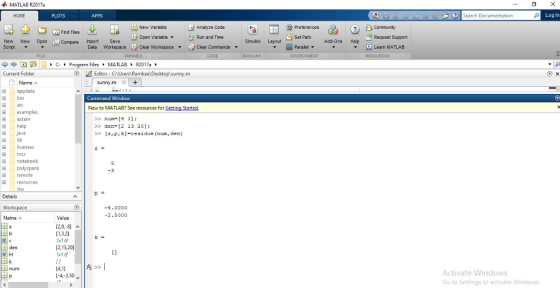
4s +1 2s2 +13s 20 H(s) = 1- Use MATLAB to plot the magnitude and phase...
Exercise 1 (Transfer Function Analysis) MATLAB provides numerous commands for working with polyno...
 Please do part C only, thank you.
Exercise 1 (Transfer Function Analysis) MATLAB provides numerous commands for working with polynomials, ratios of polynomials, partial fraction expansions and transfer functions: see, for example, the commands roots, poly, conv, residue, zpk and tf (a) Use MATLAB to gener ate the continuous-time transfer function H5+15)( +26(s+72) s(s +56)2(s2 +5s +30) H(s) displaying the result in two forms: as (i) the given ratio of factors and (ii) a ratio of two polynomials. (b) Use...
Please do part C only, thank you.
Exercise 1 (Transfer Function Analysis) MATLAB provides numerous commands for working with polynomials, ratios of polynomials, partial fraction expansions and transfer functions: see, for example, the commands roots, poly, conv, residue, zpk and tf (a) Use MATLAB to gener ate the continuous-time transfer function H5+15)( +26(s+72) s(s +56)2(s2 +5s +30) H(s) displaying the result in two forms: as (i) the given ratio of factors and (ii) a ratio of two polynomials. (b) Use...
Solve the following using MATLAB: 3. Consider the transfer function: H S ) = 6 2s2...
 Solve the following using MATLAB:
3. Consider the transfer function: H S ) = 6 2s2 + 6s 2s4 + 8 s +3 .4 L + 3 a) Write lines of code to find the zeros and poles of the above transfer function. b) Write lines of code to find a partial fraction expansion of the above transfer function.
Solve the following using MATLAB:
3. Consider the transfer function: H S ) = 6 2s2 + 6s 2s4 + 8 s +3 .4 L + 3 a) Write lines of code to find the zeros and poles of the above transfer function. b) Write lines of code to find a partial fraction expansion of the above transfer function.
Solve for H(s) and plot the magnitude and phase of that function in MATLAB. Make sure...
 Solve for H(s) and plot the magnitude and phase of that function
in MATLAB. Make sure to use the freqs() command when doing so.
Please include all the steps and add comments
to the code to help me understand the problem. Thank you
1Ω 1 F 1 H 1Ω 18
Solve for H(s) and plot the magnitude and phase of that function
in MATLAB. Make sure to use the freqs() command when doing so.
Please include all the steps and add comments
to the code to help me understand the problem. Thank you
1Ω 1 F 1 H 1Ω 18
Ri vo(t) = 0 Figure 19: Bandpass filter Use Matlab to plot the magnitude and phase...
 Ri vo(t) = 0 Figure 19: Bandpass filter Use Matlab to plot the magnitude and phase of the frequency response. Make sure the frequency range is wide enough to show enough details. Assume R1 = R2 = 1k1, C1 = 7.5nF, and C2 = 2.5uF.
4. Block Diagrams (a) Consider a causal LTI system with transfer function H(s)2 Show the direct-form block diagram of Hi(s) (b) Consider a causal LTI system with transfer function 2s2 +4s -6 H(s)- Sh...
 4. Block Diagrams (a) Consider a causal LTI system with transfer function H(s)2 Show the direct-form block diagram of Hi(s) (b) Consider a causal LTI system with transfer function 2s2 +4s -6 H(s)- Show the direct-form block diagram of Hi(s) c) Now observe that to draw a block diagram as a cascaded combination of two 1st order subsystems. d) Finally, use partial fraction expansion to express this system as a sum of individual poles and observe that you can draw...
1. The impulse response of an ideal band pass filter is given by the equation: n=0 h(n)w2 sin(n w...
 Do it using Matlab.
1. The impulse response of an ideal band pass filter is given by the equation: n=0 h(n)w2 sin(n w2) w1 sin (n w1) T nwW2 Using the above equation, write a Matlab program that implements an approximation for the band pass filter with cut-off frequencies (1-0.2π rad/sample and ω2-0.3π rad/sample. Set the order of the filter to 100 or 101. Use a Bartlett window here. Plot the frequency and phase responses of this digital filter. Hint...
Do it using Matlab.
1. The impulse response of an ideal band pass filter is given by the equation: n=0 h(n)w2 sin(n w2) w1 sin (n w1) T nwW2 Using the above equation, write a Matlab program that implements an approximation for the band pass filter with cut-off frequencies (1-0.2π rad/sample and ω2-0.3π rad/sample. Set the order of the filter to 100 or 101. Use a Bartlett window here. Plot the frequency and phase responses of this digital filter. Hint...
Matlab help 1) Given the functions x1()= tu()-tuft-1) and X2(t)=10e-5,11(), do the following: 1. Plotx,(t) and x2(0) using MATLAB 2. Use MATLAB to find and plot x(0=x:@*.x2(t), where * denotes co...
 Matlab help
1) Given the functions x1()= tu()-tuft-1) and X2(t)=10e-5,11(), do the following: 1. Plotx,(t) and x2(0) using MATLAB 2. Use MATLAB to find and plot x(0=x:@*.x2(t), where * denotes convolution. 3. Find x(t)=x;()*X2(1) by hand using Laplace transforms. 4. Plot the result of part 3 in MATLAB and compare it to that found in part 2. 2) Given the transfer function shown below, do the following: 1. Find the system's impulse response and plot it using MATLAB 2. Repeat...
Matlab help
1) Given the functions x1()= tu()-tuft-1) and X2(t)=10e-5,11(), do the following: 1. Plotx,(t) and x2(0) using MATLAB 2. Use MATLAB to find and plot x(0=x:@*.x2(t), where * denotes convolution. 3. Find x(t)=x;()*X2(1) by hand using Laplace transforms. 4. Plot the result of part 3 in MATLAB and compare it to that found in part 2. 2) Given the transfer function shown below, do the following: 1. Find the system's impulse response and plot it using MATLAB 2. Repeat...
Question 1: a) For any linear phase filter, prove that if zo is a zero, then...
 Question 1: a) For any linear phase filter, prove that if zo is a zero, then so must zobe. Hint: Using the properties of the z-transform, write h[n] = Eh[N - n) in the z-domain, and substitute 2 = 20. b) For any Type III or Type IV filter, prove that z = 1 is a zero. c) For any Type II filter, prove that z = -1 is a zero. d) In light of the above, find the zeros...
2. For the transfer functions in problem 1 (a)(d)(e), find the corresponding impulse response functions h(t) using par...
 2. For the transfer functions in problem 1 (a)(d)(e), find the corresponding impulse response functions h(t) using partial fraction expansion and determine the value of lim h(t) if the limit exists. Verify that lim- n(t)-0 for stable systems. (optional) After performing the partial fraction expansion by hand (required), yoiu are encouraged to use MATLAB to verify your results. MATLAB has a function called 'residue' that can calculate poles (pi) and residues (ci). For example, the following line will calculate the...
7 11. If a particular network is described by transfer function H(s), use MATLAB to plot the magnitude and phase Bode plot for H(s) equal to (a) 300 (s2 7s +7 s(5s +8s(2s + 4) 7 11. If a particu...
 7 11. If a particular network is described by transfer function H(s), use MATLAB to plot the magnitude and phase Bode plot for H(s) equal to (a) 300 (s2 7s +7 s(5s +8s(2s + 4)
7 11. If a particular network is described by transfer function H(s), use MATLAB to plot the magnitude and phase Bode plot for H(s) equal to (a) 300 (s2 7s +7 s(5s +8s(2s + 4)
7 11. If a particular network is described by transfer function H(s), use MATLAB to plot the magnitude and phase Bode plot for H(s) equal to (a) 300 (s2 7s +7 s(5s +8s(2s + 4)
 Please do part C only, thank you.
Exercise 1 (Transfer Function Analysis) MATLAB provides numerous commands for working with polynomials, ratios of polynomials, partial fraction expansions and transfer functions: see, for example, the commands roots, poly, conv, residue, zpk and tf (a) Use MATLAB to gener ate the continuous-time transfer function H5+15)( +26(s+72) s(s +56)2(s2 +5s +30) H(s) displaying the result in two forms: as (i) the given ratio of factors and (ii) a ratio of two polynomials. (b) Use...
Please do part C only, thank you.
Exercise 1 (Transfer Function Analysis) MATLAB provides numerous commands for working with polynomials, ratios of polynomials, partial fraction expansions and transfer functions: see, for example, the commands roots, poly, conv, residue, zpk and tf (a) Use MATLAB to gener ate the continuous-time transfer function H5+15)( +26(s+72) s(s +56)2(s2 +5s +30) H(s) displaying the result in two forms: as (i) the given ratio of factors and (ii) a ratio of two polynomials. (b) Use...
 Solve the following using MATLAB:
3. Consider the transfer function: H S ) = 6 2s2 + 6s 2s4 + 8 s +3 .4 L + 3 a) Write lines of code to find the zeros and poles of the above transfer function. b) Write lines of code to find a partial fraction expansion of the above transfer function.
Solve the following using MATLAB:
3. Consider the transfer function: H S ) = 6 2s2 + 6s 2s4 + 8 s +3 .4 L + 3 a) Write lines of code to find the zeros and poles of the above transfer function. b) Write lines of code to find a partial fraction expansion of the above transfer function.
 Solve for H(s) and plot the magnitude and phase of that function
in MATLAB. Make sure to use the freqs() command when doing so.
Please include all the steps and add comments
to the code to help me understand the problem. Thank you
1Ω 1 F 1 H 1Ω 18
Solve for H(s) and plot the magnitude and phase of that function
in MATLAB. Make sure to use the freqs() command when doing so.
Please include all the steps and add comments
to the code to help me understand the problem. Thank you
1Ω 1 F 1 H 1Ω 18
 Ri vo(t) = 0 Figure 19: Bandpass filter Use Matlab to plot the magnitude and phase of the frequency response. Make sure the frequency range is wide enough to show enough details. Assume R1 = R2 = 1k1, C1 = 7.5nF, and C2 = 2.5uF.
 4. Block Diagrams (a) Consider a causal LTI system with transfer function H(s)2 Show the direct-form block diagram of Hi(s) (b) Consider a causal LTI system with transfer function 2s2 +4s -6 H(s)- Show the direct-form block diagram of Hi(s) c) Now observe that to draw a block diagram as a cascaded combination of two 1st order subsystems. d) Finally, use partial fraction expansion to express this system as a sum of individual poles and observe that you can draw...
 Do it using Matlab.
1. The impulse response of an ideal band pass filter is given by the equation: n=0 h(n)w2 sin(n w2) w1 sin (n w1) T nwW2 Using the above equation, write a Matlab program that implements an approximation for the band pass filter with cut-off frequencies (1-0.2π rad/sample and ω2-0.3π rad/sample. Set the order of the filter to 100 or 101. Use a Bartlett window here. Plot the frequency and phase responses of this digital filter. Hint...
Do it using Matlab.
1. The impulse response of an ideal band pass filter is given by the equation: n=0 h(n)w2 sin(n w2) w1 sin (n w1) T nwW2 Using the above equation, write a Matlab program that implements an approximation for the band pass filter with cut-off frequencies (1-0.2π rad/sample and ω2-0.3π rad/sample. Set the order of the filter to 100 or 101. Use a Bartlett window here. Plot the frequency and phase responses of this digital filter. Hint...
 Matlab help
1) Given the functions x1()= tu()-tuft-1) and X2(t)=10e-5,11(), do the following: 1. Plotx,(t) and x2(0) using MATLAB 2. Use MATLAB to find and plot x(0=x:@*.x2(t), where * denotes convolution. 3. Find x(t)=x;()*X2(1) by hand using Laplace transforms. 4. Plot the result of part 3 in MATLAB and compare it to that found in part 2. 2) Given the transfer function shown below, do the following: 1. Find the system's impulse response and plot it using MATLAB 2. Repeat...
Matlab help
1) Given the functions x1()= tu()-tuft-1) and X2(t)=10e-5,11(), do the following: 1. Plotx,(t) and x2(0) using MATLAB 2. Use MATLAB to find and plot x(0=x:@*.x2(t), where * denotes convolution. 3. Find x(t)=x;()*X2(1) by hand using Laplace transforms. 4. Plot the result of part 3 in MATLAB and compare it to that found in part 2. 2) Given the transfer function shown below, do the following: 1. Find the system's impulse response and plot it using MATLAB 2. Repeat...
 Question 1: a) For any linear phase filter, prove that if zo is a zero, then so must zobe. Hint: Using the properties of the z-transform, write h[n] = Eh[N - n) in the z-domain, and substitute 2 = 20. b) For any Type III or Type IV filter, prove that z = 1 is a zero. c) For any Type II filter, prove that z = -1 is a zero. d) In light of the above, find the zeros...
 2. For the transfer functions in problem 1 (a)(d)(e), find the corresponding impulse response functions h(t) using partial fraction expansion and determine the value of lim h(t) if the limit exists. Verify that lim- n(t)-0 for stable systems. (optional) After performing the partial fraction expansion by hand (required), yoiu are encouraged to use MATLAB to verify your results. MATLAB has a function called 'residue' that can calculate poles (pi) and residues (ci). For example, the following line will calculate the...
 7 11. If a particular network is described by transfer function H(s), use MATLAB to plot the magnitude and phase Bode plot for H(s) equal to (a) 300 (s2 7s +7 s(5s +8s(2s + 4)
7 11. If a particular network is described by transfer function H(s), use MATLAB to plot the magnitude and phase Bode plot for H(s) equal to (a) 300 (s2 7s +7 s(5s +8s(2s + 4)
7 11. If a particular network is described by transfer function H(s), use MATLAB to plot the magnitude and phase Bode plot for H(s) equal to (a) 300 (s2 7s +7 s(5s +8s(2s + 4)
Most questions answered within 3 hours.
-
Where is the error in this code sequence?
String s1 = "Hello";
String s2 = "ello";...
asked 10 months ago -
Financial data for Joel de Paris, Inc., for last year
follow:
Joel de Paris, Inc.
Balance...
asked 10 months ago -
Consider this reaction:
Al2(SO4)3 (aq)+ BaCl3
(aq) Al2Cl6 (aq)- +
3BaSO4(s) . What is the...
asked 10 months ago -
Suppose that Savneet is considering increasing her
recent random sample from 20 car rentals to 40...
asked 10 months ago -
Trucks arrive at an unloading terminal at an average rate of 120
per hour.
Trucks arrive...
asked 10 months ago -
Why are methanol and ethanol completely soluble in water while
octanol is not very little soluble....
asked 10 months ago -
A facilities manager at a university reads in a research report
that the mean amount of...
asked 10 months ago -
When the CuSO4 is rehydrated by adding water to the anhydrous
compound, is this an endothermic...
asked 10 months ago -
A ray of sunlight is passing from diamond into crown glass; the
angle of incidence is...
asked 10 months ago -
A block of mass 0.249 kg is placed on top of a light, vertical
spring of...
asked 10 months ago -
how do the kidneys compensate in the presences of acidosis
a) trigger hyperventilate
b) reserve acid...
asked 10 months ago -
Question 501 pts
The rental rate of capital to the firm increases. Which of the
following...
asked 10 months ago