MATLAB
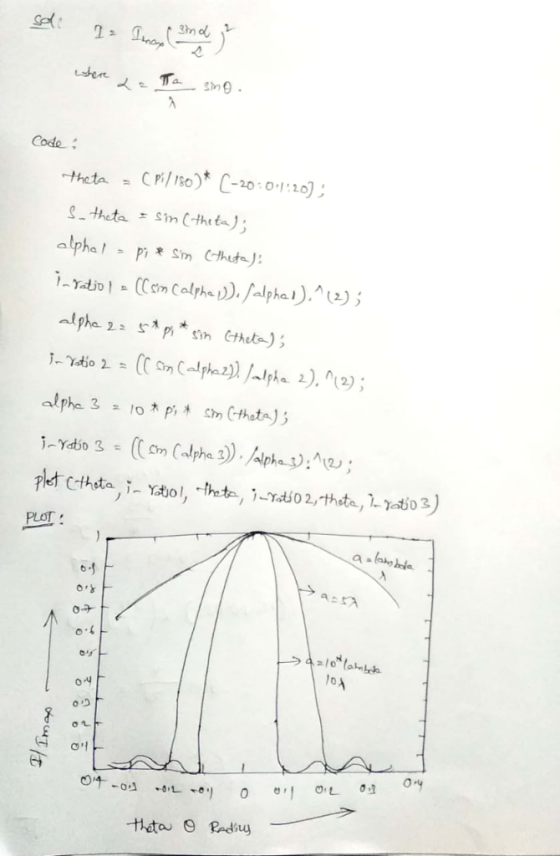
When monochromatic light passes through a narrow slit it
produces on a screen a diffraction pattern consisting of bright and
dark fringes. The intensity of the bright fringes, I, as a function
of can be
calculated by:
where
Where is the light
wave length and a is the width of the slit. Plot the relative
intenstiy I / Imax as a function of
for
-20o <=
<=
20o. Make one plot that contains three graphs for the
cases
a = 10, a = 5
,
and a =
. Label the
axes, and display a legend.
Homework Answers
Add Answer to:
MATLAB
When monochromatic light passes through a narrow slit it
produces on a screen a diffraction...
When monochromatic light passes through a narrow slit it produces on a screen a diffraction pattern...
When monochromatic light passes through a narrow slit it produces on a screen a diffraction pattern consisting of bright and dark fringes. The intensity of the bright fringes, I, as a function of can be calculated by: where Where is the light wave length and a is the width of the slit. Plot the relative intenstiy I / Imax as a function of for -20o <= <= 20o. Make one plot that contains three graphs for the cases a =...
A monochromatic light that passes through a Incident slit produces on a screen a diffraction patt...
 Please solve and plot using MATLAB:
Please solve and plot with MATLAB: Thank you
A monochromatic light that passes through a Incident slit produces on a screen a diffraction pattern light consisting of bright and dark fringes. The intensity of the bright fringes, I, as a function of 0 can be calculated by: πα where a asin θ , λ is the light wave length, a is the width of the slits. Make a 3-D plot (shown) that shows the...
Please solve and plot using MATLAB:
Please solve and plot with MATLAB: Thank you
A monochromatic light that passes through a Incident slit produces on a screen a diffraction pattern light consisting of bright and dark fringes. The intensity of the bright fringes, I, as a function of 0 can be calculated by: πα where a asin θ , λ is the light wave length, a is the width of the slits. Make a 3-D plot (shown) that shows the...
MATLAB , chapter 5 figure(n) Create new figure i# window, 3130%) When monochromatic light passes through...
 MATLAB , chapter 5
figure(n) Create new figure i# window, 3130%) When monochromatic light passes through a narrow slit it produces on a sCreen a diffraction pattern consisting of bright and dark fringes. The intensity of the bright fringes, I. as a fimc- tion of e can be calculated by Incident light sin c 2 where a TUCI sin e ax where A is the light wave length and a is the width of the slit. Plot the relative intensity...
MATLAB , chapter 5
figure(n) Create new figure i# window, 3130%) When monochromatic light passes through a narrow slit it produces on a sCreen a diffraction pattern consisting of bright and dark fringes. The intensity of the bright fringes, I. as a fimc- tion of e can be calculated by Incident light sin c 2 where a TUCI sin e ax where A is the light wave length and a is the width of the slit. Plot the relative intensity...
7. In a single-slit diffraction experiment, a beam of monochromatic light passes through a slit of...
 7. In a single-slit diffraction experiment, a beam of monochromatic light passes through a slit of width 11.0 um. If the fourth dark fringe of the resulting diffraction pattern is at an angle of 6.31°, what is the wavelength of the light? a) 302 nm b) 413 nm c) 602 nm d) 720 nm e) 827 nm
An intense monochromatic light incident on a diffraction grating with slit spacing d is causing an...
An intense monochromatic light incident on a diffraction grating with slit spacing d is causing an increase of the grating temperature. How should the frequency of the light be changed so that the position of bright fringes does not change.
An intense monochromatic light incident on a diffraction grating with slit spacing d is causing an...
An intense monochromatic light incident on a diffraction grating with slit spacing d is causing an increase of the grating temperature. How should the frequency of the light be changed so that the position of bright fringes does not change. (Consider that the thermal expansion of the diffraction grating does not damage the slits.) Select one: a. f should be increased. b. f has no effect on the position of the bright fringes. c. f should be decreased. d. f...
Monochromatic light of wavelength 500 nm is incident on a narrow slit. On a screen 2.01...
Monochromatic light of wavelength 500 nm is incident on a narrow slit. On a screen 2.01 m away, the distance between the second diffraction minimum and the central maximum is 1.85 cm. (a) Calculate the angle of diffraction ? of the second minimum. (b) Find the width of the slit.
Monochromatic light of wavelength 439 nm is incident on a narrow slit. On a screen 2.31...
Monochromatic light of wavelength 439 nm is incident on a narrow slit. On a screen 2.31 m away, the distance between the second diffraction minimum and the central maximum is 2.18 cm. (a) Calculate the angle of diffraction θ of the second minimum. (b) Find the width of the slit.
A diffraction pattern is formed on a screen 130 cm away from a 0.420-mm-wide slit. Monochromatic...
A diffraction pattern is formed on a screen 130 cm away from a 0.420-mm-wide slit. Monochromatic 546.1-nm light is used. Calculate the fractional intensity I/Imax at a point on the screen 4.10 mm from the center of the principal maximum.
Suppose a single slit diffracts monochromatic light at 562 cm and produces the first bright fring...
Suppose a single slit diffracts monochromatic light at 562 cm and produces the first bright fringe 7.5 cm away from the central axis. The screen is 2.46 m away from the slit. a. How far away from the central axis will the second bright fringe be if monochromatic light of wavelength 495 nm is put through the slit? b. What is the maximum number of dark fringes each of these wavelengths can produce for this slit?
 Please solve and plot using MATLAB:
Please solve and plot with MATLAB: Thank you
A monochromatic light that passes through a Incident slit produces on a screen a diffraction pattern light consisting of bright and dark fringes. The intensity of the bright fringes, I, as a function of 0 can be calculated by: πα where a asin θ , λ is the light wave length, a is the width of the slits. Make a 3-D plot (shown) that shows the...
Please solve and plot using MATLAB:
Please solve and plot with MATLAB: Thank you
A monochromatic light that passes through a Incident slit produces on a screen a diffraction pattern light consisting of bright and dark fringes. The intensity of the bright fringes, I, as a function of 0 can be calculated by: πα where a asin θ , λ is the light wave length, a is the width of the slits. Make a 3-D plot (shown) that shows the...
 MATLAB , chapter 5
figure(n) Create new figure i# window, 3130%) When monochromatic light passes through a narrow slit it produces on a sCreen a diffraction pattern consisting of bright and dark fringes. The intensity of the bright fringes, I. as a fimc- tion of e can be calculated by Incident light sin c 2 where a TUCI sin e ax where A is the light wave length and a is the width of the slit. Plot the relative intensity...
MATLAB , chapter 5
figure(n) Create new figure i# window, 3130%) When monochromatic light passes through a narrow slit it produces on a sCreen a diffraction pattern consisting of bright and dark fringes. The intensity of the bright fringes, I. as a fimc- tion of e can be calculated by Incident light sin c 2 where a TUCI sin e ax where A is the light wave length and a is the width of the slit. Plot the relative intensity...
 7. In a single-slit diffraction experiment, a beam of monochromatic light passes through a slit of width 11.0 um. If the fourth dark fringe of the resulting diffraction pattern is at an angle of 6.31°, what is the wavelength of the light? a) 302 nm b) 413 nm c) 602 nm d) 720 nm e) 827 nm
Most questions answered within 3 hours.
-
Where is the error in this code sequence?
String s1 = "Hello";
String s2 = "ello";...
asked 1 year ago -
Financial data for Joel de Paris, Inc., for last year
follow:
Joel de Paris, Inc.
Balance...
asked 1 year ago -
Consider this reaction:
Al2(SO4)3 (aq)+ BaCl3
(aq) Al2Cl6 (aq)- +
3BaSO4(s) . What is the...
asked 1 year ago -
Suppose that Savneet is considering increasing her
recent random sample from 20 car rentals to 40...
asked 1 year ago -
Trucks arrive at an unloading terminal at an average rate of 120
per hour.
Trucks arrive...
asked 1 year ago -
Why are methanol and ethanol completely soluble in water while
octanol is not very little soluble....
asked 1 year ago -
A facilities manager at a university reads in a research report
that the mean amount of...
asked 1 year ago -
When the CuSO4 is rehydrated by adding water to the anhydrous
compound, is this an endothermic...
asked 1 year ago -
A ray of sunlight is passing from diamond into crown glass; the
angle of incidence is...
asked 1 year ago -
A block of mass 0.249 kg is placed on top of a light, vertical
spring of...
asked 1 year ago -
how do the kidneys compensate in the presences of acidosis
a) trigger hyperventilate
b) reserve acid...
asked 1 year ago -
Question 501 pts
The rental rate of capital to the firm increases. Which of the
following...
asked 1 year ago