
Options selected are not correct.
Homework Answers
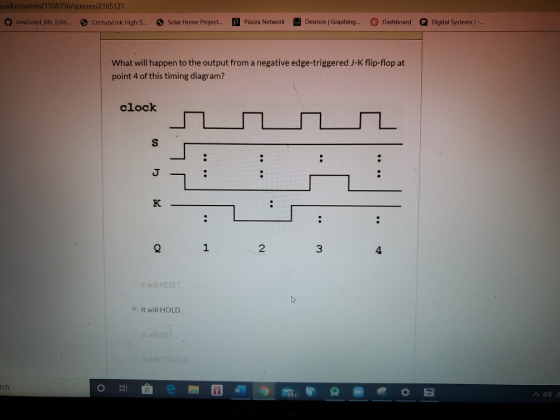
FOR FIRST QUESTION :
at point 3 (first option)
- The negative edge triggered FF changes it’s output only when the clock makes a transition fron high to low i.e at the negative edge (or falling) edge of the clock.
- TRUTH TABLE for negative edge-triggered j-k flip flop :

- as we can see from truth table of the a negative edge-triggered j-k flip flop the Q output goes HIGH when input J is HIGH and inpit K is LOW at falling edge of clock. Only at point 3 input J is HIGH and K is LOW at falling edge of clock so output Q will be HIGH.
FOR SECOND QUESTION :
it will RESET (first option)
- The negative edge triggered FF changes it’s output only when the clock makes a transition fron high to low i.e at the negative edge (or falling) edge of the clock.
- TRUTH TABLE for negative edge-triggered j-k flip flop :

- when input J is LOW and input K is HIGH at falling edge of the clock the output of the negative edge-triggered j-k flip flop is RESET.
FOR THIRD QUESTION :
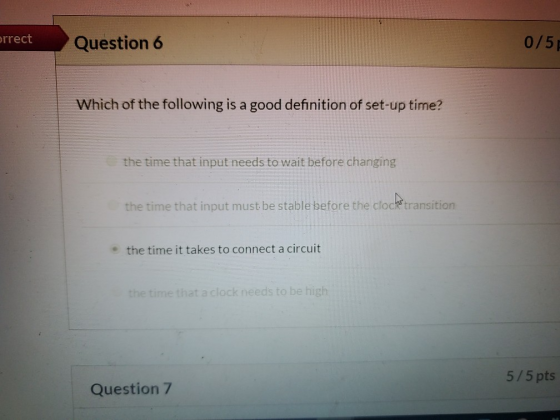
the time that input must be stable before the clock transition (second option)
- setup time is defined as the minimum amount of time before the clock's active edge that the data must be stable for it to be latched correctly. This is so that the data can be stored successfully in the storage device.
Add Answer to:
Options selected are not correct.
The waveforms below represent the inputs to a negative edge-triggered J-K...
5.4 2um 4-34. Design a negative-edge-triggered flip-flop. The flip flop has three inputs; these are Data,...
 5.4 2um
4-34. Design a negative-edge-triggered flip-flop. The flip flop has three inputs; these are Data, Clock, and Enable. If, at the negative edge of the clock, the enable input equals to 0, then the state at Data input is stored in the flip-flop. If, at the negative edge of clock, Enable is in 1 state, then the current stored value in the flip-flop is held. Design the flip-flop using only SR latches, AND gates, and NOT gates.
4-34. Design...
5.4 2um
4-34. Design a negative-edge-triggered flip-flop. The flip flop has three inputs; these are Data, Clock, and Enable. If, at the negative edge of the clock, the enable input equals to 0, then the state at Data input is stored in the flip-flop. If, at the negative edge of clock, Enable is in 1 state, then the current stored value in the flip-flop is held. Design the flip-flop using only SR latches, AND gates, and NOT gates.
4-34. Design...
For the circuit shown in Figure 7 draw the waveforms Qo and Q1. Note that the J-K flip flop is a negative edge triggered with active LOW and PRESET inputs. Assume Qo and Q1 to be initially 0
 For the circuit shown in Figure 7 draw the waveforms Qo and Q1. Note that the J-K flip flop is a negative edge triggered with active LOW and PRESET inputs. Assume Qo and Q1 to be initially 0
1. (10) Which of the following describes the operation of a positive edge-triggered D flip-lop? A...
 logic circuit
1. (10) Which of the following describes the operation of a positive edge-triggered D flip-lop? A. If both inputs are HIGH, the output will toggle. B. The output will follow the input on the leading edge of the clock. C. when both inputs are LOW, an invalid state exists. D. The input is toggled into the flip-flop on the leading edge of the clock and is passed to the output on the trailing edge of the clock. Answer...
logic circuit
1. (10) Which of the following describes the operation of a positive edge-triggered D flip-lop? A. If both inputs are HIGH, the output will toggle. B. The output will follow the input on the leading edge of the clock. C. when both inputs are LOW, an invalid state exists. D. The input is toggled into the flip-flop on the leading edge of the clock and is passed to the output on the trailing edge of the clock. Answer...
5) Complete the timing diagram for the circuit with one positive-edge and one negative-edge triggered D...
 5) Complete the timing diagram for the circuit with one positive-edge and one negative-edge triggered D FF. Q1 and Q0 start a low (0) because CLRn starts low. CLk K - 1 cun Q ई 6) For each set of waveforms, create a D, T or J/K waveform that will generate the desired Q output. Assume Q starts low. There are several right answers for the J and K inputs. To prevent flip-flop instability, all changes to the D, T...
23. A J-K flip-flop has a l on the J input and a 0 on the...
 23. A J-K flip-flop has a l on the J input and a 0 on the K input. What state is the flip-flop in? (a) Q=1,0-0 (b) Q-1, Q-1 (c) Q-0,Q 1 (d) Q-0,Q-0 -24. On a positive edge-triggered S-R flip-flop, the outputs reflect the input condition when (a) the clock pulse is LOW (b) the clock pulse is HIGH (c) the clock pulse transitions from LOW to HIGH (d) the clock pulse transitions from HIGH to LOW 25. The...
Question 06: The inputs for a positive edge triggered J-K flip-flop are shown in figure. Find...
 Question 06: The inputs for a positive edge triggered J-K flip-flop are shown in figure. Find the output Q in relative to the CLK signal. Assume that Q is initially RESET. CLK _ பபபபபட PRE V- >
Q1. The basic functionality of a D flip-flop (FF) can be implemented with a J-K FF...
 Q1. The basic functionality of a D flip-flop (FF) can be implemented with a J-K FF by connecting the input D to J and D' to K. a) Show that this is true by comparing the characteristic equations for a D FF and JK FF. b) Draw a timing diagram for clock, D and outputs Qp, On, Qms that illustrates the difference in input/output behavior of a positive edge triggered D FF, negative edge triggered D FF and a master...
1. Complete the waveform of Qoutput based on the given set of inputs. C is the...
 1. Complete the waveform of Qoutput based on the given set of inputs. C is the clock input. (2 marks) C. I к e 2. Complete the waveform of Qoutput from a D flip-flop based on the given set of inputs. C is the clock input. Notice this flip-flop has two asynchronous inputs. Notice the overhead bars above some signal names. (2 marks) c 30 Ro D e 3. Both J and Kinputs of a JK flip-flop are tied to...
1. Draw the timing diagram for a negative-edge-triggered D flip-flop with Preset and Clear functionalities for...
 1. Draw the timing diagram for a negative-edge-triggered D flip-flop with Preset and Clear functionalities for the following input signal combina- tions. The signal values for Clock, D, Preset, and Clear vary as shown below. Assume each signal is held constant from one-time step to the next. Assume gate delays to be zero. Assume the initial value of Q to be 0. The truth table is shown on the next page. (a) Draw the wave forms for Clock, D, Presetn,...
Answers are at the end of the chapter 1. If an S-R latch has a 1...
 Answers are at the end of the chapter 1. If an S-R latch has a 1 on the S input and a 0 on the R input and then the S input goes to 0, the latch will be (a) set (b) reset (c) invalid (d) clear 2. The invalid state of an S-R latch occurs when (c) S 1,R-1 (d) S-0, R-O 3. For a gated D latch, the output always equals the D input (a) before the enable...
 5.4 2um
4-34. Design a negative-edge-triggered flip-flop. The flip flop has three inputs; these are Data, Clock, and Enable. If, at the negative edge of the clock, the enable input equals to 0, then the state at Data input is stored in the flip-flop. If, at the negative edge of clock, Enable is in 1 state, then the current stored value in the flip-flop is held. Design the flip-flop using only SR latches, AND gates, and NOT gates.
4-34. Design...
5.4 2um
4-34. Design a negative-edge-triggered flip-flop. The flip flop has three inputs; these are Data, Clock, and Enable. If, at the negative edge of the clock, the enable input equals to 0, then the state at Data input is stored in the flip-flop. If, at the negative edge of clock, Enable is in 1 state, then the current stored value in the flip-flop is held. Design the flip-flop using only SR latches, AND gates, and NOT gates.
4-34. Design...
 logic circuit
1. (10) Which of the following describes the operation of a positive edge-triggered D flip-lop? A. If both inputs are HIGH, the output will toggle. B. The output will follow the input on the leading edge of the clock. C. when both inputs are LOW, an invalid state exists. D. The input is toggled into the flip-flop on the leading edge of the clock and is passed to the output on the trailing edge of the clock. Answer...
logic circuit
1. (10) Which of the following describes the operation of a positive edge-triggered D flip-lop? A. If both inputs are HIGH, the output will toggle. B. The output will follow the input on the leading edge of the clock. C. when both inputs are LOW, an invalid state exists. D. The input is toggled into the flip-flop on the leading edge of the clock and is passed to the output on the trailing edge of the clock. Answer...
 5) Complete the timing diagram for the circuit with one positive-edge and one negative-edge triggered D FF. Q1 and Q0 start a low (0) because CLRn starts low. CLk K - 1 cun Q ई 6) For each set of waveforms, create a D, T or J/K waveform that will generate the desired Q output. Assume Q starts low. There are several right answers for the J and K inputs. To prevent flip-flop instability, all changes to the D, T...
 23. A J-K flip-flop has a l on the J input and a 0 on the K input. What state is the flip-flop in? (a) Q=1,0-0 (b) Q-1, Q-1 (c) Q-0,Q 1 (d) Q-0,Q-0 -24. On a positive edge-triggered S-R flip-flop, the outputs reflect the input condition when (a) the clock pulse is LOW (b) the clock pulse is HIGH (c) the clock pulse transitions from LOW to HIGH (d) the clock pulse transitions from HIGH to LOW 25. The...
 Question 06: The inputs for a positive edge triggered J-K flip-flop are shown in figure. Find the output Q in relative to the CLK signal. Assume that Q is initially RESET. CLK _ பபபபபட PRE V- >
 Q1. The basic functionality of a D flip-flop (FF) can be implemented with a J-K FF by connecting the input D to J and D' to K. a) Show that this is true by comparing the characteristic equations for a D FF and JK FF. b) Draw a timing diagram for clock, D and outputs Qp, On, Qms that illustrates the difference in input/output behavior of a positive edge triggered D FF, negative edge triggered D FF and a master...
 1. Complete the waveform of Qoutput based on the given set of inputs. C is the clock input. (2 marks) C. I к e 2. Complete the waveform of Qoutput from a D flip-flop based on the given set of inputs. C is the clock input. Notice this flip-flop has two asynchronous inputs. Notice the overhead bars above some signal names. (2 marks) c 30 Ro D e 3. Both J and Kinputs of a JK flip-flop are tied to...
 1. Draw the timing diagram for a negative-edge-triggered D flip-flop with Preset and Clear functionalities for the following input signal combina- tions. The signal values for Clock, D, Preset, and Clear vary as shown below. Assume each signal is held constant from one-time step to the next. Assume gate delays to be zero. Assume the initial value of Q to be 0. The truth table is shown on the next page. (a) Draw the wave forms for Clock, D, Presetn,...
 Answers are at the end of the chapter 1. If an S-R latch has a 1 on the S input and a 0 on the R input and then the S input goes to 0, the latch will be (a) set (b) reset (c) invalid (d) clear 2. The invalid state of an S-R latch occurs when (c) S 1,R-1 (d) S-0, R-O 3. For a gated D latch, the output always equals the D input (a) before the enable...
Most questions answered within 3 hours.
-
Where is the error in this code sequence?
String s1 = "Hello";
String s2 = "ello";...
asked 10 months ago -
Financial data for Joel de Paris, Inc., for last year
follow:
Joel de Paris, Inc.
Balance...
asked 10 months ago -
Consider this reaction:
Al2(SO4)3 (aq)+ BaCl3
(aq) Al2Cl6 (aq)- +
3BaSO4(s) . What is the...
asked 10 months ago -
Suppose that Savneet is considering increasing her
recent random sample from 20 car rentals to 40...
asked 10 months ago -
Trucks arrive at an unloading terminal at an average rate of 120
per hour.
Trucks arrive...
asked 10 months ago -
Why are methanol and ethanol completely soluble in water while
octanol is not very little soluble....
asked 10 months ago -
A facilities manager at a university reads in a research report
that the mean amount of...
asked 10 months ago -
When the CuSO4 is rehydrated by adding water to the anhydrous
compound, is this an endothermic...
asked 10 months ago -
A ray of sunlight is passing from diamond into crown glass; the
angle of incidence is...
asked 10 months ago -
A block of mass 0.249 kg is placed on top of a light, vertical
spring of...
asked 10 months ago -
how do the kidneys compensate in the presences of acidosis
a) trigger hyperventilate
b) reserve acid...
asked 10 months ago -
Question 501 pts
The rental rate of capital to the firm increases. Which of the
following...
asked 10 months ago