
Homework Answers
Add Answer to:
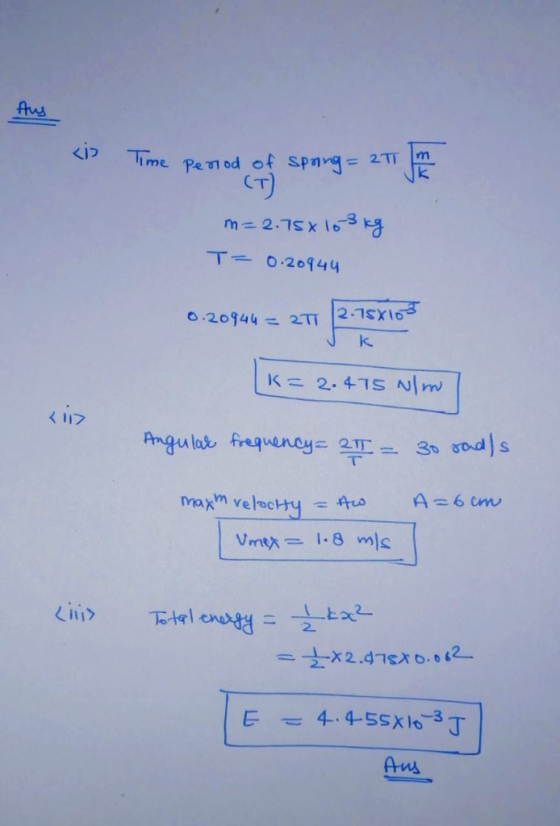
(a) Obtain the equation of motion for a 2.75-g mass, at the end of a perfectly...
Obtain the equation of motion for a 1.25-g mass, at the end of a perfectly elastic...
Obtain the equation of motion for a 1.25-g mass, at the end of a perfectly elastic spring which, when stretched 3.75 cm from equilibrium and then released from rest, undergoes simple harmonic motion with a period of 0.016667 s. B.) Find the (i) spring constant (ii) maximum velocity and (iii) total energy of the mass. C.) For the above spring find the positions for which the potential energy is one-third the kinetic energy.
Homework for Lab 15: Simple Harmonic Motion Name Date Section 15 10 -5 -15-10-5 0 5...
 Homework for Lab 15: Simple Harmonic Motion Name Date Section 15 10 -5 -15-10-5 0 5 10 15 Displacement (em) Figure 15.6: Force vs displacement graph for a 0.75 kg cart on a horizontal spring. 1. Figure 15.6 shows the force exerted by the spring on a 0.75 kg cart, as a function of its displacement from equilibrium. Positive displacements (in cm) represent stretching of the spring; negative displacements represent compression. Find the spring constant. 2. The cart is moved...
An object–spring system moving with simple harmonic motion has an amplitude A. (a) What is the...
An object–spring system moving with simple harmonic motion has an amplitude A. (a) What is the total energy of the system in terms of k and A only? E : (b) Suppose at a certain instant the kinetic energy is twice the elastic potential energy. Write an equation describing this situation, using only the variables for the mass m, velocity v, spring constant k, and position x. (c) Using the results of parts (a) and (b) and the conservation of...
A block attached to a spring undergoes simple harmonic motion, sliding back and forth along a...
 A block attached to a spring undergoes simple harmonic motion,
sliding back and forth along a straight line on a horizontal,
frictionless surface. The amplitude of the block's motion is
cm, the frequency of the block's motion is
Hz, and the mass of the block is kg.
a) Determine the spring's stiffness constant.
N/m
b) The block is initially stretched and then released at time
. Determine a formula for the position
function of the block, where the position is...
A block attached to a spring undergoes simple harmonic motion,
sliding back and forth along a straight line on a horizontal,
frictionless surface. The amplitude of the block's motion is
cm, the frequency of the block's motion is
Hz, and the mass of the block is kg.
a) Determine the spring's stiffness constant.
N/m
b) The block is initially stretched and then released at time
. Determine a formula for the position
function of the block, where the position is...
A mass m on a spring of stiffness k undergoes horizontal simple harmonic motion with amplitude...
A mass m on a spring of stiffness k undergoes horizontal simple harmonic motion with amplitude A, centered around x = 0. a) What is the total "mechanical" energy (kinetic plus potential) of the mass-spring system? b) What is the value of x when the mass-spring system has twice as much kinetic energy as potential energy? Your answers should be in terms of the quantities m, k, and A--or some subset thereof.
A spring-block system sits on a horizontal, frictionless surface. The spring has a spring constant k...
A spring-block system sits on a horizontal, frictionless surface. The spring has a spring constant k =2000N/m. The mass of the block is 14.5 kg. The spring is stretched out a distance of 20.0 cm and released. The block undergoes simple harmonic motion with a phase constant φ=?. a) if the velocity of the block is -2.00 m/s at t= 0.150 s, what is the phase constant? b) determine the acceleration of the block at t = 0.150 s. c) what...
A block having mass m and charge +Q is connected to an insulating spring having a force constant k.
 A block having mass m and charge +Q is connected to an insulating spring having a force constant k. The block lies on a frictionless, insulating, horizontal track, and the system is immersed In a uniform electric field of magnitude E directed as shown in the figure below. The block Is released from rest when the spring Is unstretched (at x = 0). We wish to show that the ensuing motion of the block is simple harmonic. (a) Consider the system...
A mass is attached to the end of a spring and set into simple harmonic motion...
 A mass is attached to the end of a spring and set into simple harmonic motion with an amplitude A on a horizontal frictionless surface. Determine the following in terms of only the variable A. (a) Magnitude of the position in terms of A) of the oscillating mass when its speed is 20% of its maximum value. A (b) Magnitude of the position (in terms of A) of the oscillating mass when the elastic potential energy of the spring is...
A mass is attached to the end of a spring and set into simple harmonic motion...
 A mass is attached to the end of a spring and set into simple harmonic motion with an amplitude A on a horizontal frictionless surface. Determine the following in terms of only the variable A. (a) Magnitude of the position (in terms of A) of the oscillating mass when its speed is 40% of its maximum value. A (b) Magnitude of the position (in terms of A) of the oscillating mass when the elastic potential energy of the spring is...
A vertical elastic cord is stretched 0.306 m when a mass 1.66 kg is attached to...
A vertical elastic cord is stretched 0.306 m when a mass 1.66 kg is attached to it. The cord is then stretched an additional 0.114 m and released from rest. Assuming the cord is an ideal linear spring, how long does it take for the mass to reach its original equilibrium position? HINTS: First find the elastic constant of the elastic cord, using the fact that the gravitational weight mg of the mass is balanced by the upward pull of...
 Homework for Lab 15: Simple Harmonic Motion Name Date Section 15 10 -5 -15-10-5 0 5 10 15 Displacement (em) Figure 15.6: Force vs displacement graph for a 0.75 kg cart on a horizontal spring. 1. Figure 15.6 shows the force exerted by the spring on a 0.75 kg cart, as a function of its displacement from equilibrium. Positive displacements (in cm) represent stretching of the spring; negative displacements represent compression. Find the spring constant. 2. The cart is moved...
 A mass is attached to the end of a spring and set into simple harmonic motion with an amplitude A on a horizontal frictionless surface. Determine the following in terms of only the variable A. (a) Magnitude of the position in terms of A) of the oscillating mass when its speed is 20% of its maximum value. A (b) Magnitude of the position (in terms of A) of the oscillating mass when the elastic potential energy of the spring is...
 A mass is attached to the end of a spring and set into simple harmonic motion with an amplitude A on a horizontal frictionless surface. Determine the following in terms of only the variable A. (a) Magnitude of the position (in terms of A) of the oscillating mass when its speed is 40% of its maximum value. A (b) Magnitude of the position (in terms of A) of the oscillating mass when the elastic potential energy of the spring is...
Most questions answered within 3 hours.
-
Where is the error in this code sequence?
String s1 = "Hello";
String s2 = "ello";...
asked 11 months ago -
Financial data for Joel de Paris, Inc., for last year
follow:
Joel de Paris, Inc.
Balance...
asked 11 months ago -
Consider this reaction:
Al2(SO4)3 (aq)+ BaCl3
(aq) Al2Cl6 (aq)- +
3BaSO4(s) . What is the...
asked 11 months ago -
Suppose that Savneet is considering increasing her
recent random sample from 20 car rentals to 40...
asked 11 months ago -
Trucks arrive at an unloading terminal at an average rate of 120
per hour.
Trucks arrive...
asked 11 months ago -
Why are methanol and ethanol completely soluble in water while
octanol is not very little soluble....
asked 11 months ago -
A facilities manager at a university reads in a research report
that the mean amount of...
asked 11 months ago -
When the CuSO4 is rehydrated by adding water to the anhydrous
compound, is this an endothermic...
asked 11 months ago -
A ray of sunlight is passing from diamond into crown glass; the
angle of incidence is...
asked 11 months ago -
A block of mass 0.249 kg is placed on top of a light, vertical
spring of...
asked 11 months ago -
how do the kidneys compensate in the presences of acidosis
a) trigger hyperventilate
b) reserve acid...
asked 11 months ago -
Question 501 pts
The rental rate of capital to the firm increases. Which of the
following...
asked 11 months ago