What answer is correct. I’m not sure if I chose the correct answer.

Homework Answers
First option is correct. Proton will move in direction of Electric field. And the direction of the field is the one in which potential decreases. S it will move from hight to low potential.
Add Answer to:
#5
What answer is correct. I’m not sure if I chose the correct
answer.
If a...
A proton is released from rest in a uniform electric field. Which statement is correct? The...
A proton is released from rest in a uniform electric field. Which statement is correct? The proton will move in the opposite direction as the electric field to regions of lower electric potential. The proton will move in the same direction as the electric field to regions of lower electric potential. The proton will move in the opposite direction as the electric field to regions of higher electric potential. The proton will move in the same direction as the electric...
I am confused on this question, the correct answer is A and I chose B. I...
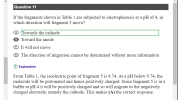 I am confused on this question, the correct answer is A and I
chose B. I thought the cathode was positively charged, and the
anode was negateively charged; and a high PI would incicate a more
positive charge, and a low PI would incidate a more negative chare.
Are these correct or am I backwards in some these? Also, are any of
these different for a galvanic or electrolytic cell?
Please explain how you would answer this question, thank
you!...
I am confused on this question, the correct answer is A and I
chose B. I thought the cathode was positively charged, and the
anode was negateively charged; and a high PI would incicate a more
positive charge, and a low PI would incidate a more negative chare.
Are these correct or am I backwards in some these? Also, are any of
these different for a galvanic or electrolytic cell?
Please explain how you would answer this question, thank
you!...
I mostly just need to confirm my answers thanks! In a typical parallel plate capacitor the...
 I mostly just need to confirm my answers thanks!
In a typical parallel plate capacitor the separation distance between the plates is "d". For a charged capacitor, if you increase only the separation distance of the plates the following occurs: The potential (V) between the plates remains constant but the electric field increases, The potential (V) between the plates increases but the electric field remains constant. The potential (V) between the plates remains constant and the electric remains constant. The...
I mostly just need to confirm my answers thanks!
In a typical parallel plate capacitor the separation distance between the plates is "d". For a charged capacitor, if you increase only the separation distance of the plates the following occurs: The potential (V) between the plates remains constant but the electric field increases, The potential (V) between the plates increases but the electric field remains constant. The potential (V) between the plates remains constant and the electric remains constant. The...
Please help me break down and work through this practice question so that I can better...
 Please help me break down and work through this practice
question so that I can better under the steps and work it out on my
own.
6. A proton and an electron are separately placed at rest in the same uniform electric field. What can be said about the motion of each? A) Both remain stationary. B) Both move in the direction of the electric field. C) Both move in the opposite direction of the electric field. D) The proton...
Please help me break down and work through this practice
question so that I can better under the steps and work it out on my
own.
6. A proton and an electron are separately placed at rest in the same uniform electric field. What can be said about the motion of each? A) Both remain stationary. B) Both move in the direction of the electric field. C) Both move in the opposite direction of the electric field. D) The proton...
charges move in an electric field due to the Coulomb force. Some unknowns charge moves in...
 charges move in an electric field due to the Coulomb force.
Some unknowns charge moves in a direction perpendicular to the
direction of the electric field
TakeTutorialA Home Student: amaile7 Esam 1 PRACTICE Begin Date: 3/19/2019 1201.00 AM-Due Date: 3/20/2019 11 59.00 PM End Date: 3/20/2019 11 59.00 PM a3%) Problem 2: Charges move in an electric field due to the Coulomb force. moves in a direction perpendicular to the direction of the electric field lines. We can conctade that...
charges move in an electric field due to the Coulomb force.
Some unknowns charge moves in a direction perpendicular to the
direction of the electric field
TakeTutorialA Home Student: amaile7 Esam 1 PRACTICE Begin Date: 3/19/2019 1201.00 AM-Due Date: 3/20/2019 11 59.00 PM End Date: 3/20/2019 11 59.00 PM a3%) Problem 2: Charges move in an electric field due to the Coulomb force. moves in a direction perpendicular to the direction of the electric field lines. We can conctade that...
What is the answer to part B, and what formula should be used? t A Proton...
 What is the answer to part B, and what formula should
be used?
t A Proton between Oppositely Charged Plates 4 of 10 > Constants Part A A uniform electric field exists in the region between two oppositely charged parallel plates 1.70 cm apart. A proton is released from rest at the surface of the positively charged plate and strikes the surface of the opposite plate in a time interval 1.54x10⁻⁶ s Find the magnitude of the electric field Use...
What is the answer to part B, and what formula should
be used?
t A Proton between Oppositely Charged Plates 4 of 10 > Constants Part A A uniform electric field exists in the region between two oppositely charged parallel plates 1.70 cm apart. A proton is released from rest at the surface of the positively charged plate and strikes the surface of the opposite plate in a time interval 1.54x10⁻⁶ s Find the magnitude of the electric field Use...
(7%) Problem 5: Suppose you have the 7.75 F capacitor of a heart defibrillator at a...
 (7%) Problem 5: Suppose you have the 7.75 F capacitor of a heart defibrillator at a potential difference of 17.5 x 10⁴ V. Randomized Variables V-17.5 x 10⁴ v 50% Part (a) What is the energy stored in it in J? U 118671.88 U-118700 Correct! | 50% Part (b) Find the amount of stored charge in mC. Grade Summary Deductions 0% Potential Q = 13.561 100% (7%) Problem 15: select part Charges move in an electric field due to the...
A proton is released from rest at point A in a constant electric field and accelerates...
 A proton is released from rest at point A in a constant electric field and accelerates to point B (see part a of the drawing). An electron is released from rest at point 8 and accelerates to point A (see part b of the drawing). How does the change in the proton's electric potential energy compare with the change in the electrons electric potential energy? O The proton experiences a greater change in electric potential energy, since it has a...
Part A What is the magnitude of the force per meter of length on a straight...
Part A What is the magnitude of the force per meter of length on a straight wire carrying an 7.90-A current when perpendicular to a 0.70-T uniform magnetic field? Part B What if the angle between the wire and field is 57.0 ∘? Express your answer to two significant figures and include the appropriate units. ------------------------------- An electron is projected vertically upward with a speed of 1.20×10⁶m/s into a uniform magnetic field of 0.590 T that is directed horizontally away...
which statement(s) is(are) TRUE for a proton moving in the direction of an electric field?...
which statement(s) is(are) TRUE for a proton moving in the direction of an electric field? There may be more than one correct choice. Its electric potential energy increases as it goes from high to low potential. Its electric potential energy decreases as it goes from high to low potential. Its electric potential energy increases as its kinetic energy decreases. Its electric potential energy remains constant. Its kinetic energy decreases as it moves in the direction of the electric field....
 I am confused on this question, the correct answer is A and I
chose B. I thought the cathode was positively charged, and the
anode was negateively charged; and a high PI would incicate a more
positive charge, and a low PI would incidate a more negative chare.
Are these correct or am I backwards in some these? Also, are any of
these different for a galvanic or electrolytic cell?
Please explain how you would answer this question, thank
you!...
I am confused on this question, the correct answer is A and I
chose B. I thought the cathode was positively charged, and the
anode was negateively charged; and a high PI would incicate a more
positive charge, and a low PI would incidate a more negative chare.
Are these correct or am I backwards in some these? Also, are any of
these different for a galvanic or electrolytic cell?
Please explain how you would answer this question, thank
you!...
 I mostly just need to confirm my answers thanks!
In a typical parallel plate capacitor the separation distance between the plates is "d". For a charged capacitor, if you increase only the separation distance of the plates the following occurs: The potential (V) between the plates remains constant but the electric field increases, The potential (V) between the plates increases but the electric field remains constant. The potential (V) between the plates remains constant and the electric remains constant. The...
I mostly just need to confirm my answers thanks!
In a typical parallel plate capacitor the separation distance between the plates is "d". For a charged capacitor, if you increase only the separation distance of the plates the following occurs: The potential (V) between the plates remains constant but the electric field increases, The potential (V) between the plates increases but the electric field remains constant. The potential (V) between the plates remains constant and the electric remains constant. The...
 Please help me break down and work through this practice
question so that I can better under the steps and work it out on my
own.
6. A proton and an electron are separately placed at rest in the same uniform electric field. What can be said about the motion of each? A) Both remain stationary. B) Both move in the direction of the electric field. C) Both move in the opposite direction of the electric field. D) The proton...
Please help me break down and work through this practice
question so that I can better under the steps and work it out on my
own.
6. A proton and an electron are separately placed at rest in the same uniform electric field. What can be said about the motion of each? A) Both remain stationary. B) Both move in the direction of the electric field. C) Both move in the opposite direction of the electric field. D) The proton...
 charges move in an electric field due to the Coulomb force.
Some unknowns charge moves in a direction perpendicular to the
direction of the electric field
TakeTutorialA Home Student: amaile7 Esam 1 PRACTICE Begin Date: 3/19/2019 1201.00 AM-Due Date: 3/20/2019 11 59.00 PM End Date: 3/20/2019 11 59.00 PM a3%) Problem 2: Charges move in an electric field due to the Coulomb force. moves in a direction perpendicular to the direction of the electric field lines. We can conctade that...
charges move in an electric field due to the Coulomb force.
Some unknowns charge moves in a direction perpendicular to the
direction of the electric field
TakeTutorialA Home Student: amaile7 Esam 1 PRACTICE Begin Date: 3/19/2019 1201.00 AM-Due Date: 3/20/2019 11 59.00 PM End Date: 3/20/2019 11 59.00 PM a3%) Problem 2: Charges move in an electric field due to the Coulomb force. moves in a direction perpendicular to the direction of the electric field lines. We can conctade that...
 What is the answer to part B, and what formula should
be used?
t A Proton between Oppositely Charged Plates 4 of 10 > Constants Part A A uniform electric field exists in the region between two oppositely charged parallel plates 1.70 cm apart. A proton is released from rest at the surface of the positively charged plate and strikes the surface of the opposite plate in a time interval 1.54x10⁻⁶ s Find the magnitude of the electric field Use...
What is the answer to part B, and what formula should
be used?
t A Proton between Oppositely Charged Plates 4 of 10 > Constants Part A A uniform electric field exists in the region between two oppositely charged parallel plates 1.70 cm apart. A proton is released from rest at the surface of the positively charged plate and strikes the surface of the opposite plate in a time interval 1.54x10⁻⁶ s Find the magnitude of the electric field Use...
 (7%) Problem 5: Suppose you have the 7.75 F capacitor of a heart defibrillator at a potential difference of 17.5 x 10⁴ V. Randomized Variables V-17.5 x 10⁴ v 50% Part (a) What is the energy stored in it in J? U 118671.88 U-118700 Correct! | 50% Part (b) Find the amount of stored charge in mC. Grade Summary Deductions 0% Potential Q = 13.561 100% (7%) Problem 15: select part Charges move in an electric field due to the...
 A proton is released from rest at point A in a constant electric field and accelerates to point B (see part a of the drawing). An electron is released from rest at point 8 and accelerates to point A (see part b of the drawing). How does the change in the proton's electric potential energy compare with the change in the electrons electric potential energy? O The proton experiences a greater change in electric potential energy, since it has a...
Most questions answered within 3 hours.
-
Where is the error in this code sequence?
String s1 = "Hello";
String s2 = "ello";...
asked 10 months ago -
Financial data for Joel de Paris, Inc., for last year
follow:
Joel de Paris, Inc.
Balance...
asked 10 months ago -
Consider this reaction:
Al2(SO4)3 (aq)+ BaCl3
(aq) Al2Cl6 (aq)- +
3BaSO4(s) . What is the...
asked 10 months ago -
Suppose that Savneet is considering increasing her
recent random sample from 20 car rentals to 40...
asked 10 months ago -
Trucks arrive at an unloading terminal at an average rate of 120
per hour.
Trucks arrive...
asked 10 months ago -
Why are methanol and ethanol completely soluble in water while
octanol is not very little soluble....
asked 10 months ago -
A facilities manager at a university reads in a research report
that the mean amount of...
asked 10 months ago -
When the CuSO4 is rehydrated by adding water to the anhydrous
compound, is this an endothermic...
asked 10 months ago -
A ray of sunlight is passing from diamond into crown glass; the
angle of incidence is...
asked 10 months ago -
A block of mass 0.249 kg is placed on top of a light, vertical
spring of...
asked 10 months ago -
how do the kidneys compensate in the presences of acidosis
a) trigger hyperventilate
b) reserve acid...
asked 10 months ago -
Question 501 pts
The rental rate of capital to the firm increases. Which of the
following...
asked 10 months ago