
Homework Answers
Request Answer!
We need at least 10 more requests to produce the answer.
0 / 10 have requested this problem solution
The more requests, the faster the answer.
Add Answer to:
3.5 (5) Considering the 1092 resistor as a load element, simplify the circuit shown, using source...
Solve by hand and simulate in any electrical circuit simulator preferrably LTSpice Solve by hand only. Problem #4: Consider the circuit shown below. 6Ω /8 Ω 302 2700 V (rms) 40 2 Source-Line Load...
 Solve by hand and simulate in any electrical circuit
simulator preferrably LTSpice
Solve by hand only.
Problem #4: Consider the circuit shown below. 6Ω /8 Ω 302 2700 V (rms) 40 2 Source-Line Load (a) Find the real power dissipated in the line. (b) Find the capacitive reactance that when connected in parallel with the load will pl make the load look purely resistive. (c) What is the equivalent impedance of the load in (b)? (d) Find the real power...
Solve by hand and simulate in any electrical circuit
simulator preferrably LTSpice
Solve by hand only.
Problem #4: Consider the circuit shown below. 6Ω /8 Ω 302 2700 V (rms) 40 2 Source-Line Load (a) Find the real power dissipated in the line. (b) Find the capacitive reactance that when connected in parallel with the load will pl make the load look purely resistive. (c) What is the equivalent impedance of the load in (b)? (d) Find the real power...
For the circuit shown, using resistor combinations and Ohm's Law, calculate (a) Vo and b, (b)...
 For the circuit shown, using resistor combinations and Ohm's Law, calculate (a) Vo and b, (b) the power dissipated in the 15 ? resistor, and (c) the power developed by the voltage source. 2? 15 ? 120 V
MULTISIM 10.65 The variable load resistor R¡ in the circuit shown in PSPICE Fig. P10.65 is...
 MULTISIM 10.65 The variable load resistor R¡ in the circuit shown in PSPICE Fig. P10.65 is adjusted for maximum average power transfer to RL a) Find the maximum average power. b) What percentage of the average power devel- oped by the ideal voltage source is delivered to Rź when R is absorbing maximum average power? c) Test your solution by showing that the power developed by the ideal voltage source equals the power dissipated in the circuit. Figure P10.65 1212...
PROBLEM 5 (15 Points) Compute the power dissipated across the 6 Ohms resistor. Use source transformation...
 PROBLEM 5 (15 Points) Compute the power dissipated across the 6 Ohms resistor. Use source transformation to reduce the circuit to only one large loop. You may have to use it a few times. 6 t e 12 511 201 40 v
A 3-phase circuit is shown in figure below. Load resistors (66 ?) are connected in delta...
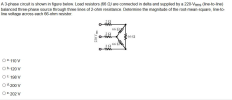 A 3-phase circuit is shown in figure below. Load resistors (66 ?) are connected in delta and supplied by a 220-Vrms (line-to-line) balanced three-phase source through three lines of 2-ohm resistance. Determine the magnitude of the root-mean-square, line-to- line voltage across each 66-ohm resistor. 212 66 ? 2? O a 110 V ob, 120 V , 198 V O d. 200 V O e.202 V
please do all parts of both questions thanks 5. (10 points) For the circuit shown in...
 please do all parts of both questions thanks
5. (10 points) For the circuit shown in Figure 2, compute the voltage across the load terminals. *Tip: use KVL 0.19 0.52 1 = 60/A 120/0° v VLOND LOAD Figure 2. Circuit for problem 5. 6. (15 points) A 60-Hz, single-phase source with V = 277230°volts is applied to a circuit element (a) Determine the instantaneous source voltage (b) Also determine the phasor and instantaneous currents entering the positive terminal if the...
please do all parts of both questions thanks
5. (10 points) For the circuit shown in Figure 2, compute the voltage across the load terminals. *Tip: use KVL 0.19 0.52 1 = 60/A 120/0° v VLOND LOAD Figure 2. Circuit for problem 5. 6. (15 points) A 60-Hz, single-phase source with V = 277230°volts is applied to a circuit element (a) Determine the instantaneous source voltage (b) Also determine the phasor and instantaneous currents entering the positive terminal if the...
1.1 Preliminary design: Signal generator a. Modify your signal source as shown in the circuit below....
 1.1 Preliminary design: Signal generator a. Modify your signal source as shown in the circuit below. The normal 50 output impedance of the signal generator is insignificant compared to the 30 k resistor and can be ignored. 30 k 2k Vag 1000 b. Your modified signal source can be represented by the Thevenin equivalent circuit shown here. Determine the value of Rr that R Th ww applies to the previous circuit. Your answer need be good to only 10%; after...
8. A simple circuit is composed of an ideal 100 v battery in series with three resistors (R1 = 10Ω, R2 = 20Ω, R3 = 30Ω). Which of the following statements is true? Statement A: Each resistor carries t...
 8. A simple circuit is composed of an ideal 100 v battery
in series with three resistors (R1 = 10Ω, R2 = 20Ω, R3 = 30Ω).
Which of the following statements is true?
Statement A: Each resistor carries the same current.
Statement B: Each resistor has the same voltage.
Statement C: Each resistor dissipates the same amount energy per
second.
Statement D: The battery power output is greater than the power
output of Resistor 1.
a. Only A is true....
8. A simple circuit is composed of an ideal 100 v battery
in series with three resistors (R1 = 10Ω, R2 = 20Ω, R3 = 30Ω).
Which of the following statements is true?
Statement A: Each resistor carries the same current.
Statement B: Each resistor has the same voltage.
Statement C: Each resistor dissipates the same amount energy per
second.
Statement D: The battery power output is greater than the power
output of Resistor 1.
a. Only A is true....
The circuit shown in Figure Q4-1 includes an audio source and the equivalent circuit of a...
 The circuit shown in Figure Q4-1 includes an audio source and the equivalent circuit of a loudspeaker that you have been asked to analyse. 4. a) Assuming the speaker is to operate at a single frequency of 200 Hz and is5 driven by a cosinusoidal signal with peak amplitude of 20 V; determine the equivalent impedance of the speaker When connected to the audio source, calculate the current flow i() When testing the loudspeaker detailed in Q4a) i), you can...
can you solve this 5 problem please Q2. Using voltage divider and/or current divider to find...
 can you solve this 5 problem please
Q2. Using voltage divider and/or current divider to find the unknown on each of the circuits: 40 V -) ) ξR, υ ξR, 6 Ω 20 Ωξυ, 2.4A 1) 1890 Ω ξ10Ω 10 Ω ξ5 kΩ 360 kΩ 45 VI + υ, ξ 20 kΩ ξ90 ΚΩ Q3. Using a Y to delta transformation find the currents il, i2, and i3. And the power delivered by the source. 56 Ω 44Ω 80 Ω...
can you solve this 5 problem please
Q2. Using voltage divider and/or current divider to find the unknown on each of the circuits: 40 V -) ) ξR, υ ξR, 6 Ω 20 Ωξυ, 2.4A 1) 1890 Ω ξ10Ω 10 Ω ξ5 kΩ 360 kΩ 45 VI + υ, ξ 20 kΩ ξ90 ΚΩ Q3. Using a Y to delta transformation find the currents il, i2, and i3. And the power delivered by the source. 56 Ω 44Ω 80 Ω...
 Solve by hand and simulate in any electrical circuit
simulator preferrably LTSpice
Solve by hand only.
Problem #4: Consider the circuit shown below. 6Ω /8 Ω 302 2700 V (rms) 40 2 Source-Line Load (a) Find the real power dissipated in the line. (b) Find the capacitive reactance that when connected in parallel with the load will pl make the load look purely resistive. (c) What is the equivalent impedance of the load in (b)? (d) Find the real power...
Solve by hand and simulate in any electrical circuit
simulator preferrably LTSpice
Solve by hand only.
Problem #4: Consider the circuit shown below. 6Ω /8 Ω 302 2700 V (rms) 40 2 Source-Line Load (a) Find the real power dissipated in the line. (b) Find the capacitive reactance that when connected in parallel with the load will pl make the load look purely resistive. (c) What is the equivalent impedance of the load in (b)? (d) Find the real power...
 For the circuit shown, using resistor combinations and Ohm's Law, calculate (a) Vo and b, (b) the power dissipated in the 15 ? resistor, and (c) the power developed by the voltage source. 2? 15 ? 120 V
 MULTISIM 10.65 The variable load resistor R¡ in the circuit shown in PSPICE Fig. P10.65 is adjusted for maximum average power transfer to RL a) Find the maximum average power. b) What percentage of the average power devel- oped by the ideal voltage source is delivered to Rź when R is absorbing maximum average power? c) Test your solution by showing that the power developed by the ideal voltage source equals the power dissipated in the circuit. Figure P10.65 1212...
 PROBLEM 5 (15 Points) Compute the power dissipated across the 6 Ohms resistor. Use source transformation to reduce the circuit to only one large loop. You may have to use it a few times. 6 t e 12 511 201 40 v
 A 3-phase circuit is shown in figure below. Load resistors (66 ?) are connected in delta and supplied by a 220-Vrms (line-to-line) balanced three-phase source through three lines of 2-ohm resistance. Determine the magnitude of the root-mean-square, line-to- line voltage across each 66-ohm resistor. 212 66 ? 2? O a 110 V ob, 120 V , 198 V O d. 200 V O e.202 V
 please do all parts of both questions thanks
5. (10 points) For the circuit shown in Figure 2, compute the voltage across the load terminals. *Tip: use KVL 0.19 0.52 1 = 60/A 120/0° v VLOND LOAD Figure 2. Circuit for problem 5. 6. (15 points) A 60-Hz, single-phase source with V = 277230°volts is applied to a circuit element (a) Determine the instantaneous source voltage (b) Also determine the phasor and instantaneous currents entering the positive terminal if the...
please do all parts of both questions thanks
5. (10 points) For the circuit shown in Figure 2, compute the voltage across the load terminals. *Tip: use KVL 0.19 0.52 1 = 60/A 120/0° v VLOND LOAD Figure 2. Circuit for problem 5. 6. (15 points) A 60-Hz, single-phase source with V = 277230°volts is applied to a circuit element (a) Determine the instantaneous source voltage (b) Also determine the phasor and instantaneous currents entering the positive terminal if the...
 1.1 Preliminary design: Signal generator a. Modify your signal source as shown in the circuit below. The normal 50 output impedance of the signal generator is insignificant compared to the 30 k resistor and can be ignored. 30 k 2k Vag 1000 b. Your modified signal source can be represented by the Thevenin equivalent circuit shown here. Determine the value of Rr that R Th ww applies to the previous circuit. Your answer need be good to only 10%; after...
 8. A simple circuit is composed of an ideal 100 v battery
in series with three resistors (R1 = 10Ω, R2 = 20Ω, R3 = 30Ω).
Which of the following statements is true?
Statement A: Each resistor carries the same current.
Statement B: Each resistor has the same voltage.
Statement C: Each resistor dissipates the same amount energy per
second.
Statement D: The battery power output is greater than the power
output of Resistor 1.
a. Only A is true....
8. A simple circuit is composed of an ideal 100 v battery
in series with three resistors (R1 = 10Ω, R2 = 20Ω, R3 = 30Ω).
Which of the following statements is true?
Statement A: Each resistor carries the same current.
Statement B: Each resistor has the same voltage.
Statement C: Each resistor dissipates the same amount energy per
second.
Statement D: The battery power output is greater than the power
output of Resistor 1.
a. Only A is true....
 The circuit shown in Figure Q4-1 includes an audio source and the equivalent circuit of a loudspeaker that you have been asked to analyse. 4. a) Assuming the speaker is to operate at a single frequency of 200 Hz and is5 driven by a cosinusoidal signal with peak amplitude of 20 V; determine the equivalent impedance of the speaker When connected to the audio source, calculate the current flow i() When testing the loudspeaker detailed in Q4a) i), you can...
 can you solve this 5 problem please
Q2. Using voltage divider and/or current divider to find the unknown on each of the circuits: 40 V -) ) ξR, υ ξR, 6 Ω 20 Ωξυ, 2.4A 1) 1890 Ω ξ10Ω 10 Ω ξ5 kΩ 360 kΩ 45 VI + υ, ξ 20 kΩ ξ90 ΚΩ Q3. Using a Y to delta transformation find the currents il, i2, and i3. And the power delivered by the source. 56 Ω 44Ω 80 Ω...
can you solve this 5 problem please
Q2. Using voltage divider and/or current divider to find the unknown on each of the circuits: 40 V -) ) ξR, υ ξR, 6 Ω 20 Ωξυ, 2.4A 1) 1890 Ω ξ10Ω 10 Ω ξ5 kΩ 360 kΩ 45 VI + υ, ξ 20 kΩ ξ90 ΚΩ Q3. Using a Y to delta transformation find the currents il, i2, and i3. And the power delivered by the source. 56 Ω 44Ω 80 Ω...
Most questions answered within 3 hours.
-
Where is the error in this code sequence?
String s1 = "Hello";
String s2 = "ello";...
asked 10 months ago -
Financial data for Joel de Paris, Inc., for last year
follow:
Joel de Paris, Inc.
Balance...
asked 10 months ago -
Consider this reaction:
Al2(SO4)3 (aq)+ BaCl3
(aq) Al2Cl6 (aq)- +
3BaSO4(s) . What is the...
asked 10 months ago -
Suppose that Savneet is considering increasing her
recent random sample from 20 car rentals to 40...
asked 10 months ago -
Trucks arrive at an unloading terminal at an average rate of 120
per hour.
Trucks arrive...
asked 10 months ago -
Why are methanol and ethanol completely soluble in water while
octanol is not very little soluble....
asked 10 months ago -
A facilities manager at a university reads in a research report
that the mean amount of...
asked 10 months ago -
When the CuSO4 is rehydrated by adding water to the anhydrous
compound, is this an endothermic...
asked 10 months ago -
A ray of sunlight is passing from diamond into crown glass; the
angle of incidence is...
asked 10 months ago -
A block of mass 0.249 kg is placed on top of a light, vertical
spring of...
asked 10 months ago -
how do the kidneys compensate in the presences of acidosis
a) trigger hyperventilate
b) reserve acid...
asked 10 months ago -
Question 501 pts
The rental rate of capital to the firm increases. Which of the
following...
asked 10 months ago