. For a protein P binding to a ligand L, derive the Scatchard equation that relates...
. For a protein P binding to a ligand L, derive the Scatchard equation that relates the inverse of the concentration of the bound form (1/[P:L]) to the inverse of the concentration of free form (1/[P]).
Homework Answers

Add Answer to:
. For a protein P binding to a ligand L, derive the Scatchard
equation that relates...
-3. (5 pt) Beginning with the equilibrium for protein-ligand binding: P + NL PLN derive the...
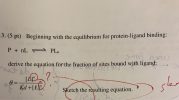 -3. (5 pt) Beginning with the equilibrium for protein-ligand binding: P + NL PLN derive the equation for the fraction of sites bound with ligand: Kd +[Lju. Sketch the resulting equation.
1. The Hill Equation a) Derive the Hill Equation for a protein binding a single ligand (i.e. the ...
 1. The Hill Equation a) Derive the Hill Equation for a protein binding a single ligand (i.e. the reaction P + PL) and explain how a plot will appear. Derive the Hill Equation for a dimeric protein that simultaneously binds two ligands (i.e. the reaction: P2 2L- P2L2) and explain how a plot will appear. Explain what is problematic about the reaction shown in question b) L b) c)
1. The Hill Equation a) Derive the Hill Equation for a...
1. The Hill Equation a) Derive the Hill Equation for a protein binding a single ligand (i.e. the reaction P + PL) and explain how a plot will appear. Derive the Hill Equation for a dimeric protein that simultaneously binds two ligands (i.e. the reaction: P2 2L- P2L2) and explain how a plot will appear. Explain what is problematic about the reaction shown in question b) L b) c)
1. The Hill Equation a) Derive the Hill Equation for a...
A binding protein binds to a ligand with Kd=30nm. What is the concentration of ligand when...
 A binding protein binds to a ligand with Kd=30nm. What is the
concentration of ligand when the [L] when the fraction
bound,,
is a) 0.25, b) 0.6 and c) 0.95.
A binding protein binds to a ligand with Kd=30nm. What is the
concentration of ligand when the [L] when the fraction
bound,,
is a) 0.25, b) 0.6 and c) 0.95.
Short answer questions: 21. Protein A has a binding site for ligand L with a Ka...
 Short answer questions: 21. Protein A has a binding site for ligand L with a Ka of 10-6 M. Protein B has a binding site for ligand L with a Ka of 10'M. (a). Which protein has a higher affinity for ligand L? Explain your reasoning. (b). At what concentration of ligand L is proteins A half-saturated. At what concentration of L is protein B half-saturated. [L] y = [L] + Ka 22. A protein binds to a ligand L...
Usually a protein-binding curve is a hyperbolic function, with theta on the y-axis and [total ligand]...
 Usually a protein-binding curve
is a hyperbolic function, with theta on the y-axis and [total
ligand] on the x-axis. We can only assume that [Free L]=[L total]
when the ligand is in excess of the protein. For example the
[protein] would be 0.001 nM and you start adding ligand in .05nm
increments. But what would the binding curve above look like if the
[receptor]=1 nM: the ligand concentration is no longer in excess of
the protein concentration? Would you still...
Usually a protein-binding curve
is a hyperbolic function, with theta on the y-axis and [total
ligand] on the x-axis. We can only assume that [Free L]=[L total]
when the ligand is in excess of the protein. For example the
[protein] would be 0.001 nM and you start adding ligand in .05nm
increments. But what would the binding curve above look like if the
[receptor]=1 nM: the ligand concentration is no longer in excess of
the protein concentration? Would you still...
A binding protein binds to a ligand L with a K_d of 400 nM. What is...
A binding protein binds to a ligand L with a K_d of 400 nM. What is the concentration of ligand when is a) 0.25, b) 0.6, c) 0.95?
Wrine a rate equation depicting the rate of change in the concentration of the protein ligand...
 Wrine a rate equation depicting the rate of change in the concentration of the protein ligand eomples formedi acvonding to the reaction below e5 pts ndng Se LP L+P k Protein (P) Protein (P) The reaction above has a 2 onder association rate constant (k.) of 500 mM's and a 1" order dissociation rate constant (ka) of 10 s, What are the equilibrium association (KA) and dissociation (Kn) constants for this basic ligand binding event (I BP) 2.) Use the...
Protein A Protein B [PL), UM 0.00 0 0.000 0 1) (10 marks) You study ligand...
 Protein A Protein B [PL), UM 0.00 0 0.000 0 1) (10 marks) You study ligand binding to two proteins, A and B. You measured the concentration, (PL), of the ligand-bound form of the protein at various ligand concentrations, [L]. The data are summarized in the two tables below. Note that you do not know the total concentration of the protein, but you know that adding more ligand did not noticeably change the bound- protein concentration. [L), UM [PL], uM...
Scatchard analysis may give information about? O A. the ligand binding constant (Kb) of a protein,...
 Scatchard analysis may give information about? O A. the ligand binding constant (Kb) of a protein, OB. the number of ligand binding sites on a protein, the type of homotropic cooperativity with ligand binding, OD. Bmax: O E. all of the above, OF. none of the above. In glycolysis, fructose 1,6-bisphosphate is converted to two products with a AG'º of 23.8 kJ/mol. Under what conditions encountered in a normal cell will the free-energy change (AG) be negative, enabling the reaction...
If 20% of binding sites of a protein are occupied by its ligand when the concentration...
If 20% of binding sites of a protein are occupied by its ligand when the concentration of the ligand is 1mM, what is the Kd of this protein-ligand interaction? A. 0.2mM B. 1mM C. 2.5 mM D. 4mM E. 5mM
 -3. (5 pt) Beginning with the equilibrium for protein-ligand binding: P + NL PLN derive the equation for the fraction of sites bound with ligand: Kd +[Lju. Sketch the resulting equation.
 1. The Hill Equation a) Derive the Hill Equation for a protein binding a single ligand (i.e. the reaction P + PL) and explain how a plot will appear. Derive the Hill Equation for a dimeric protein that simultaneously binds two ligands (i.e. the reaction: P2 2L- P2L2) and explain how a plot will appear. Explain what is problematic about the reaction shown in question b) L b) c)
1. The Hill Equation a) Derive the Hill Equation for a...
1. The Hill Equation a) Derive the Hill Equation for a protein binding a single ligand (i.e. the reaction P + PL) and explain how a plot will appear. Derive the Hill Equation for a dimeric protein that simultaneously binds two ligands (i.e. the reaction: P2 2L- P2L2) and explain how a plot will appear. Explain what is problematic about the reaction shown in question b) L b) c)
1. The Hill Equation a) Derive the Hill Equation for a...
 A binding protein binds to a ligand with Kd=30nm. What is the
concentration of ligand when the [L] when the fraction
bound,,
is a) 0.25, b) 0.6 and c) 0.95.
A binding protein binds to a ligand with Kd=30nm. What is the
concentration of ligand when the [L] when the fraction
bound,,
is a) 0.25, b) 0.6 and c) 0.95.
 Short answer questions: 21. Protein A has a binding site for ligand L with a Ka of 10-6 M. Protein B has a binding site for ligand L with a Ka of 10'M. (a). Which protein has a higher affinity for ligand L? Explain your reasoning. (b). At what concentration of ligand L is proteins A half-saturated. At what concentration of L is protein B half-saturated. [L] y = [L] + Ka 22. A protein binds to a ligand L...
 Usually a protein-binding curve
is a hyperbolic function, with theta on the y-axis and [total
ligand] on the x-axis. We can only assume that [Free L]=[L total]
when the ligand is in excess of the protein. For example the
[protein] would be 0.001 nM and you start adding ligand in .05nm
increments. But what would the binding curve above look like if the
[receptor]=1 nM: the ligand concentration is no longer in excess of
the protein concentration? Would you still...
Usually a protein-binding curve
is a hyperbolic function, with theta on the y-axis and [total
ligand] on the x-axis. We can only assume that [Free L]=[L total]
when the ligand is in excess of the protein. For example the
[protein] would be 0.001 nM and you start adding ligand in .05nm
increments. But what would the binding curve above look like if the
[receptor]=1 nM: the ligand concentration is no longer in excess of
the protein concentration? Would you still...
 Wrine a rate equation depicting the rate of change in the concentration of the protein ligand eomples formedi acvonding to the reaction below e5 pts ndng Se LP L+P k Protein (P) Protein (P) The reaction above has a 2 onder association rate constant (k.) of 500 mM's and a 1" order dissociation rate constant (ka) of 10 s, What are the equilibrium association (KA) and dissociation (Kn) constants for this basic ligand binding event (I BP) 2.) Use the...
 Protein A Protein B [PL), UM 0.00 0 0.000 0 1) (10 marks) You study ligand binding to two proteins, A and B. You measured the concentration, (PL), of the ligand-bound form of the protein at various ligand concentrations, [L]. The data are summarized in the two tables below. Note that you do not know the total concentration of the protein, but you know that adding more ligand did not noticeably change the bound- protein concentration. [L), UM [PL], uM...
 Scatchard analysis may give information about? O A. the ligand binding constant (Kb) of a protein, OB. the number of ligand binding sites on a protein, the type of homotropic cooperativity with ligand binding, OD. Bmax: O E. all of the above, OF. none of the above. In glycolysis, fructose 1,6-bisphosphate is converted to two products with a AG'º of 23.8 kJ/mol. Under what conditions encountered in a normal cell will the free-energy change (AG) be negative, enabling the reaction...
Most questions answered within 3 hours.
-
Where is the error in this code sequence?
String s1 = "Hello";
String s2 = "ello";...
asked 11 months ago -
Financial data for Joel de Paris, Inc., for last year
follow:
Joel de Paris, Inc.
Balance...
asked 11 months ago -
Consider this reaction:
Al2(SO4)3 (aq)+ BaCl3
(aq) Al2Cl6 (aq)- +
3BaSO4(s) . What is the...
asked 11 months ago -
Suppose that Savneet is considering increasing her
recent random sample from 20 car rentals to 40...
asked 11 months ago -
Trucks arrive at an unloading terminal at an average rate of 120
per hour.
Trucks arrive...
asked 11 months ago -
Why are methanol and ethanol completely soluble in water while
octanol is not very little soluble....
asked 11 months ago -
A facilities manager at a university reads in a research report
that the mean amount of...
asked 11 months ago -
When the CuSO4 is rehydrated by adding water to the anhydrous
compound, is this an endothermic...
asked 11 months ago -
A ray of sunlight is passing from diamond into crown glass; the
angle of incidence is...
asked 11 months ago -
A block of mass 0.249 kg is placed on top of a light, vertical
spring of...
asked 11 months ago -
how do the kidneys compensate in the presences of acidosis
a) trigger hyperventilate
b) reserve acid...
asked 11 months ago -
Question 501 pts
The rental rate of capital to the firm increases. Which of the
following...
asked 11 months ago