
Homework Answers
Ans c) 3' hydroxyl of deoxyribose.
During elongation phase of DNA replication, DNA polymerase adds new nucleotides to the 3' OH of the growing strand with the replication progressing in 5' to 3' direction. The nucleotide has a phosphate group, a ribose/ deoxyribose sugar, and a nitrogenous base. The phosphate group is attached to the 5' position of the deoxyribose sugar while its 3' position is occupied by the hydroxyl group. The motive behind the incorporation of new nucleotide always at 3' OH end of growing DNA chain is the nucleophilic approach used by 3' OH attacking the phosphorous atom of incoming dNTPs and simultaneously a phosphodiester bond is formed with the release of inorganic pyrophosphate. Mg ion, in turn, helps in minimizing the interaction between the O and the H, leaving a nucleophile 3'O- . Since 3' hydroxyl group is a better nucleophile as compared to others this explains the addition of new nucleotide here. One more reaction that is essential for DNA replication, the pyrophosphate hydrolysis is easily accomplished in this way.
Add Answer to:
When enzymes are elongating (building) a newly synthesized DNA strand in PCR, new nucleotides are being...
DNA is formed by building blocks called __________. nucleotides nitrogenous bases polypeptides deoxyribose 0.5 points ...
DNA is formed by building blocks called __________. nucleotides nitrogenous bases polypeptides deoxyribose 0.5 points QUESTION 2 What does DNA stand for? Double-stranded Nucleic Acid Ribonucleic acid Deoxyribonucleic Acid Double-helix Nucleic Acid 0.5 points QUESTION 3 The nucleotides of DNA are held together by ___________. ionic bond hydrogen bond phosphodiester bond sugar-phosphate backbone 0.5 points QUESTION 4 DNA nucleotides with one-carbon nitrogen ring bases are called ________. adenines purines pyrimidines guanines 0.5 points QUESTION 5 Basic...
DNA mismatch repair enzymes preferentially repair bases on the newly synthesized DNA strand, using the old...
 DNA mismatch repair enzymes preferentially repair bases on the newly synthesized DNA strand, using the old DNA strand as the template. If mismatches were simply repaired without regard for which strand served as template, would this reduce replication errors? Explain your answer (5 pts) Describe DNA replication (remember to mention all the enzymes involved) (10 pts)
1) The DNA template is read in the ______ direction, and the new strand is synthesized...
1) The DNA template is read in the ______ direction, and the new strand is synthesized in the ____ direction. A) 5' to 3' ; 3' to 5' B) 5' to 3' ; 5' to 3' C) 3' to 5' ; 5' to 3' D) 3' to 5' ; 3' to 5' 2) If a sequence of DNA is 5' AATTGCCGT 3', the complementary strand would be A) 3' AAAACGCCA 5' B) 3' TTAACGGCT 5' C) 5' ACGGCAATT 3' D)...
21. In DNA replication, new nucleotides are added a. To the 5' end of each nascent...
 21. In DNA replication, new nucleotides are added a. To the 5' end of each nascent strand b. To the 3'end of each nascent strand To both ends of each nascent strand d. To the 5' end of the continuous strand and the 3' end of the discontinuous strand e. To the end of the continuous strand and the end of discontinuous strand fragments 22. DNA unwinding is done by a. Ligase b. Helicase c. Topoisomerase dHexonuclease 23. Proofreading of...
The enzymes that initiates synthesis of a new DNA strand is called _________. The name given...
The enzymes that initiates synthesis of a new DNA strand is called _________. The name given to the short segments of RNA that is added at the beginning of all newly synthesized DNA strands is called _________.
QUESTION 5 The enzymes that connect nucleotides to the growing end of a new DNA strand are called O Toposiomerases...
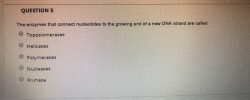 QUESTION 5 The enzymes that connect nucleotides to the growing end of a new DNA strand are called O Toposiomerases O Helicases polymerases Nucleases O Primase
When a dideoxynucleotide is incorporated into one new strand by DNA polymerase, 1.addition of nucleotides to...
When a dideoxynucleotide is incorporated into one new strand by DNA polymerase, 1.addition of nucleotides to all new strands stop. 2.addition of nucleotides only to that strand ceases. 3.nothing changes. 4.addition of nucleotides only to that strand speeds up. 5.nucleotides are removed only from that strand and then new nucleotides are added.
Question 1: In DNA, which of the following functional groups plays a key role in polymerization...
Question 1: In DNA, which of the following functional groups plays a key role in polymerization (covalent linkage of the monomer nucleotides)? A. phosphate B. methyl C. sulfhydryl D. hydrogen E. nitrogen Question 2. The named components of a nucleotide of RNA are A. ribose, phosphate, A,U,G or C base B. deoxyribose, phosphate, A, T, G or C base C. deoxyribose, phosphate, A, U, G, or C base D. ribose, phosphate, A, T, G or C base Question 3. In...
Question 2a Deoxyribonucleic acid (DNA) is made up of nucleotides. Which part of the nucleotide stabilizes...
Question 2a Deoxyribonucleic acid (DNA) is made up of nucleotides. Which part of the nucleotide stabilizes the structure of DNA using weak van der Waals interactions (stacking) and using hydrogen bonds? (Note that covalent bonds are not included in that sentence.) a. the deoxyribose sugar b. the ribose sugar c. the phosphate d. the nitrogenous base e. the amino acid Question 2b This ability of the nitrogenous bases to exist in more than one form can lead to incorporation of...
Vocabulary: DNA Replication
Vocabulary: DNA Replication A. Helicase B. Primase C. Single Strand Binding Protein (SSB) D. Topoisomerase E. Origin of Replication F. DNA Polymerase G. Leading Strand H. Lagging strand I. DNA Ligase J. Okazaki Fragment K. Replication Fork L. RNA Primer M. Topoisomerase .1. Site where the replication of a DNA molecule begins. 2. The new continuous complementary DNA strand synthesized in the direction for the replication fork. 3. A discontinuously synthesized DNA strand that elongates in a direction away from the replication fork 4. Relaxes...
 DNA mismatch repair enzymes preferentially repair bases on the newly synthesized DNA strand, using the old DNA strand as the template. If mismatches were simply repaired without regard for which strand served as template, would this reduce replication errors? Explain your answer (5 pts) Describe DNA replication (remember to mention all the enzymes involved) (10 pts)
 21. In DNA replication, new nucleotides are added a. To the 5' end of each nascent strand b. To the 3'end of each nascent strand To both ends of each nascent strand d. To the 5' end of the continuous strand and the 3' end of the discontinuous strand e. To the end of the continuous strand and the end of discontinuous strand fragments 22. DNA unwinding is done by a. Ligase b. Helicase c. Topoisomerase dHexonuclease 23. Proofreading of...
 QUESTION 5 The enzymes that connect nucleotides to the growing end of a new DNA strand are called O Toposiomerases O Helicases polymerases Nucleases O Primase
Most questions answered within 3 hours.
-
Where is the error in this code sequence?
String s1 = "Hello";
String s2 = "ello";...
asked 10 months ago -
Financial data for Joel de Paris, Inc., for last year
follow:
Joel de Paris, Inc.
Balance...
asked 10 months ago -
Consider this reaction:
Al2(SO4)3 (aq)+ BaCl3
(aq) Al2Cl6 (aq)- +
3BaSO4(s) . What is the...
asked 10 months ago -
Suppose that Savneet is considering increasing her
recent random sample from 20 car rentals to 40...
asked 10 months ago -
Trucks arrive at an unloading terminal at an average rate of 120
per hour.
Trucks arrive...
asked 10 months ago -
Why are methanol and ethanol completely soluble in water while
octanol is not very little soluble....
asked 10 months ago -
A facilities manager at a university reads in a research report
that the mean amount of...
asked 10 months ago -
When the CuSO4 is rehydrated by adding water to the anhydrous
compound, is this an endothermic...
asked 10 months ago -
A ray of sunlight is passing from diamond into crown glass; the
angle of incidence is...
asked 10 months ago -
A block of mass 0.249 kg is placed on top of a light, vertical
spring of...
asked 10 months ago -
how do the kidneys compensate in the presences of acidosis
a) trigger hyperventilate
b) reserve acid...
asked 10 months ago -
Question 501 pts
The rental rate of capital to the firm increases. Which of the
following...
asked 10 months ago