A stationary particle of charge q = 2.2 × 10⁻⁸ C is placed in a laser...
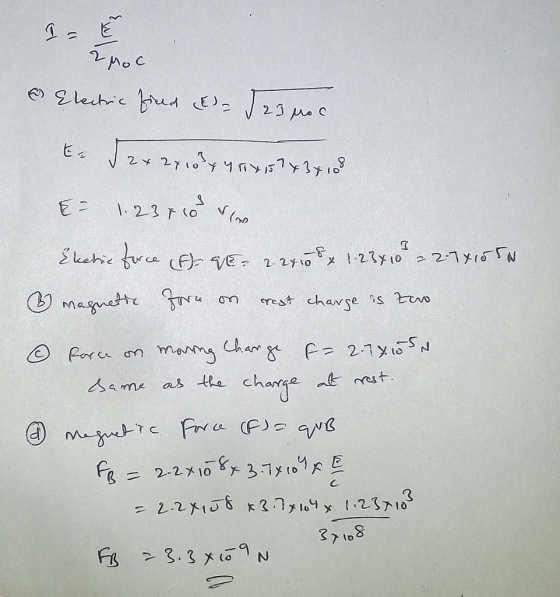
A stationary particle of charge q = 2.2 × 10⁻⁸ C is placed in a laser beam (an electromagnetic wave) whose intensity is 2.0 × 10³ W/m2. Determine the maximum magnitude of the (a) electric and (b) magnetic forces exerted on the charge. If the charge is moving at a speed of 3.7 × 10⁴ m/s perpendicular to the magnetic field of the electromagnetic wave, find the maximum magnitudes of the (c) electric and (d) magnetic forces exerted on the particle.
Homework Answers
Add Answer to:
A stationary particle of charge q = 2.2 × 10⁻⁸ C is placed in a
laser...
A stationary particle of charge q = 2.9 × 10⁻⁸ C is placed in a laser...
A stationary particle of charge q = 2.9 × 10⁻⁸ C is placed in a laser beam (an electromagnetic wave) whose intensity is 2.4 × 10³ W/m2. Determine the maximum magnitude of the (a) electric and (b) magnetic forces exerted on the charge. If the charge is moving at a speed of 3.7 × 10⁴ m/s perpendicular to the magnetic field of the electromagnetic wave, find the maximum magnitudes of the (c) electric and (d) magnetic forces exerted on the...
A stationary particle of charge q = 2.3 times 10^-8 C is placed in a laser...
 A stationary particle of charge q = 2.3 times 10^-8 C is placed in a laser beam (an electromagnetic wave) whose intensity is 3.0 times 10^3 W/m^2. Determine the maximum magnitude of the (a) electric and (b) magnetic forces exerted on the charge. If the charge is moving at a speed of 3.7 times 10^4 m/s perpendicular to the magnetic field of the electromagnetic wave, find the maximum magnitudes of the (c) electric and (d) magnetic forces exerted on the...
A neodymium-glass laser emits short pulses of high-intensity electromagnetic waves. The electric field of such a...
 A neodymium-glass laser emits short pulses of high-intensity
electromagnetic waves. The electric field of such a wave has an rms
value of Erms = 2.0 × 10⁹ N/C. Find the average power of each pulse
that passes through a 1.6 × 10⁻⁵-m2 surface that is perpendicular
to the laser beam.
A neodymium-glass laser emits short pulses of high-intensity electromagnetic waves. The electric field of such a wave has an rms value of E 2.0 x 10⁹ NIC. Find the average...
A neodymium-glass laser emits short pulses of high-intensity
electromagnetic waves. The electric field of such a wave has an rms
value of Erms = 2.0 × 10⁹ N/C. Find the average power of each pulse
that passes through a 1.6 × 10⁻⁵-m2 surface that is perpendicular
to the laser beam.
A neodymium-glass laser emits short pulses of high-intensity electromagnetic waves. The electric field of such a wave has an rms value of E 2.0 x 10⁹ NIC. Find the average...
A particle with a charge of -1.23 × 10⁻⁸ C is moving with instantaneous velocity =...
 A particle with a charge of -1.23 × 10⁻⁸ C
is moving with instantaneous velocity
= (4.27 × 10⁴ m/s)
+ (-3.79 × 10⁴ m/s).
What is the magnitude of the force exerted on this particle by
magnetic field
= (1.32 T)?
(Give your answer in scientific notation using "N" as unit)
A particle with a charge of -1.23 × 10⁻⁸ C
is moving with instantaneous velocity
= (4.27 × 10⁴ m/s)
+ (-3.79 × 10⁴ m/s).
What is the magnitude of the force exerted on this particle by
magnetic field
= (1.32 T)?
(Give your answer in scientific notation using "N" as unit)
Particle 1 and particle 2 have masses of m1 = 2.2 × 10⁻⁸ kg and m2...
Particle 1 and particle 2 have masses of m1 = 2.2 × 10⁻⁸ kg and m2 = 5.6 × 10⁻⁸ kg, but they carry the same charge q. The two particles accelerate from rest through the same electric potential difference V and enter the same magnetic field, which has a magnitude B. The particles travel perpendicular to the magnetic field on circular paths. The radius of the circular path for particle 1 is r1 = 7 cm. What is the...
A particle has a charge of q = +5.1 ?C and is located at the origin....
 A particle has a charge of q = +5.1 ?C and is located
at the origin. As the drawing shows, an electric field of
Ex = +232 N/C exists along the +x
axis. A magnetic field also exists, and its x and
ycomponents are Bx = +1.5 T and
By = +1.0 T. Calculate the force (magnitude and
direction) exerted on the particle by each of the three fields when
it is (a) stationary, (b) moving
along the +x axis...
A particle has a charge of q = +5.1 ?C and is located
at the origin. As the drawing shows, an electric field of
Ex = +232 N/C exists along the +x
axis. A magnetic field also exists, and its x and
ycomponents are Bx = +1.5 T and
By = +1.0 T. Calculate the force (magnitude and
direction) exerted on the particle by each of the three fields when
it is (a) stationary, (b) moving
along the +x axis...
#4 part a,b,c 4. An electromagnetic wave with a frequency of 100,0 MHz, İs traveling direction....
 #4 part a,b,c
4. An electromagnetic wave with a frequency of 100,0 MHz, İs traveling direction. Att-0 s, the electric field due to this wave of 300.0 V/m. through a vacuum in x- (i) What is the wavelength of this wave? a. 1.0 m b. 2.0 m c, 3.0 m d. 4.0 m (ii) What is the amplitude of the magnetic field due to this wave? a, 1.0 μΤ b, 2.0 μ T c. 3.0 uT d. 4.0 HT (iii)...
#4 part a,b,c
4. An electromagnetic wave with a frequency of 100,0 MHz, İs traveling direction. Att-0 s, the electric field due to this wave of 300.0 V/m. through a vacuum in x- (i) What is the wavelength of this wave? a. 1.0 m b. 2.0 m c, 3.0 m d. 4.0 m (ii) What is the amplitude of the magnetic field due to this wave? a, 1.0 μΤ b, 2.0 μ T c. 3.0 uT d. 4.0 HT (iii)...
A particle with a charge of -1.15 × 10⁻⁸ C is moving with instantaneous velocity v...
A particle with a charge of -1.15 × 10⁻⁸ C is moving with instantaneous velocity v with rightwards arrow on top = (4.14 × 10⁴ m/s)i with hat on top + (-3.83 × 10⁴ m/s)j with hat on top. What is the magnitude of the force exerted on this particle by magnetic field B with rightwards arrow on top = (1.34 T)k with hat on top? (Give your answer in scientific notation using "N" as unit)
A particle has a charge of q = +4.7 μC and is located at the origin....
A particle has a charge of q = +4.7 μC and is located at the origin. As the drawing shows, an electric field of Ex = +232 N/C exists along the +x axis. A magnetic field also exists, and its x and y components are Bx = +1.7 T and By = +1.6 T. Calculate the force (magnitude and direction) exerted on the particle by each of the three fields when it is (a) stationary, (b) moving along the +x...
A particle with a charge of -2.30 x 10^-8 c is moving with an instantaneous velocity...
A particle with a charge of -2.30 x 10^-8 c is moving with an instantaneous velocity of magnitude 39.5 km/s in the x-y plane at an angle of 55 degrees counterclockwise fromthe + x axis. A. what is the direction of the force exerted on this particle by a magnetic field with magnitude 2.00 T in the -x direction. B. what is the magnitude of the force exerted on this particle by a magnetic field with magnitude 2.00 T in...
 A stationary particle of charge q = 2.3 times 10^-8 C is placed in a laser beam (an electromagnetic wave) whose intensity is 3.0 times 10^3 W/m^2. Determine the maximum magnitude of the (a) electric and (b) magnetic forces exerted on the charge. If the charge is moving at a speed of 3.7 times 10^4 m/s perpendicular to the magnetic field of the electromagnetic wave, find the maximum magnitudes of the (c) electric and (d) magnetic forces exerted on the...
 A neodymium-glass laser emits short pulses of high-intensity
electromagnetic waves. The electric field of such a wave has an rms
value of Erms = 2.0 × 10⁹ N/C. Find the average power of each pulse
that passes through a 1.6 × 10⁻⁵-m2 surface that is perpendicular
to the laser beam.
A neodymium-glass laser emits short pulses of high-intensity electromagnetic waves. The electric field of such a wave has an rms value of E 2.0 x 10⁹ NIC. Find the average...
A neodymium-glass laser emits short pulses of high-intensity
electromagnetic waves. The electric field of such a wave has an rms
value of Erms = 2.0 × 10⁹ N/C. Find the average power of each pulse
that passes through a 1.6 × 10⁻⁵-m2 surface that is perpendicular
to the laser beam.
A neodymium-glass laser emits short pulses of high-intensity electromagnetic waves. The electric field of such a wave has an rms value of E 2.0 x 10⁹ NIC. Find the average...
 A particle with a charge of -1.23 × 10⁻⁸ C
is moving with instantaneous velocity
= (4.27 × 10⁴ m/s)
+ (-3.79 × 10⁴ m/s).
What is the magnitude of the force exerted on this particle by
magnetic field
= (1.32 T)?
(Give your answer in scientific notation using "N" as unit)
A particle with a charge of -1.23 × 10⁻⁸ C
is moving with instantaneous velocity
= (4.27 × 10⁴ m/s)
+ (-3.79 × 10⁴ m/s).
What is the magnitude of the force exerted on this particle by
magnetic field
= (1.32 T)?
(Give your answer in scientific notation using "N" as unit)
 A particle has a charge of q = +5.1 ?C and is located
at the origin. As the drawing shows, an electric field of
Ex = +232 N/C exists along the +x
axis. A magnetic field also exists, and its x and
ycomponents are Bx = +1.5 T and
By = +1.0 T. Calculate the force (magnitude and
direction) exerted on the particle by each of the three fields when
it is (a) stationary, (b) moving
along the +x axis...
A particle has a charge of q = +5.1 ?C and is located
at the origin. As the drawing shows, an electric field of
Ex = +232 N/C exists along the +x
axis. A magnetic field also exists, and its x and
ycomponents are Bx = +1.5 T and
By = +1.0 T. Calculate the force (magnitude and
direction) exerted on the particle by each of the three fields when
it is (a) stationary, (b) moving
along the +x axis...
 #4 part a,b,c
4. An electromagnetic wave with a frequency of 100,0 MHz, İs traveling direction. Att-0 s, the electric field due to this wave of 300.0 V/m. through a vacuum in x- (i) What is the wavelength of this wave? a. 1.0 m b. 2.0 m c, 3.0 m d. 4.0 m (ii) What is the amplitude of the magnetic field due to this wave? a, 1.0 μΤ b, 2.0 μ T c. 3.0 uT d. 4.0 HT (iii)...
#4 part a,b,c
4. An electromagnetic wave with a frequency of 100,0 MHz, İs traveling direction. Att-0 s, the electric field due to this wave of 300.0 V/m. through a vacuum in x- (i) What is the wavelength of this wave? a. 1.0 m b. 2.0 m c, 3.0 m d. 4.0 m (ii) What is the amplitude of the magnetic field due to this wave? a, 1.0 μΤ b, 2.0 μ T c. 3.0 uT d. 4.0 HT (iii)...
Most questions answered within 3 hours.
-
Where is the error in this code sequence?
String s1 = "Hello";
String s2 = "ello";...
asked 11 months ago -
Financial data for Joel de Paris, Inc., for last year
follow:
Joel de Paris, Inc.
Balance...
asked 11 months ago -
Consider this reaction:
Al2(SO4)3 (aq)+ BaCl3
(aq) Al2Cl6 (aq)- +
3BaSO4(s) . What is the...
asked 11 months ago -
Suppose that Savneet is considering increasing her
recent random sample from 20 car rentals to 40...
asked 11 months ago -
Trucks arrive at an unloading terminal at an average rate of 120
per hour.
Trucks arrive...
asked 11 months ago -
Why are methanol and ethanol completely soluble in water while
octanol is not very little soluble....
asked 11 months ago -
A facilities manager at a university reads in a research report
that the mean amount of...
asked 11 months ago -
When the CuSO4 is rehydrated by adding water to the anhydrous
compound, is this an endothermic...
asked 11 months ago -
A ray of sunlight is passing from diamond into crown glass; the
angle of incidence is...
asked 11 months ago -
A block of mass 0.249 kg is placed on top of a light, vertical
spring of...
asked 11 months ago -
how do the kidneys compensate in the presences of acidosis
a) trigger hyperventilate
b) reserve acid...
asked 11 months ago -
Question 501 pts
The rental rate of capital to the firm increases. Which of the
following...
asked 11 months ago