A set of point charges is held in place at the vertices of an equilateral triangle...
A set of point charges is held in place at the vertices of an equilateral triangle of side 13.0 cm , as shown in the figure (Figure 1) .
Part A: Find the maximum amount of total kinetic energy that will be produced when the charges are released from rest in the frictionless void of outer space.
K= 1.80x10^-6 J
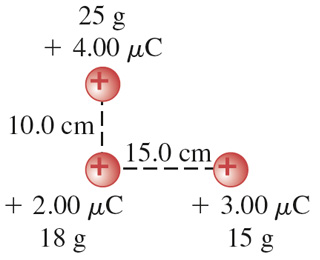
Part B. If the charges at the vertices of the right triangle in the figure are released, how much total kinetic energy will they gain?(Figure 2) .
I CANT FIGURE OUT PART B!!!!
Figure 1
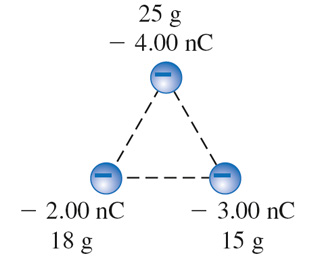
figure2
Homework Answers
Gain in KInetic energy is dKE = change in potential energy
dKE = -(k*q1*q2/r12)-(k*q2*q3/r23)-(k*q1*q3/r13)
dKE =
-(9*10^9*4*2*10^-12/0.1)-(9*10^9*4*3*10^-12/sqrt(0.1^2+0.15^2))-(9*10^9*3*2*10^-12/0.15)
=-1.67 J
So the final answer is gain in KE = 1.679 J
Add Answer to:
A set of point charges is held in place at the vertices of an
equilateral triangle...
Three identical point charges, Q = +5 C are placed at the vertices of an equilateral...
 Three identical point charges,
Q = +5 C are placed at the vertices of an equilateral triangle as
shown in the figure. The length of each side of the triangle is d =
1.5 cm
I think the answer is 3.46E7 upwards but I'm not sure
SECTION B Do all the Problems) 1) Three identical point charges, Q +5HC are placed at the vertices of an equilateral triangle as shown in the figure. The length of each side of the...
Three identical point charges,
Q = +5 C are placed at the vertices of an equilateral triangle as
shown in the figure. The length of each side of the triangle is d =
1.5 cm
I think the answer is 3.46E7 upwards but I'm not sure
SECTION B Do all the Problems) 1) Three identical point charges, Q +5HC are placed at the vertices of an equilateral triangle as shown in the figure. The length of each side of the...
Three point charges lie at the vertices of an equilateral triangle as shown. Charges #2 and...
 Three point charges lie at the vertices of an equilateral
triangle as shown. Charges #2 and #3 make up an electric dipole.
The net electric torque that charge #1 exerts on the dipole is:
Three point charges lie at the vertices of an equilateral
triangle as shown. Charges #2 and #3 make up an electric dipole.
The net electric force that charge #1 exerts on the dipole is
in
The answer for first one is A and the second one...
Three point charges lie at the vertices of an equilateral
triangle as shown. Charges #2 and #3 make up an electric dipole.
The net electric torque that charge #1 exerts on the dipole is:
Three point charges lie at the vertices of an equilateral
triangle as shown. Charges #2 and #3 make up an electric dipole.
The net electric force that charge #1 exerts on the dipole is
in
The answer for first one is A and the second one...
4. Three charges lie on the vertices of an equilateral triangle of side a. Find the...
 4. Three charges lie on the vertices of an equilateral triangle of side a. Find the net force on Q in terms of Q,q, a and k. -9
9. As shown in the figure, two charges are at the vertices of an equilateral triangle....
 9. As shown in the figure, two charges are at the vertices of an equilateral triangle. What is the magnitude and direction of the electric field at the upper vertex of the triangle. 1 cm ' 1 cm 2nc 6.0 600 2ncº-len - 2 nc
5. [5pt] Three identical charges q are placed on the vertices of an equilateral triangle of...
5. [5pt] Three identical charges q are placed on the vertices of an equilateral triangle of side-lengths, a. What charge Q must be placed in the middle of the triangle (equidistant from the three charges q) so that the system is in equilibrium? [ans. Q = -q / sqrt(3)]
7.(+4pts) Three charges Q. +20, and -20 are at the vertices of an equilateral triangle as...
 7.(+4pts) Three charges Q. +20, and -20 are at the vertices of an equilateral triangle as shown in the figure. The distance a is measured from the vertex to point P. What is the electric potential at P, the center of the triangle?
Three charges, q1=+q, q2=-q, and q3=+q, are at the vertices of an equilateral triangle, as shown...
 Three charges, q1=+q, q2=-q, and q3=+q, are at the
vertices of an equilateral triangle, as shown in the figure.
***Part A***
Rank the three charges in order of decreasing magnitude of the
electric force they experience. Rank charges from largest to
smallest magnitude of the electric force they experience. To rank
items as equivalent, overlap them.
***Part B***
Give the direction angle, theta, or the net force experienced by
charge 1. Note that theta is measured counterclockwise from the
positive...
Three charges, q1=+q, q2=-q, and q3=+q, are at the
vertices of an equilateral triangle, as shown in the figure.
***Part A***
Rank the three charges in order of decreasing magnitude of the
electric force they experience. Rank charges from largest to
smallest magnitude of the electric force they experience. To rank
items as equivalent, overlap them.
***Part B***
Give the direction angle, theta, or the net force experienced by
charge 1. Note that theta is measured counterclockwise from the
positive...
Three identical charges q=1nC are placed in three vertices of an equilateral triangle of side 1m....
Three identical charges q=1nC are placed in three vertices of an equilateral triangle of side 1m. Make a large clear diagram of this situation and find the electric field at the centre of the triangle (where the angle bisectors cross).
Three equal charges of magnitude +6.00 μC are placed at the corners of an equilateral triangle...
Three equal charges of magnitude +6.00 μC are placed at the corners of an equilateral triangle of side 4.00 cm. What is the electric field potential energy of the system of these charges? 0 J 24.3 J 90.0 J 900 mJ 243 mJ (There is no figure with this question.)
 Three identical point charges,
Q = +5 C are placed at the vertices of an equilateral triangle as
shown in the figure. The length of each side of the triangle is d =
1.5 cm
I think the answer is 3.46E7 upwards but I'm not sure
SECTION B Do all the Problems) 1) Three identical point charges, Q +5HC are placed at the vertices of an equilateral triangle as shown in the figure. The length of each side of the...
Three identical point charges,
Q = +5 C are placed at the vertices of an equilateral triangle as
shown in the figure. The length of each side of the triangle is d =
1.5 cm
I think the answer is 3.46E7 upwards but I'm not sure
SECTION B Do all the Problems) 1) Three identical point charges, Q +5HC are placed at the vertices of an equilateral triangle as shown in the figure. The length of each side of the...
 Three point charges lie at the vertices of an equilateral
triangle as shown. Charges #2 and #3 make up an electric dipole.
The net electric torque that charge #1 exerts on the dipole is:
Three point charges lie at the vertices of an equilateral
triangle as shown. Charges #2 and #3 make up an electric dipole.
The net electric force that charge #1 exerts on the dipole is
in
The answer for first one is A and the second one...
Three point charges lie at the vertices of an equilateral
triangle as shown. Charges #2 and #3 make up an electric dipole.
The net electric torque that charge #1 exerts on the dipole is:
Three point charges lie at the vertices of an equilateral
triangle as shown. Charges #2 and #3 make up an electric dipole.
The net electric force that charge #1 exerts on the dipole is
in
The answer for first one is A and the second one...
 4. Three charges lie on the vertices of an equilateral triangle of side a. Find the net force on Q in terms of Q,q, a and k. -9
 9. As shown in the figure, two charges are at the vertices of an equilateral triangle. What is the magnitude and direction of the electric field at the upper vertex of the triangle. 1 cm ' 1 cm 2nc 6.0 600 2ncº-len - 2 nc
 7.(+4pts) Three charges Q. +20, and -20 are at the vertices of an equilateral triangle as shown in the figure. The distance a is measured from the vertex to point P. What is the electric potential at P, the center of the triangle?
 Three charges, q1=+q, q2=-q, and q3=+q, are at the
vertices of an equilateral triangle, as shown in the figure.
***Part A***
Rank the three charges in order of decreasing magnitude of the
electric force they experience. Rank charges from largest to
smallest magnitude of the electric force they experience. To rank
items as equivalent, overlap them.
***Part B***
Give the direction angle, theta, or the net force experienced by
charge 1. Note that theta is measured counterclockwise from the
positive...
Three charges, q1=+q, q2=-q, and q3=+q, are at the
vertices of an equilateral triangle, as shown in the figure.
***Part A***
Rank the three charges in order of decreasing magnitude of the
electric force they experience. Rank charges from largest to
smallest magnitude of the electric force they experience. To rank
items as equivalent, overlap them.
***Part B***
Give the direction angle, theta, or the net force experienced by
charge 1. Note that theta is measured counterclockwise from the
positive...
Most questions answered within 3 hours.
-
Where is the error in this code sequence?
String s1 = "Hello";
String s2 = "ello";...
asked 11 months ago -
Financial data for Joel de Paris, Inc., for last year
follow:
Joel de Paris, Inc.
Balance...
asked 11 months ago -
Consider this reaction:
Al2(SO4)3 (aq)+ BaCl3
(aq) Al2Cl6 (aq)- +
3BaSO4(s) . What is the...
asked 11 months ago -
Suppose that Savneet is considering increasing her
recent random sample from 20 car rentals to 40...
asked 11 months ago -
Trucks arrive at an unloading terminal at an average rate of 120
per hour.
Trucks arrive...
asked 11 months ago -
Why are methanol and ethanol completely soluble in water while
octanol is not very little soluble....
asked 11 months ago -
A facilities manager at a university reads in a research report
that the mean amount of...
asked 11 months ago -
When the CuSO4 is rehydrated by adding water to the anhydrous
compound, is this an endothermic...
asked 11 months ago -
A ray of sunlight is passing from diamond into crown glass; the
angle of incidence is...
asked 11 months ago -
A block of mass 0.249 kg is placed on top of a light, vertical
spring of...
asked 11 months ago -
how do the kidneys compensate in the presences of acidosis
a) trigger hyperventilate
b) reserve acid...
asked 11 months ago -
Question 501 pts
The rental rate of capital to the firm increases. Which of the
following...
asked 11 months ago