we have 15g ice with temperature -10 we want to convert to water 18oc
we have 15g ice with temperature -10 we want to convert to water 18oc
Homework Answers
Answer -
Given,
Mass of Ice = 15 g
Temperature of Ice = -10
 C
C
Temperature of water = 18
C
 Hfus
of water at 0
C = 334 J/g
Hfus
of water at 0
C = 334 J/g
Specific heat of Ice = 2.108 J°C⁻¹g⁻¹
Specific heat of Water = 4.184 J°C⁻¹g⁻¹
Heat required = ?
For this process,
First, heat (Q1) required to bring temperature
form -10
C to 0
C
Second, heat (Q2) required to melt ICE to WATER
at 0
C
Third, heat (Q3) required to increase the
temperature form 0
C to 18
C
Total Heat required = Q1 + Q2 + Q3
We know that,
Heat = m * c *
T
where,
m = mass
c = specific heat
T
= Tfinal - Tinitial
Now,
Heat = m *
Hfus
where,
m = Mass
Hfus
= Heat of Fusion
Q1 = m * c *
T
Q1 = 15 g
* 2.108 J°C⁻¹g⁻¹ * [0
C - (-10
C)]
Q1 = 316.2 J
Q2 = m *
Hfus
Q2 = 15 g * 334 J/g
Q2 = 5010 J
Q3 = m * c *
T
Q3 = 15 g
* 4.184 J°C⁻¹g⁻¹ * [18
C - (0
C)]
Q3 = 1129.68 J
Total Heat required = 316.2 J + 5010 J + 1129.68 J
Total Heat required = 6455.88 J or 6.456 kJ [ANSWER]
Add Answer to:
we have 15g ice with temperature -10 we want to convert to water
18oc
How much heat is required to convert 5.0 kg of ice from a temperature of -10...
How much heat is required to convert 5.0 kg of ice from a temperature of -10 C to water vapor at a temperature of 213 degrees F?
We want to determine how much the room temperature increases when a kg of ice freezes.
We want to determine how much the room temperature increases when a kg of ice freezes.Suppose you have a freezer that needs 1 J of energy for every 3 J of heat it removes.How much thermal energy must be removed from 1 kg of water at room temperature? How much electrical energy is used to freeze the ice?What is the total energy, including waste heat, that is dumped into the kitchen? If the kitchen contains 40 kg of air, how...
10, we will use 45.5 g of ice and add it to 227.5 g of water...
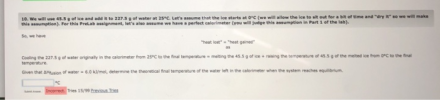 10, we will use 45.5 g of ice and add it to 227.5 g of water at 25.C Let's assume that the lce starts at Oe (we wm allow the ice to-out for·ba oftme and-er r 'o w. wil make this assumption). For this Prelab assignment, let's also assume we have a perfect calorimeter (you will judge this assumption in Part 1 of the lab). So, we have heat lost" "heat gained Cooling the 227.5 g of water originally in...
We have a closed system with an aluminum cup, water and a cube of ice. The...
We have a closed system with an aluminum cup, water and a cube of ice. The glass has a mass of 100 grams. The temperature of the glass and water is 20 degrees C. We also have 200 grams of water in total. The cube of ice weighs 5 grams and is at 0 degrees C. Find the equilibrium temperature of the system.
Calculate the heat required in Joules to convert 18.0 grams of water ice at a temperature...
Calculate the heat required in Joules to convert 18.0 grams of water ice at a temperature of -20° C to liquid water at the normal boiling point of water. Given: -specific heat of ice = 2.09 J/g°C -specific heat of liquid water = 4.184 J/g°C -specific heat of water vapor = 2.03 J/g°C -molar heat of fusion of water = 6.02 kJ/mol -molar heat of vaporization of water = 40.7 kJ/mol
The energy needed to convert 2 kg of ice at -10 °C to water at 10...
 The energy needed to convert 2 kg of ice at -10 °C to water at 10 °C will be { Constants Given: Specific Heat of Water = 4186 J/kg ºc, Specific Heat of Ice = 2100 J/kg ºc, and Latent Heat of Fusion = 3.33 x 10⁵ J/kg. }
a hot piece of iron at 75 degrees celsius was dropped on a 15g ice cube...
a hot piece of iron at 75 degrees celsius was dropped on a 15g ice cube at 0 degrees celsius. after a few minutes, both the iron and the water stayed at 0 degrees celsius but the ice melted completely. what is the mass of the iron? (Ciron = 0.0449 J/g degrees celsius, △Hfus = 6.00 kJ/mol)
You have a block of ice at a temperature of -100°C. This block of ice is...
You have a block of ice at a temperature of -100°C. This block of ice is made from 180g H2O. The block of ice will be heated continually until it becomes super-heated steam at a temperature of 200°C Cice = 2.03 J/g-K ΔHfus=6.01 kJ/mol Cwater = 4.18 J/g-K Csteam = 1.84 J/g-K ΔHvap=40.67 kJ/mol What is the enthalpy change raising the temperature of 180 g of ice at −100 °C to 0°C? What is the enthalpy change upon melting 180...
please answer clear and complete 2) 355 g of water ice is initially at a temperature...
 please answer clear and complete
2) 355 g of water ice is initially at a temperature of -11.0°C. If you want to turn it into water vapor at 122°C, how much heat energy will you have to add to It?
please answer clear and complete
2) 355 g of water ice is initially at a temperature of -11.0°C. If you want to turn it into water vapor at 122°C, how much heat energy will you have to add to It?
How much heat is released when 15g of ice is heated from -12 °C to water vapor at 105 °C? (AH fus = 79.5 cal/g, AH...
 How much heat is released when 15g of ice is heated from -12 °C to water vapor at 105 °C? (AH fus = 79.5 cal/g, AH vap = 539 cal/g) Substance Specific Heat (cal/g °C) 1.00 Water (liquid) Water (gas) Water (solid) 0.497 0.490
 10, we will use 45.5 g of ice and add it to 227.5 g of water at 25.C Let's assume that the lce starts at Oe (we wm allow the ice to-out for·ba oftme and-er r 'o w. wil make this assumption). For this Prelab assignment, let's also assume we have a perfect calorimeter (you will judge this assumption in Part 1 of the lab). So, we have heat lost" "heat gained Cooling the 227.5 g of water originally in...
 The energy needed to convert 2 kg of ice at -10 °C to water at 10 °C will be { Constants Given: Specific Heat of Water = 4186 J/kg ºc, Specific Heat of Ice = 2100 J/kg ºc, and Latent Heat of Fusion = 3.33 x 10⁵ J/kg. }
 please answer clear and complete
2) 355 g of water ice is initially at a temperature of -11.0°C. If you want to turn it into water vapor at 122°C, how much heat energy will you have to add to It?
please answer clear and complete
2) 355 g of water ice is initially at a temperature of -11.0°C. If you want to turn it into water vapor at 122°C, how much heat energy will you have to add to It?
 How much heat is released when 15g of ice is heated from -12 °C to water vapor at 105 °C? (AH fus = 79.5 cal/g, AH vap = 539 cal/g) Substance Specific Heat (cal/g °C) 1.00 Water (liquid) Water (gas) Water (solid) 0.497 0.490
Most questions answered within 3 hours.
-
Where is the error in this code sequence?
String s1 = "Hello";
String s2 = "ello";...
asked 10 months ago -
Financial data for Joel de Paris, Inc., for last year
follow:
Joel de Paris, Inc.
Balance...
asked 10 months ago -
Consider this reaction:
Al2(SO4)3 (aq)+ BaCl3
(aq) Al2Cl6 (aq)- +
3BaSO4(s) . What is the...
asked 10 months ago -
Suppose that Savneet is considering increasing her
recent random sample from 20 car rentals to 40...
asked 10 months ago -
Trucks arrive at an unloading terminal at an average rate of 120
per hour.
Trucks arrive...
asked 10 months ago -
Why are methanol and ethanol completely soluble in water while
octanol is not very little soluble....
asked 10 months ago -
A facilities manager at a university reads in a research report
that the mean amount of...
asked 10 months ago -
When the CuSO4 is rehydrated by adding water to the anhydrous
compound, is this an endothermic...
asked 10 months ago -
A ray of sunlight is passing from diamond into crown glass; the
angle of incidence is...
asked 10 months ago -
A block of mass 0.249 kg is placed on top of a light, vertical
spring of...
asked 10 months ago -
how do the kidneys compensate in the presences of acidosis
a) trigger hyperventilate
b) reserve acid...
asked 10 months ago -
Question 501 pts
The rental rate of capital to the firm increases. Which of the
following...
asked 10 months ago