
Homework Answers


Add Answer to:
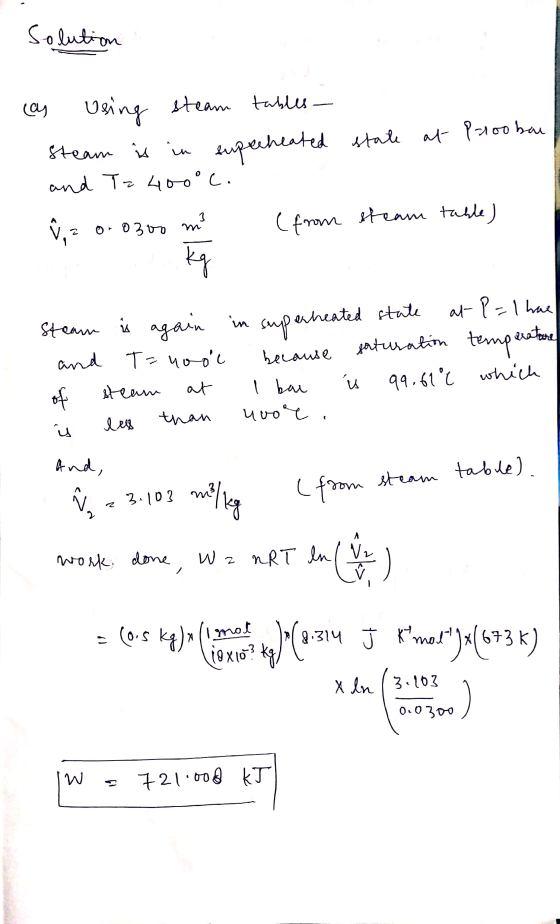
ice, take us 3.26 Consider a piston-cylinder assembly that initially contains 0.5 kg of steam at...
A piston-cylinder assembly contains 0.5 kg of water. Initially, the piston is resting against the stops...
A piston-cylinder assembly contains 0.5 kg of water. Initially, the piston is resting against the stops when the water pressure and temperature are 1.00 bar and 125 degrees celsius, respectively. The piston has a mass of 50 kg and face area of 0.01 m^2; local atmospheric pressure is 1.01 bar; local gravitational acceleration is 9.81 m/s^2. 1. What water pressure would be required to lift the piston from the stops? 2. If the initial specific internal energy is 2544.86 kJ/kg,...
Arigid tank of volume 0.5 m3 is connected to a piston-cylinder assembly by a valve as...
 Arigid tank of volume 0.5 m3 is connected to a piston-cylinder assembly by a valve as shown in the diagram below. Both vessels contain pure water. They are immersed in a constant- temperature bath at 200°C and 600 kPa. Consider the tank and the piston-cylinder as- sembly as the system and the constant-temperature bath as the surroundings. Initially the valve is closed, and both units are in equilibrium with the surroundings (the bath). The rigid tank contains saturated water with...
Question 11 A piston cylinder-device contains 12 kg of steam at 100 kPa and 175°C. Over...
 Question 11 A piston cylinder-device contains 12 kg of steam at 100 kPa and 175°C. Over time, the steam in the piston-cylinder device isobarically loses heat to its surroundings until it reaches a temperature of 99.61"C and all the vapor in the piston has condensed into liquid. a. Determine the entropy change of the steam, in kJ/K b. For the steam and its surroundings, determine the total entropy change associated with this process, in kJ/K. The temperature of the surroundings...
100 kg of steam is enclosed in a piston-cylinder device, initially at 573.15 K and 0.5...
100 kg of steam is enclosed in a piston-cylinder device, initially at 573.15 K and 0.5 MPa. It expands and cools to 473.15 K and 0.1 MPa. A. What is the change in internal energy of the steam in this process? B. If the external pressure is constant at 0.1 MPa, how much work was done by the steam on the surroundings?
1.Water vapor contained in a piston–cylinder assembly undergoes an isothermal expansion at 277°C from a pressure...
1.Water vapor contained in a piston–cylinder assembly undergoes an isothermal expansion at 277°C from a pressure of 5.1 bar to a pressure of 2.7 bar. Evaluate the work, in kJ/kg. 2.Nitrogen (N2) contained in a piston–cylinder arrangement, initially at 9.3 bar and 437 K, undergoes an expansion to a final temperature of 300 K, during which the pressure–volume relationship is pV1.1 = constant. Assuming the ideal gas model for the N2, determine the heat transfer in kJ/kg. 3.Argon contained in...
Question 1 A piston-cylinder assembly contains 3.2 kg of water at 211.9oC and 3 bar. The...
Question 1 A piston-cylinder assembly contains 3.2 kg of water at 211.9oC and 3 bar. The water is compressed to a saturated vapor state where the pressure is 51.5 bar. During compression, there is a heat transfer of energy from the water to its surroundings having a magnitude of 230 kJ. Neglecting changes in kinetic energy and potential energy, determine the work, in kJ, for the process of the water. Question 2 Water, initially saturated vapor at 10.2 bar, fills...
Steam undergoes an isentropic compression in an insulated piston–cylinder assembly from an initial state where T1...
Steam undergoes an isentropic compression in an insulated piston–cylinder assembly from an initial state where T1 = 120°C, p1 = 1 bar to a final state where the pressure p2 = 20 bar. Determine the final temperature, in °C, and the work, in kJ per kg of steam.
consider a piston-cylinder assembly that operate in isobaric process. steam undergoes the process from 400C to...
 consider a piston-cylinder assembly that operate in
isobaric process. steam undergoes the process from 400C to reach
900C. Select two different values of pressure in the range of 5 to
20 MPa at which the preocess is undergoing and subsequently plot
the heat transfer (kJ/kg) as a function of the chosen pressure
values.
Consider a piston-cylinder assembly that operates in isobaric process. Steam undergoes the process from 400 °C to reach 900 °C. Select two different values of pressure in...
consider a piston-cylinder assembly that operate in
isobaric process. steam undergoes the process from 400C to reach
900C. Select two different values of pressure in the range of 5 to
20 MPa at which the preocess is undergoing and subsequently plot
the heat transfer (kJ/kg) as a function of the chosen pressure
values.
Consider a piston-cylinder assembly that operates in isobaric process. Steam undergoes the process from 400 °C to reach 900 °C. Select two different values of pressure in...
100 kg of steam is enclosed in a piston-cylinder device initially at 300°C and 5 bar...
100 kg of steam is enclosed in a piston-cylinder device initially at 300°C and 5 bar It expands and cools to 200°C and 1 bar. What is the change in entropy?
A piston –cylinder device initially contains 0.2 kg of steam at 1400 kPa and 350C. The...
A piston –cylinder device initially contains 0.2 kg of steam at 1400 kPa and 350C. The steam is then cooled at constant pressure until it is at 200C. (a) Determine the volume change of the cylinder during this process using the compressibility factor. (b) Compare the result in part (a) to that obtained using actual property values.
 Arigid tank of volume 0.5 m3 is connected to a piston-cylinder assembly by a valve as shown in the diagram below. Both vessels contain pure water. They are immersed in a constant- temperature bath at 200°C and 600 kPa. Consider the tank and the piston-cylinder as- sembly as the system and the constant-temperature bath as the surroundings. Initially the valve is closed, and both units are in equilibrium with the surroundings (the bath). The rigid tank contains saturated water with...
 Question 11 A piston cylinder-device contains 12 kg of steam at 100 kPa and 175°C. Over time, the steam in the piston-cylinder device isobarically loses heat to its surroundings until it reaches a temperature of 99.61"C and all the vapor in the piston has condensed into liquid. a. Determine the entropy change of the steam, in kJ/K b. For the steam and its surroundings, determine the total entropy change associated with this process, in kJ/K. The temperature of the surroundings...
 consider a piston-cylinder assembly that operate in
isobaric process. steam undergoes the process from 400C to reach
900C. Select two different values of pressure in the range of 5 to
20 MPa at which the preocess is undergoing and subsequently plot
the heat transfer (kJ/kg) as a function of the chosen pressure
values.
Consider a piston-cylinder assembly that operates in isobaric process. Steam undergoes the process from 400 °C to reach 900 °C. Select two different values of pressure in...
consider a piston-cylinder assembly that operate in
isobaric process. steam undergoes the process from 400C to reach
900C. Select two different values of pressure in the range of 5 to
20 MPa at which the preocess is undergoing and subsequently plot
the heat transfer (kJ/kg) as a function of the chosen pressure
values.
Consider a piston-cylinder assembly that operates in isobaric process. Steam undergoes the process from 400 °C to reach 900 °C. Select two different values of pressure in...
Most questions answered within 3 hours.
-
Where is the error in this code sequence?
String s1 = "Hello";
String s2 = "ello";...
asked 10 months ago -
Financial data for Joel de Paris, Inc., for last year
follow:
Joel de Paris, Inc.
Balance...
asked 10 months ago -
Consider this reaction:
Al2(SO4)3 (aq)+ BaCl3
(aq) Al2Cl6 (aq)- +
3BaSO4(s) . What is the...
asked 10 months ago -
Suppose that Savneet is considering increasing her
recent random sample from 20 car rentals to 40...
asked 10 months ago -
Trucks arrive at an unloading terminal at an average rate of 120
per hour.
Trucks arrive...
asked 10 months ago -
Why are methanol and ethanol completely soluble in water while
octanol is not very little soluble....
asked 10 months ago -
A facilities manager at a university reads in a research report
that the mean amount of...
asked 10 months ago -
When the CuSO4 is rehydrated by adding water to the anhydrous
compound, is this an endothermic...
asked 10 months ago -
A ray of sunlight is passing from diamond into crown glass; the
angle of incidence is...
asked 10 months ago -
A block of mass 0.249 kg is placed on top of a light, vertical
spring of...
asked 10 months ago -
how do the kidneys compensate in the presences of acidosis
a) trigger hyperventilate
b) reserve acid...
asked 10 months ago -
Question 501 pts
The rental rate of capital to the firm increases. Which of the
following...
asked 10 months ago