A number of chemical reactions have been proposed for the formation of organic (chemicals of life)...
A number of chemical reactions have been proposed for the formation of organic (chemicals of life) compounds from inorganic precursors. Here is one of them: H2S(g) + FeS(s) + CO2(g) → FeS2(s) + HCO2H(l)
a) identify the ions and charges in FeS and FeS2 and name the compounds
b) How much HCO2H is obtained by reacting 1.10 g of FeS with 0.500 g H2S and 0.500 g of CO2 if the reaction produces a yield of 50%?
Homework Answers
a) Fe2+ , S2-, and S22-
The ion names would be iron(II), sulfide, and disulfide, and you would just combine them to make the names of the iron compounds.
FeS = iron (II) sulfide
FeS2 = iron (II) persulfide
The other compounds are hydrogen sulfide and formic acid.
b) (1.10g FeS)/(87.910g FeS/mol FeS) = 0.0125mol FeS
(0.5g H2S)/(34.081g H2S/mol H2S) = 0.0147mol H2S
There's a slight excess H2S. Hence FeS is the limiting reactant.
Theoretically we would get
(1.10g FeS)/(87.910g FeS/mol FeS)(1mol HCO2H/1mol FeS)(46.025g HCO2H/mol HCO2H)
With 50.0% yield, you will get
(1.10g FeS)/(87.910g FeS/mol)(1mol HCO2H/1mol FeS)(46.025g HCO2H/mol)(0.50) = 0.2879g HCO2H
Add Answer to:
A number of chemical reactions have been proposed for the
formation of organic (chemicals of life)...
Question A number of chemical reactions have been proposed for the formation of organic compounds from...
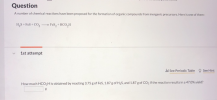 Question A number of chemical reactions have been proposed for the formation of organic compounds from inorganic precursors. Here is one of them: H,S+ FeS+ CO2 Fes, +HCO,H 1st attempt i See Periodic Table See Hint How much HCO2H is obtained by reacting 3.75 g of FeS, 1.87 g of H2S, and 1.87 g of CO2 if the reaction results in a 47.0 % yield ?
198 CHAPTER 5 Chemical Reactions Practice Problems 5.24 Determine if the reactions in Problem 500 reversible or ir...
 198 CHAPTER 5 Chemical Reactions Practice Problems 5.24 Determine if the reactions in Problem 500 reversible or irreversible. 5.25 Write the products and balance the follos tion for the complete combustion of ethane CH() + O2(g) —? 5.21 Categorize the following reactions as synthesis, decomposition, or exchange reactions in the forward direction: a. Cuo(s) + 2HCl(aq) —> CuCl2(aq) + H2O(1) b. CH,206(ag) -> 2C,H,O(aq) + 2CO (9) c. 2H269) + O2(8) = 2H2O) 5.22 Categorize the following reactions as synthesis,...
CH 111 - Introduction to Inorganic and Organic Chemistry Lab 10 - Exp. 341 Synthesis of...
 CH 111 - Introduction to Inorganic and Organic Chemistry Lab 10 - Exp. 341 Synthesis of Strontium lodate In this lab, we will perform a synthesis reaction to generate a desired product. Synthesis reactions are performed in many different industries including fertilizers, plastics, pharmaceuticals and many others. The goal in a synthesis reaction is to generate and obtain as much of the desired product as possible. In this synthesis, the reaction between KIO, (potassium iodate) and Sr(NO3)2 (strontium nitrate) produces...
I just need the blank data table with all the reactions shown. I need ALL 36...
 I just need the blank data table with
all the reactions shown. I need ALL 36 spaces for reacting
solutions. I don't need the observations. Please
help.
ARE hem 310 LAB EXPERIMENT #6 Chemical Reactions: Double Replacements I. OBJECTIVES 1. To perform and record observations of some chemical reactions. 2. To gain skill in writing balanced equations from observations of chemical reactions using known reactants. 3. To look for ions that, if present, may cause the compounds to be insoluble...
I just need the blank data table with
all the reactions shown. I need ALL 36 spaces for reacting
solutions. I don't need the observations. Please
help.
ARE hem 310 LAB EXPERIMENT #6 Chemical Reactions: Double Replacements I. OBJECTIVES 1. To perform and record observations of some chemical reactions. 2. To gain skill in writing balanced equations from observations of chemical reactions using known reactants. 3. To look for ions that, if present, may cause the compounds to be insoluble...
Experiment 8 Double Replacement Reactions Background: Some reactions have the net effect of causing the cation...
 Experiment 8 Double Replacement Reactions Background: Some reactions have the net effect of causing the cation of each reactant to trade places, forming a compound with the other anion. These reactions are known as double replacement reactions. In the example below (unbalanced equation), the barium and sodium cations switch places so that barium forms a product with sulfate while sodium forms a product with chloride. Note that the formula of each product is determined by the charges of the ions,...
accordingly answer and i pt): Polymers and Monomers. Read each question chemical structure, in a oymer chemical structure based on the polymer name and provide the monomer unit chemical st...
 accordingly answer and i pt): Polymers and Monomers. Read each question chemical structure, in a oymer chemical structure based on the polymer name and provide the monomer unit chemical structure, in addition. Lastly applications. An example answer is provided as guidance. , provide an example of how the polymers are utilized in (bio)engineering Polymer Chemical Structure Polymer Full Name and Abbreviation Usage Example for Monomer Unit Structure(s) _ _pt per box) pt per box) pt per box) Nucleic Acid (DNA)...
if you can't answer all ,please don't answer 1) of the reactions below, which one is...
 if you can't answer all ,please don't answer
1) of the reactions below, which one is a decomposition reaction? A) Ca(NO3)2 + Na2S -- CdS +2NaNO3 B) NH4Cl- NH3 + HCI C) 2Mg + 02 - 2MgO D) 2N2 + 3H2 → 2NH3 E) 2CH4 + 402 - 2002 + 4H20 miches of - x 1? 2 2) Calculate the percentage by mass of ammonia in cisplatin, PtCl2/NH3 12. A) 12.53 B) 5.68 C) 18.09 D) 11.35 E) 4.67 3)...
if you can't answer all ,please don't answer
1) of the reactions below, which one is a decomposition reaction? A) Ca(NO3)2 + Na2S -- CdS +2NaNO3 B) NH4Cl- NH3 + HCI C) 2Mg + 02 - 2MgO D) 2N2 + 3H2 → 2NH3 E) 2CH4 + 402 - 2002 + 4H20 miches of - x 1? 2 2) Calculate the percentage by mass of ammonia in cisplatin, PtCl2/NH3 12. A) 12.53 B) 5.68 C) 18.09 D) 11.35 E) 4.67 3)...
Need help, numbers 3-6 please show work. and fill out table of chemicals for all chemical...
 Need help, numbers 3-6 please show work. and fill out table of
chemicals for all chemical used.
calculate mmol in the table as well show work please
and each of these must be listed in its own row. There are 10 column headings: IUPAC name OR common name, structure, CAS number (Chemical Abstract Service number) molecular mass, melting point (if applicable), boiling point (if applicable), solubility (in water, if applicable), density, amounts to be used in the experiment, and the...
Need help, numbers 3-6 please show work. and fill out table of
chemicals for all chemical used.
calculate mmol in the table as well show work please
and each of these must be listed in its own row. There are 10 column headings: IUPAC name OR common name, structure, CAS number (Chemical Abstract Service number) molecular mass, melting point (if applicable), boiling point (if applicable), solubility (in water, if applicable), density, amounts to be used in the experiment, and the...
When you write the answers, please write the page number for which the question is located....
 When you write the answers, please write the page number for
which the question is located. Thank you!
Experiment 8 Name: Double Replacement Reactions Background: Some reactions have the net effect of causing the cation of cach reactant to trade places, forming a compound with the other anion. These reactions are known as double replacement reactions. In the example below (unbalanced equation), the barium and sodium cations switch places so that barium forms a product with sulfate while sodium forms...
When you write the answers, please write the page number for
which the question is located. Thank you!
Experiment 8 Name: Double Replacement Reactions Background: Some reactions have the net effect of causing the cation of cach reactant to trade places, forming a compound with the other anion. These reactions are known as double replacement reactions. In the example below (unbalanced equation), the barium and sodium cations switch places so that barium forms a product with sulfate while sodium forms...
Postlab Questions Answer the following questions on a separate sheet or in your lab notebook. Make...
 Postlab Questions Answer the following questions on a separate sheet or in your lab notebook. Make sure that the copy page is readable! D) Calculate the percentage yield for both reactions. Show all calculations. 2) What is the color of the reaction at the beginning of reaction? What causes the color? 3) Why do you dissolve maleic acid in diethyl ether and fumaric acid in water? 4) Give the complete reaction mechanisms for the formation of meso and racemic 2,3-...
 Question A number of chemical reactions have been proposed for the formation of organic compounds from inorganic precursors. Here is one of them: H,S+ FeS+ CO2 Fes, +HCO,H 1st attempt i See Periodic Table See Hint How much HCO2H is obtained by reacting 3.75 g of FeS, 1.87 g of H2S, and 1.87 g of CO2 if the reaction results in a 47.0 % yield ?
 198 CHAPTER 5 Chemical Reactions Practice Problems 5.24 Determine if the reactions in Problem 500 reversible or irreversible. 5.25 Write the products and balance the follos tion for the complete combustion of ethane CH() + O2(g) —? 5.21 Categorize the following reactions as synthesis, decomposition, or exchange reactions in the forward direction: a. Cuo(s) + 2HCl(aq) —> CuCl2(aq) + H2O(1) b. CH,206(ag) -> 2C,H,O(aq) + 2CO (9) c. 2H269) + O2(8) = 2H2O) 5.22 Categorize the following reactions as synthesis,...
 CH 111 - Introduction to Inorganic and Organic Chemistry Lab 10 - Exp. 341 Synthesis of Strontium lodate In this lab, we will perform a synthesis reaction to generate a desired product. Synthesis reactions are performed in many different industries including fertilizers, plastics, pharmaceuticals and many others. The goal in a synthesis reaction is to generate and obtain as much of the desired product as possible. In this synthesis, the reaction between KIO, (potassium iodate) and Sr(NO3)2 (strontium nitrate) produces...
 I just need the blank data table with
all the reactions shown. I need ALL 36 spaces for reacting
solutions. I don't need the observations. Please
help.
ARE hem 310 LAB EXPERIMENT #6 Chemical Reactions: Double Replacements I. OBJECTIVES 1. To perform and record observations of some chemical reactions. 2. To gain skill in writing balanced equations from observations of chemical reactions using known reactants. 3. To look for ions that, if present, may cause the compounds to be insoluble...
I just need the blank data table with
all the reactions shown. I need ALL 36 spaces for reacting
solutions. I don't need the observations. Please
help.
ARE hem 310 LAB EXPERIMENT #6 Chemical Reactions: Double Replacements I. OBJECTIVES 1. To perform and record observations of some chemical reactions. 2. To gain skill in writing balanced equations from observations of chemical reactions using known reactants. 3. To look for ions that, if present, may cause the compounds to be insoluble...
 Experiment 8 Double Replacement Reactions Background: Some reactions have the net effect of causing the cation of each reactant to trade places, forming a compound with the other anion. These reactions are known as double replacement reactions. In the example below (unbalanced equation), the barium and sodium cations switch places so that barium forms a product with sulfate while sodium forms a product with chloride. Note that the formula of each product is determined by the charges of the ions,...
 accordingly answer and i pt): Polymers and Monomers. Read each question chemical structure, in a oymer chemical structure based on the polymer name and provide the monomer unit chemical structure, in addition. Lastly applications. An example answer is provided as guidance. , provide an example of how the polymers are utilized in (bio)engineering Polymer Chemical Structure Polymer Full Name and Abbreviation Usage Example for Monomer Unit Structure(s) _ _pt per box) pt per box) pt per box) Nucleic Acid (DNA)...
 if you can't answer all ,please don't answer
1) of the reactions below, which one is a decomposition reaction? A) Ca(NO3)2 + Na2S -- CdS +2NaNO3 B) NH4Cl- NH3 + HCI C) 2Mg + 02 - 2MgO D) 2N2 + 3H2 → 2NH3 E) 2CH4 + 402 - 2002 + 4H20 miches of - x 1? 2 2) Calculate the percentage by mass of ammonia in cisplatin, PtCl2/NH3 12. A) 12.53 B) 5.68 C) 18.09 D) 11.35 E) 4.67 3)...
if you can't answer all ,please don't answer
1) of the reactions below, which one is a decomposition reaction? A) Ca(NO3)2 + Na2S -- CdS +2NaNO3 B) NH4Cl- NH3 + HCI C) 2Mg + 02 - 2MgO D) 2N2 + 3H2 → 2NH3 E) 2CH4 + 402 - 2002 + 4H20 miches of - x 1? 2 2) Calculate the percentage by mass of ammonia in cisplatin, PtCl2/NH3 12. A) 12.53 B) 5.68 C) 18.09 D) 11.35 E) 4.67 3)...
 Need help, numbers 3-6 please show work. and fill out table of
chemicals for all chemical used.
calculate mmol in the table as well show work please
and each of these must be listed in its own row. There are 10 column headings: IUPAC name OR common name, structure, CAS number (Chemical Abstract Service number) molecular mass, melting point (if applicable), boiling point (if applicable), solubility (in water, if applicable), density, amounts to be used in the experiment, and the...
Need help, numbers 3-6 please show work. and fill out table of
chemicals for all chemical used.
calculate mmol in the table as well show work please
and each of these must be listed in its own row. There are 10 column headings: IUPAC name OR common name, structure, CAS number (Chemical Abstract Service number) molecular mass, melting point (if applicable), boiling point (if applicable), solubility (in water, if applicable), density, amounts to be used in the experiment, and the...
 When you write the answers, please write the page number for
which the question is located. Thank you!
Experiment 8 Name: Double Replacement Reactions Background: Some reactions have the net effect of causing the cation of cach reactant to trade places, forming a compound with the other anion. These reactions are known as double replacement reactions. In the example below (unbalanced equation), the barium and sodium cations switch places so that barium forms a product with sulfate while sodium forms...
When you write the answers, please write the page number for
which the question is located. Thank you!
Experiment 8 Name: Double Replacement Reactions Background: Some reactions have the net effect of causing the cation of cach reactant to trade places, forming a compound with the other anion. These reactions are known as double replacement reactions. In the example below (unbalanced equation), the barium and sodium cations switch places so that barium forms a product with sulfate while sodium forms...
 Postlab Questions Answer the following questions on a separate sheet or in your lab notebook. Make sure that the copy page is readable! D) Calculate the percentage yield for both reactions. Show all calculations. 2) What is the color of the reaction at the beginning of reaction? What causes the color? 3) Why do you dissolve maleic acid in diethyl ether and fumaric acid in water? 4) Give the complete reaction mechanisms for the formation of meso and racemic 2,3-...
Most questions answered within 3 hours.
-
Where is the error in this code sequence?
String s1 = "Hello";
String s2 = "ello";...
asked 11 months ago -
Financial data for Joel de Paris, Inc., for last year
follow:
Joel de Paris, Inc.
Balance...
asked 11 months ago -
Consider this reaction:
Al2(SO4)3 (aq)+ BaCl3
(aq) Al2Cl6 (aq)- +
3BaSO4(s) . What is the...
asked 11 months ago -
Suppose that Savneet is considering increasing her
recent random sample from 20 car rentals to 40...
asked 11 months ago -
Trucks arrive at an unloading terminal at an average rate of 120
per hour.
Trucks arrive...
asked 11 months ago -
Why are methanol and ethanol completely soluble in water while
octanol is not very little soluble....
asked 11 months ago -
A facilities manager at a university reads in a research report
that the mean amount of...
asked 11 months ago -
When the CuSO4 is rehydrated by adding water to the anhydrous
compound, is this an endothermic...
asked 11 months ago -
A ray of sunlight is passing from diamond into crown glass; the
angle of incidence is...
asked 11 months ago -
A block of mass 0.249 kg is placed on top of a light, vertical
spring of...
asked 11 months ago -
how do the kidneys compensate in the presences of acidosis
a) trigger hyperventilate
b) reserve acid...
asked 11 months ago -
Question 501 pts
The rental rate of capital to the firm increases. Which of the
following...
asked 11 months ago