
Homework Answers
Add Answer to:
QUESTION 7 2.5 p A block is placed on a surface with a coefficient of static...
Question 7 A 0.73 kg block is placed on a horizontal surface with a coefficient of...
 Question 7 A 0.73 kg block is placed on a horizontal surface with a coefficient of kinetic friction of 0.122. The block is pressed against a spring that has a spring constant of 683 N/m until it has compressed the spring by 13.7 cm. When the block is allowed to move freely, the spring pushes the block 10 cm along the horizontal surface at which point it encounters an upward slope with an angle of 29.0°. This slope has the...
Need help with the first and third question. Thanks Question: A block is placed on an...
 Need help with the first and third question. Thanks
Question: A block is placed on an inclined plane as shown in Figure 1. The block has a mass m = 1.85 kg. The angle is slowly increased. When 0 = 39.5° the block starts to slide down the inclined plane. When the block has travelled 1.00 m along the slope it has a speed of v = 0.555 m/s. Figure 1: A block of mass m resting on an inclined...
Need help with the first and third question. Thanks
Question: A block is placed on an inclined plane as shown in Figure 1. The block has a mass m = 1.85 kg. The angle is slowly increased. When 0 = 39.5° the block starts to slide down the inclined plane. When the block has travelled 1.00 m along the slope it has a speed of v = 0.555 m/s. Figure 1: A block of mass m resting on an inclined...
Suppose a block with mass 2.00 kg is resting on a ramp. If the coefficient of...
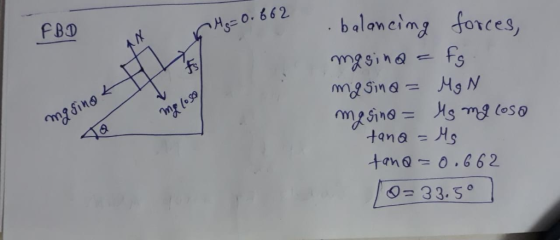
Suppose a block with mass 2.00 kg is resting on a ramp. If the coefficient of static friction between the block and the ramp is 0.430. (a) What maximum angle can the ramp make with the horizontal before the block starts to slip down? The ramp in the figure is roughed up and the experiment repeated. (b) What is the new coefficient of static friction if the maximum angle turns out to be 38.9°? (c) Find the magnitude of the...
A block of mass m=2kg is placed on a horizontal surface with which its coefficient of...
A block of mass m=2kg is placed on a horizontal surface with which its coefficient of kinetic friction is 0.5. Determine the magnitude of the force applied to the block at an angle of 53 degrees above the horizontal that would accelerate the block at 2 m/s^2.
Suppose a block is placed on a rough surface inclined relative to the horizontal. The incline...
Suppose a block is placed on a rough surface inclined relative to the horizontal. The incline angle is increased until the block starts to move. Show that you can obtain Us by measuring the critical angle c at which this slipping just occurs. If the critical angle c = 15 degrees at which this slipping just occurs, Us = ______ a. 0.27 b. 0.17 c. 0.47 d. 0.37
A mass of 10 kg is placed on an incline with a coefficient of static friction...
A mass of 10 kg is placed on an incline with a coefficient of static friction of 1.59 and coefficient of kinetic friction of 1.21. No additional forces are acting on it and it is raised slowly from a small angle and it begins to slide at some angle. If 10 degrees is added to this angle, and the mass started from rest from a vertical height of 33 meters, how much longer would it take to travel down the...
A mass of 8 kg is placed on an incline with a coefficient of static friction...
A mass of 8 kg is placed on an incline with a coefficient of static friction of 1.72 and coefficient of kinetic friction of 1.33. No additional forces are acting on it and it is raised slowly from a small angle and it begins to slide at some angle. If 10 degrees is added to this angle, and the mass started from rest from a vertical height of 32 meters, how much longer would it take to travel down the...
QUESTION 1 2.5 points Save Answer A block of mass 1.56kg is being pulled by a...
 QUESTION 1 2.5 points Save Answer A block of mass 1.56kg is being pulled by a string parallel to the contact surface with a slowly increasing force. If the block remains stationary until the force reaches 10N, what is the static friction coefficient? QUESTION 2 2.5 points Save Answer A box of mass 3,401.62g is on level ground being pulled bya slowly increasing force at an angle 35.69 above horizontal. If the block is stationary until this force reaches of...
A block of mass is placed on a horizontal surface and attached to the free end...
A block of mass is placed on a horizontal surface and attached to the free end of a spring. When the spring is neither stretched nor compressed, it exerts no force on the block. When the block is displaced from this position the force on it due to the spring is equal to 250 N/m times the distance the block is displaced. If the coefficient of static friction between the block and the surface is 0.24, how far from this...
A box is placed on a plank. One end of the plank is gradually raised. When...
A box is placed on a plank. One end of the plank is gradually raised. When the angle of inclination with the horizontal reaches 30, the box starts to slip, and then slides 2.5 m down the plank in 4.5 seconds. Find the Coefficient of static friction, and (b) coefficient of kinetic friction between the box and the plank.
 Question 7 A 0.73 kg block is placed on a horizontal surface with a coefficient of kinetic friction of 0.122. The block is pressed against a spring that has a spring constant of 683 N/m until it has compressed the spring by 13.7 cm. When the block is allowed to move freely, the spring pushes the block 10 cm along the horizontal surface at which point it encounters an upward slope with an angle of 29.0°. This slope has the...
 Need help with the first and third question. Thanks
Question: A block is placed on an inclined plane as shown in Figure 1. The block has a mass m = 1.85 kg. The angle is slowly increased. When 0 = 39.5° the block starts to slide down the inclined plane. When the block has travelled 1.00 m along the slope it has a speed of v = 0.555 m/s. Figure 1: A block of mass m resting on an inclined...
Need help with the first and third question. Thanks
Question: A block is placed on an inclined plane as shown in Figure 1. The block has a mass m = 1.85 kg. The angle is slowly increased. When 0 = 39.5° the block starts to slide down the inclined plane. When the block has travelled 1.00 m along the slope it has a speed of v = 0.555 m/s. Figure 1: A block of mass m resting on an inclined...
 QUESTION 1 2.5 points Save Answer A block of mass 1.56kg is being pulled by a string parallel to the contact surface with a slowly increasing force. If the block remains stationary until the force reaches 10N, what is the static friction coefficient? QUESTION 2 2.5 points Save Answer A box of mass 3,401.62g is on level ground being pulled bya slowly increasing force at an angle 35.69 above horizontal. If the block is stationary until this force reaches of...
Most questions answered within 3 hours.
-
Where is the error in this code sequence?
String s1 = "Hello";
String s2 = "ello";...
asked 10 months ago -
Financial data for Joel de Paris, Inc., for last year
follow:
Joel de Paris, Inc.
Balance...
asked 10 months ago -
Consider this reaction:
Al2(SO4)3 (aq)+ BaCl3
(aq) Al2Cl6 (aq)- +
3BaSO4(s) . What is the...
asked 10 months ago -
Suppose that Savneet is considering increasing her
recent random sample from 20 car rentals to 40...
asked 10 months ago -
Trucks arrive at an unloading terminal at an average rate of 120
per hour.
Trucks arrive...
asked 10 months ago -
Why are methanol and ethanol completely soluble in water while
octanol is not very little soluble....
asked 10 months ago -
A facilities manager at a university reads in a research report
that the mean amount of...
asked 10 months ago -
When the CuSO4 is rehydrated by adding water to the anhydrous
compound, is this an endothermic...
asked 10 months ago -
A ray of sunlight is passing from diamond into crown glass; the
angle of incidence is...
asked 10 months ago -
A block of mass 0.249 kg is placed on top of a light, vertical
spring of...
asked 10 months ago -
how do the kidneys compensate in the presences of acidosis
a) trigger hyperventilate
b) reserve acid...
asked 10 months ago -
Question 501 pts
The rental rate of capital to the firm increases. Which of the
following...
asked 10 months ago