provide an example that proves heating is an irreversible process.
provide an example that proves heating is an irreversible process.
Homework Answers

The heating of the system is an irreversible process. Briefly explain why, and describe how you...
The heating of the system is an irreversible process. Briefly explain why, and describe how you would need to modify the heating process to make it reversible instead.
Is volume an additive quantity? Please give an example that proves your answer.
Is volume an additive quantity? Please give an example that proves your answer.
for the irreversible adiabatic heating of an ideal diatomic gas, calculate q, w, delta U, delta...
for the irreversible adiabatic heating of an ideal diatomic gas, calculate q, w, delta U, delta H, and the final temperature given p1 = 0.5 bar, p2 =3.5 bar, and T1 = 150 K
look at #17 and provide an example and reasoning behind that example. the energy changes and...
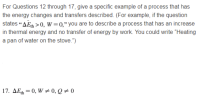 look at #17 and provide an
example and reasoning behind that example.
the energy changes and transfers described. (For example, if the question states "AEh>0, W 0," you are to describe a process that has an increase in thermal energy and no transfer of energy by work. You could write "Heating a pan of water on the stove.")
look at #17 and provide an
example and reasoning behind that example.
the energy changes and transfers described. (For example, if the question states "AEh>0, W 0," you are to describe a process that has an increase in thermal energy and no transfer of energy by work. You could write "Heating a pan of water on the stove.")
Discuss the difference between a spontaneous and nonspontaneous process, and a reversible and irreversible process.
Discuss the difference between a spontaneous and nonspontaneous process, and a reversible and irreversible process.
What kind of process does the air in the piston-cylinder apparatus undergo during the process? Irreversible...
What kind of process does the air in the piston-cylinder apparatus undergo during the process? Irreversible adiabatic Reversible isochoric Reversible adiabatic Reversible isothermal Irreversible isobaric Reversible isobaric
Provide an example of SLT in the context of the directing process in the workplace.
Provide an example of SLT in the context of the directing process in the workplace.
Provide an example of a process that you feel is in control but might not be...
Provide an example of a process that you feel is in control but might not be capable of producing the desired quality output.
Illustrate differences between an isothermal irreversible process and a reversible process by using a P-V diagram,...
Illustrate differences between an isothermal irreversible process and a reversible process by using a P-V diagram, and explain why Q might not be zero even when temperature is a constant
1. Calculate AS, AH and AG for the following spontaneous (irreversible) process (with 3.0 mol of...
 1. Calculate AS, AH and AG for the following spontaneous (irreversible) process (with 3.0 mol of water at 1 atm). H2O (liquid, -15 °C) → H2O (solid, -15 °C) It is known that the heat of fusion of water at 0 °C is 1436 cal/mol; the heat capacity of liquid water is 18.0 cal/mol, the heat of capacity of ice is 8.7 cal/mol. H2O (liquid, -10 °C) → H2O (liquid, 0 °C). HO (liquid, -15°C) H.O(solid, -15°C) Process (1) Process...
 look at #17 and provide an
example and reasoning behind that example.
the energy changes and transfers described. (For example, if the question states "AEh>0, W 0," you are to describe a process that has an increase in thermal energy and no transfer of energy by work. You could write "Heating a pan of water on the stove.")
look at #17 and provide an
example and reasoning behind that example.
the energy changes and transfers described. (For example, if the question states "AEh>0, W 0," you are to describe a process that has an increase in thermal energy and no transfer of energy by work. You could write "Heating a pan of water on the stove.")
 1. Calculate AS, AH and AG for the following spontaneous (irreversible) process (with 3.0 mol of water at 1 atm). H2O (liquid, -15 °C) → H2O (solid, -15 °C) It is known that the heat of fusion of water at 0 °C is 1436 cal/mol; the heat capacity of liquid water is 18.0 cal/mol, the heat of capacity of ice is 8.7 cal/mol. H2O (liquid, -10 °C) → H2O (liquid, 0 °C). HO (liquid, -15°C) H.O(solid, -15°C) Process (1) Process...
Most questions answered within 3 hours.
-
Where is the error in this code sequence?
String s1 = "Hello";
String s2 = "ello";...
asked 10 months ago -
Financial data for Joel de Paris, Inc., for last year
follow:
Joel de Paris, Inc.
Balance...
asked 10 months ago -
Consider this reaction:
Al2(SO4)3 (aq)+ BaCl3
(aq) Al2Cl6 (aq)- +
3BaSO4(s) . What is the...
asked 10 months ago -
Suppose that Savneet is considering increasing her
recent random sample from 20 car rentals to 40...
asked 10 months ago -
Trucks arrive at an unloading terminal at an average rate of 120
per hour.
Trucks arrive...
asked 10 months ago -
Why are methanol and ethanol completely soluble in water while
octanol is not very little soluble....
asked 10 months ago -
A facilities manager at a university reads in a research report
that the mean amount of...
asked 10 months ago -
When the CuSO4 is rehydrated by adding water to the anhydrous
compound, is this an endothermic...
asked 10 months ago -
A ray of sunlight is passing from diamond into crown glass; the
angle of incidence is...
asked 10 months ago -
A block of mass 0.249 kg is placed on top of a light, vertical
spring of...
asked 10 months ago -
how do the kidneys compensate in the presences of acidosis
a) trigger hyperventilate
b) reserve acid...
asked 10 months ago -
Question 501 pts
The rental rate of capital to the firm increases. Which of the
following...
asked 10 months ago