
Homework Answers
Add Answer to:
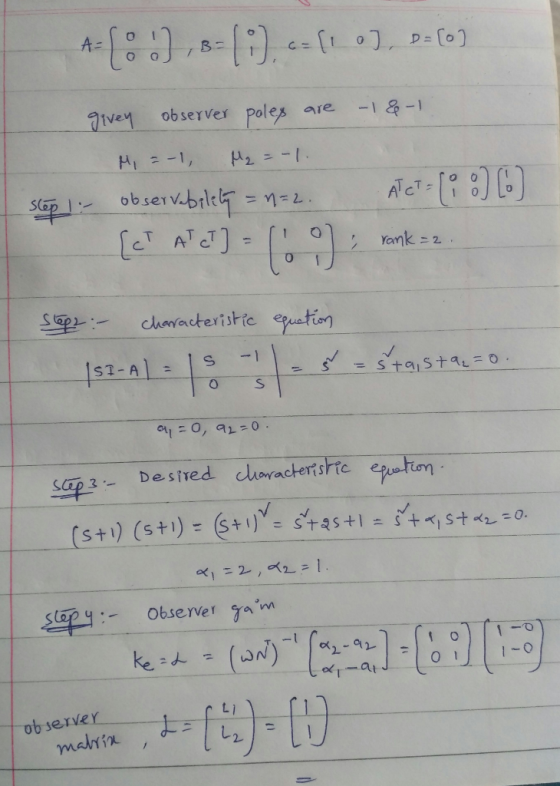
4. Given the following state-space system: (4 pts) Determine an observer matrix L -1 and-1 =?11...
3. The transfer function of a control system is given as G(s) = (s+1)(s+2)(s45) (a) Determine a state variable representation in observer canonical form. (b) Design a full order observer of the syste...
 3. The transfer function of a control system is given as G(s) = (s+1)(s+2)(s45) (a) Determine a state variable representation in observer canonical form. (b) Design a full order observer of the system. Let the poles of the observer be 10 times faster than the system poles. Show the observer gain matrix. (c) Determine and plot the errors responses between the estimated output and the actual output. (d) Determine and plot the estimated state variables and determine their settling times....
- 4. Full State Feedback and Observer Design Consider the plant s + 1 G(s)- (s + a(s +8(s +10) where a-1. a) Find a...
 - 4. Full State Feedback and Observer Design Consider the plant s + 1 G(s)- (s + a(s +8(s +10) where a-1. a) Find a convenient state space representation of model G(s) . b) Using place design a controller for the system that puts the poles at -1 and-2 +-2 . c) Using place design an observer with poles at-10,-11 and-12 d) Simulate the states with the state estimates overlaid e)Find a state space representation of the closed loop system...
(Full Order Observer). Given the following state space equations =1-5-251-1 -1 0 1 0 CID |...
 (Full Order Observer). Given the following state space equations =1-5-251-1 -1 0 1 0 CID | a) Determine if the system is stable. b) Is the system Observable? Detectable? c) Design a full order observer that places the estimator-error poles at {-5±5 d) Check the entire set of eigenvalues of the estimator.
Consider the following transfer function of a linear control system 1- Determine the state feedb...
 Consider the following transfer function of a linear control
system
1- Determine the state feedback gain matrix that places the
closed system at s=-32, -3.234 ± j3.3.
2- Design a full order observer which produces a set of desired
closed loop poles at s=-16, -16.15±j16.5
3-Assume X1 is measurable, design a reduced order observer with
desired closed loop poles at -16.15±j16.5
We were unable to transcribe this image1 Y(s) U(s) (s+1)(s2+0.7s+2) Consider the following transfer function of a linear control...
Consider the following transfer function of a linear control
system
1- Determine the state feedback gain matrix that places the
closed system at s=-32, -3.234 ± j3.3.
2- Design a full order observer which produces a set of desired
closed loop poles at s=-16, -16.15±j16.5
3-Assume X1 is measurable, design a reduced order observer with
desired closed loop poles at -16.15±j16.5
We were unable to transcribe this image1 Y(s) U(s) (s+1)(s2+0.7s+2) Consider the following transfer function of a linear control...
Consider the following transfer function of a linear control system Determine the state feedba...
 Consider the following transfer function of a linear control
system
Determine the state feedback gain matrix that places the closed
system at s=-32, -3.234 ± j3.3.
Design a full order observer which produces a set of desired
closed loop poles at s=-16, -16.15±j16.5
Assume X1 is measurable, design a reduced order observer with
desired closed loop poles at -16.15±j16.5
We were unable to transcribe this image1 Y(s) U(s) (s+1)(s2+0.7s+2) Consider the following transfer function of a linear control system (a)...
Consider the following transfer function of a linear control
system
Determine the state feedback gain matrix that places the closed
system at s=-32, -3.234 ± j3.3.
Design a full order observer which produces a set of desired
closed loop poles at s=-16, -16.15±j16.5
Assume X1 is measurable, design a reduced order observer with
desired closed loop poles at -16.15±j16.5
We were unable to transcribe this image1 Y(s) U(s) (s+1)(s2+0.7s+2) Consider the following transfer function of a linear control system (a)...
i dont understand this problem. please show how to solve all parts using MATLAB. thank you. State-Space Representation and Analysis csys canon(sys,type) compute a canonical state-space realization...
 i dont understand this problem. please show how to solve all
parts using MATLAB. thank you.
State-Space Representation and Analysis csys canon(sys,type) compute a canonical state-space realization type 'companion': controllable canonical form type modal: modal canonical form poles of a system controllability matrix observability matrix eig(A) ctrb(A,B) obsv(A,C) -7 L-12 0 EX A 2C-ioD0 uestions () Define the system in the state-space form (2) Determine the stability of the system (3) Determine the controllability and the observability of the system....
i dont understand this problem. please show how to solve all
parts using MATLAB. thank you.
State-Space Representation and Analysis csys canon(sys,type) compute a canonical state-space realization type 'companion': controllable canonical form type modal: modal canonical form poles of a system controllability matrix observability matrix eig(A) ctrb(A,B) obsv(A,C) -7 L-12 0 EX A 2C-ioD0 uestions () Define the system in the state-space form (2) Determine the stability of the system (3) Determine the controllability and the observability of the system....
5. For the following state space systems, determine the controllability matrix and the observability matrix O....
 5. For the following state space systems, determine the controllability matrix and the observability matrix O. State whether they are controllable and/or observable based on the matrices. a) * = 12 *_]x+[{]u; y = [1 2]> b) *="2)+ [a] u y = [1 0x 1-1 0 c) i = 0 -2 lo 0 y = [1 0 2]x 0 1 11] 0 x + 1 u -3 10)
1) The following state-space system is dominated by a pair of lightly damped poles, 0 -1...
 1) The following state-space system is dominated by a pair of lightly damped poles, 0 -1 (t)1-2 2 (1u(t) 0 2 2 y(t)0 11(t) Do the following: i) Verify that the system is controllable by computing the determinant of the con- trollability matrix. Use pole-placement to design a regulator K that makes the closed-loop damping () of the dominant poles 10 times that of the open-loop while keeping the natural frequency (wn) the same, Make a reasonable choice for the...
Solve the following State - Space equa [4] = [:] 4 cs] + [ ]ule given:...
 Solve the following State - Space equa [4] = [:] 4 cs] + [ ]ule given: c= [1 o x(0)=( 17 t and u(t)= unit step function 1 I= Identity matrix Find: D= [o] 2 0 (t) = L [(sI-A)'] @ ylt)
2. Olen)-11 27 +(6) 4. ). U skl= (^ 13. UG) Design an observer for the...
 2. Olen)-11 27 +(6) 4. ). U skl= (^ 13. UG) Design an observer for the ② system with state feedback (with the poles o such that observer leads deatbeat response. Capply all methods) :) :) ii) (6 write the state equation of observer © write the state equation of overall systen. We were unable to transcribe this image
 3. The transfer function of a control system is given as G(s) = (s+1)(s+2)(s45) (a) Determine a state variable representation in observer canonical form. (b) Design a full order observer of the system. Let the poles of the observer be 10 times faster than the system poles. Show the observer gain matrix. (c) Determine and plot the errors responses between the estimated output and the actual output. (d) Determine and plot the estimated state variables and determine their settling times....
 - 4. Full State Feedback and Observer Design Consider the plant s + 1 G(s)- (s + a(s +8(s +10) where a-1. a) Find a convenient state space representation of model G(s) . b) Using place design a controller for the system that puts the poles at -1 and-2 +-2 . c) Using place design an observer with poles at-10,-11 and-12 d) Simulate the states with the state estimates overlaid e)Find a state space representation of the closed loop system...
 (Full Order Observer). Given the following state space equations =1-5-251-1 -1 0 1 0 CID | a) Determine if the system is stable. b) Is the system Observable? Detectable? c) Design a full order observer that places the estimator-error poles at {-5±5 d) Check the entire set of eigenvalues of the estimator.
 Consider the following transfer function of a linear control
system
1- Determine the state feedback gain matrix that places the
closed system at s=-32, -3.234 ± j3.3.
2- Design a full order observer which produces a set of desired
closed loop poles at s=-16, -16.15±j16.5
3-Assume X1 is measurable, design a reduced order observer with
desired closed loop poles at -16.15±j16.5
We were unable to transcribe this image1 Y(s) U(s) (s+1)(s2+0.7s+2) Consider the following transfer function of a linear control...
Consider the following transfer function of a linear control
system
1- Determine the state feedback gain matrix that places the
closed system at s=-32, -3.234 ± j3.3.
2- Design a full order observer which produces a set of desired
closed loop poles at s=-16, -16.15±j16.5
3-Assume X1 is measurable, design a reduced order observer with
desired closed loop poles at -16.15±j16.5
We were unable to transcribe this image1 Y(s) U(s) (s+1)(s2+0.7s+2) Consider the following transfer function of a linear control...
 Consider the following transfer function of a linear control
system
Determine the state feedback gain matrix that places the closed
system at s=-32, -3.234 ± j3.3.
Design a full order observer which produces a set of desired
closed loop poles at s=-16, -16.15±j16.5
Assume X1 is measurable, design a reduced order observer with
desired closed loop poles at -16.15±j16.5
We were unable to transcribe this image1 Y(s) U(s) (s+1)(s2+0.7s+2) Consider the following transfer function of a linear control system (a)...
Consider the following transfer function of a linear control
system
Determine the state feedback gain matrix that places the closed
system at s=-32, -3.234 ± j3.3.
Design a full order observer which produces a set of desired
closed loop poles at s=-16, -16.15±j16.5
Assume X1 is measurable, design a reduced order observer with
desired closed loop poles at -16.15±j16.5
We were unable to transcribe this image1 Y(s) U(s) (s+1)(s2+0.7s+2) Consider the following transfer function of a linear control system (a)...
 i dont understand this problem. please show how to solve all
parts using MATLAB. thank you.
State-Space Representation and Analysis csys canon(sys,type) compute a canonical state-space realization type 'companion': controllable canonical form type modal: modal canonical form poles of a system controllability matrix observability matrix eig(A) ctrb(A,B) obsv(A,C) -7 L-12 0 EX A 2C-ioD0 uestions () Define the system in the state-space form (2) Determine the stability of the system (3) Determine the controllability and the observability of the system....
i dont understand this problem. please show how to solve all
parts using MATLAB. thank you.
State-Space Representation and Analysis csys canon(sys,type) compute a canonical state-space realization type 'companion': controllable canonical form type modal: modal canonical form poles of a system controllability matrix observability matrix eig(A) ctrb(A,B) obsv(A,C) -7 L-12 0 EX A 2C-ioD0 uestions () Define the system in the state-space form (2) Determine the stability of the system (3) Determine the controllability and the observability of the system....
 5. For the following state space systems, determine the controllability matrix and the observability matrix O. State whether they are controllable and/or observable based on the matrices. a) * = 12 *_]x+[{]u; y = [1 2]> b) *="2)+ [a] u y = [1 0x 1-1 0 c) i = 0 -2 lo 0 y = [1 0 2]x 0 1 11] 0 x + 1 u -3 10)
 1) The following state-space system is dominated by a pair of lightly damped poles, 0 -1 (t)1-2 2 (1u(t) 0 2 2 y(t)0 11(t) Do the following: i) Verify that the system is controllable by computing the determinant of the con- trollability matrix. Use pole-placement to design a regulator K that makes the closed-loop damping () of the dominant poles 10 times that of the open-loop while keeping the natural frequency (wn) the same, Make a reasonable choice for the...
 Solve the following State - Space equa [4] = [:] 4 cs] + [ ]ule given: c= [1 o x(0)=( 17 t and u(t)= unit step function 1 I= Identity matrix Find: D= [o] 2 0 (t) = L [(sI-A)'] @ ylt)
 2. Olen)-11 27 +(6) 4. ). U skl= (^ 13. UG) Design an observer for the ② system with state feedback (with the poles o such that observer leads deatbeat response. Capply all methods) :) :) ii) (6 write the state equation of observer © write the state equation of overall systen. We were unable to transcribe this image
Most questions answered within 3 hours.
-
Where is the error in this code sequence?
String s1 = "Hello";
String s2 = "ello";...
asked 10 months ago -
Financial data for Joel de Paris, Inc., for last year
follow:
Joel de Paris, Inc.
Balance...
asked 10 months ago -
Consider this reaction:
Al2(SO4)3 (aq)+ BaCl3
(aq) Al2Cl6 (aq)- +
3BaSO4(s) . What is the...
asked 10 months ago -
Suppose that Savneet is considering increasing her
recent random sample from 20 car rentals to 40...
asked 10 months ago -
Trucks arrive at an unloading terminal at an average rate of 120
per hour.
Trucks arrive...
asked 10 months ago -
Why are methanol and ethanol completely soluble in water while
octanol is not very little soluble....
asked 10 months ago -
A facilities manager at a university reads in a research report
that the mean amount of...
asked 10 months ago -
When the CuSO4 is rehydrated by adding water to the anhydrous
compound, is this an endothermic...
asked 10 months ago -
A ray of sunlight is passing from diamond into crown glass; the
angle of incidence is...
asked 10 months ago -
A block of mass 0.249 kg is placed on top of a light, vertical
spring of...
asked 10 months ago -
how do the kidneys compensate in the presences of acidosis
a) trigger hyperventilate
b) reserve acid...
asked 10 months ago -
Question 501 pts
The rental rate of capital to the firm increases. Which of the
following...
asked 10 months ago